
The bombs had barely stopped falling when the arguments started — not just in Tehran, but in Texas.
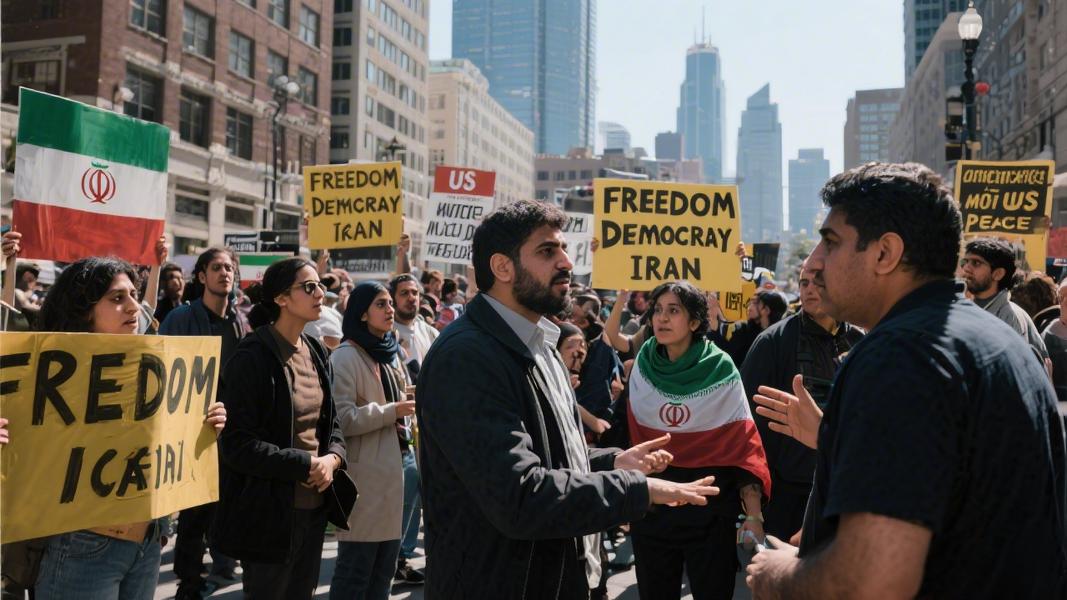
On February 28, 2026, the United States and Israel launched coordinated joint strikes on Iran in an operation that shook the region and ignited fierce debate thousands of miles away, including on the streets of North Texas, where Iranian-Americans and anti-war protesters squared off over what it all means — and what should come next. The strikes, codenamed Operation Roaring Lion by Israel and Operation Epic Fury by the U.S., targeted military and nuclear-related sites across Tehran, Isfahan, Qom, Karaj, and Kermanshah, and by most accounts, they hit hard.
Seven Officials Down, One Supreme Leader Gone
The Israel Defense Forces confirmed the elimination of seven senior Iranian defense officials in the aftermath of the airstrikes, naming Ali Shamkhani, Mohammad Pakpour, Saleh Asadi, Mohammad Shirazi, Aziz Nasirzadeh, Hossein Jabal Amelian, and Reza Mozaffari-Nia among those killed. The IDF confirmed that IAF fighter jets struck military targets across the country with precision. But the headline that no one was fully prepared for: the reported death of Ayatollah Ali Khamenei, Iran’s Supreme Leader, who had ruled with an iron grip for over three decades.
Iran’s government declared 40 days of national mourning and seven public holidays following Khamenei’s death — a formal acknowledgment that the country’s defining political figure was gone. The question now hanging over the entire Middle East: what fills that vacuum?
What Washington and Jerusalem Said
Israeli Prime Minister Benjamin Netanyahu framed the operation in sweeping, almost historic terms, saying the strikes were designed to “remove the existential threat posed by the terrorist regime in Iran” and that “our joint action will create the conditions for the brave Iranian people to take their destiny into their own hands.” It’s the kind of language that sounds like liberation and, depending on who you ask, either is or absolutely isn’t.
President Donald Trump was more blunt. He announced the strikes and, in characteristic fashion, spoke directly to the Iranian people, urging them to “take over your government.” The broader U.S. objectives, as outlined, included preventing Iran from developing nuclear capabilities, dismantling its missile programs, neutralizing its naval forces, and — yes — toppling the regime entirely. That’s an ambitious list.
Joy, Grief, and Everything In Between on the Streets of North Texas
Back in Dallas, the reaction was raw and personal. Hesami Homeirah, representing the Iranian-American Community of North Texas, didn’t mince words when asked about Khamenei’s reported death. “If it is true, we are very, very happy,” she said, “because he has made crimes against humanity.” For Homeirah and others in the Iranian diaspora, this wasn’t geopolitics — it was personal history, family, and decades of pain.
She’s also been clear about what she believes the real solution looks like. “So as long as the regime is in power, the terrorism continues, the nuclear program continues, the missile program continues,” she said. “So the real ultimate solution is to change the regime by the Iranian people and the organized resistance.” That last part matters — by the Iranian people.
Protester Hannah Jan echoed that sentiment, but with a caveat worth noting. She believes the regime could now collapse entirely — “I would say the whole regime would crumble, because that’s how dictatorship is working. Just, it’s just there on one person. And hopefully we will have a free Iran” — but she was equally firm that the work of overthrowing it can’t be outsourced. “We need boots on the ground to overthrow this regime,” she told reporters, “but that’s just the responsibility of the Iranian people, not outsiders.”
But Not Everyone Is Celebrating
That’s the catch. Not everyone standing outside that day shared the same flag or the same feelings. Lizbeth Martinez, who came out to protest U.S. military involvement, pushed back hard. “I love human rights,” she said. “I don’t like when people lose their lives because we’re gonna send the soldiers, and they’re starting a war.” She didn’t stop there. “It’s authoritarian behavior, like, let’s just call it what it is, you know, and it’s scary.”
And that tension — between those who see the strikes as a long-overdue blow against tyranny and those who see them as dangerous imperial overreach — isn’t going away anytime soon. It’s the same argument playing out in newsrooms, in Congress, and in living rooms across the country. Two groups of people, both claiming to care about human lives, arriving at completely opposite conclusions. That’s not new. But the stakes right now feel different.
What Comes Next
Still, for all the noise and the flags and the competing chants in North Texas, the most pressing questions aren’t being answered on any American street corner. They’re being answered — or not — inside Iran, where a regime built around one man’s authority has just lost that man, where the military command has been significantly degraded, and where ordinary Iranians are now navigating a moment that could define the country’s next century.
Hannah Jan put it simply, and maybe most honestly: “Hopefully we will have a free Iran.” Whether the events of February 28th make that more likely or simply more chaotic is something nobody — not in Washington, not in Jerusalem, and not in Dallas — can say for certain yet.
History rarely announces itself cleanly. It just arrives.
