
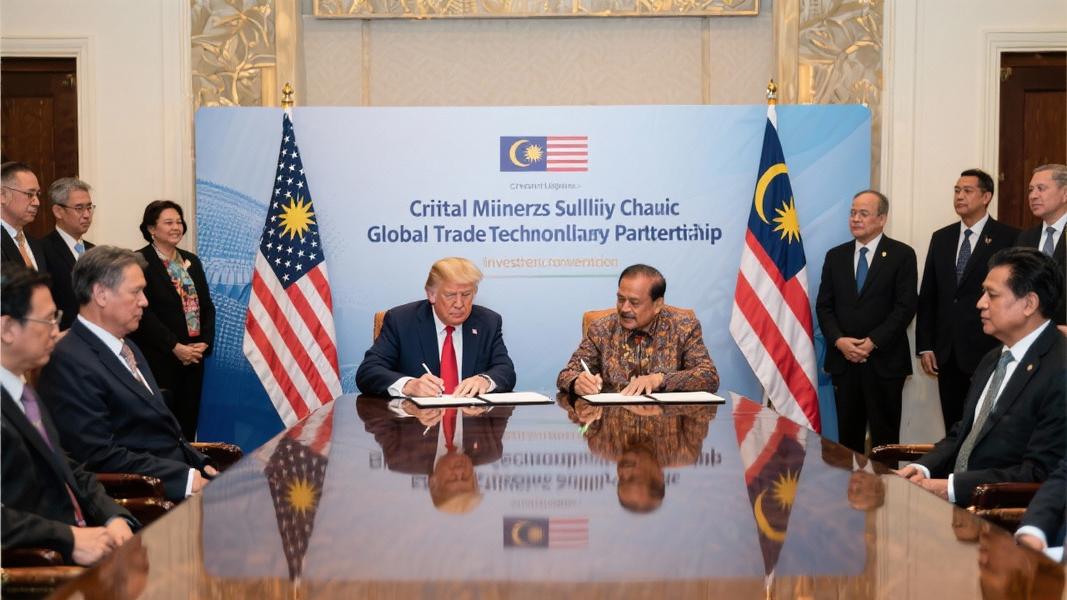
The United States and Malaysia have inked a landmark deal to secure critical minerals access, a move widely seen as Washington’s latest effort to counter China’s dominance in the rare earths market.
President Donald Trump and Malaysian Prime Minister Anwar Ibrahim formalized the agreement during a bilateral meeting on the sidelines of recent diplomatic engagements. The Memorandum of Understanding aims to strengthen cooperation in critical minerals supply chains and promote investments in these sectors, according to documents released by the White House.
Breaking China’s Grip
Why does this matter? Rare earth elements are crucial components in everything from smartphones to military equipment, and China currently controls roughly 85% of global processing capacity. The new agreement enhances America’s access to these strategic resources, potentially reducing its vulnerability to supply disruptions.
Under the deal, Malaysia has committed to refrain from banning or imposing quotas on exports of critical minerals to the United States, a key provision that guarantees supply chain stability. This represents a significant shift in the geopolitical landscape of rare earths trade.
“This is about more than just trade,” said a senior administration official speaking on background. “It’s about securing America’s technological future.”
Economic Benefits
The agreement isn’t one-sided. Malaysia stands to gain substantial economic benefits, including increased U.S. investment in its mining and processing sectors. The Southeast Asian nation has agreed to provide significant preferential market access for U.S. industrial goods exports, including chemicals and machinery.
The deal also includes investment facilitation in sectors beyond minerals, extending to energy resources and other strategic industries, as outlined in supporting documentation. Analysts estimate the agreement could generate billions in new cross-border investment over the coming decade.
But it’s the minerals component that has geopolitical observers buzzing. The U.S. has been aggressively pursuing agreements with various nations to reduce its dependence on Chinese supply chains, particularly after pandemic-related disruptions highlighted vulnerabilities in global trade networks.
Regional Strategy
This isn’t happening in isolation. The Malaysia agreement follows similar moves with other Southeast Asian nations, forming part of a broader strategy to counter Chinese influence in the region.
Malaysia’s commitment to not restrict exports of critical minerals or rare earth elements to the United States represents a diplomatic win for the administration, which has made supply chain resilience a cornerstone of its economic security policy. The provisions specifically prevent the kind of export restrictions that have previously created market volatility.
Trade experts note that securing stable access to rare earths is particularly crucial as demand skyrockets with the green energy transition and growing defense needs. Electric vehicle motors, wind turbines, and advanced weapons systems all rely heavily on these materials.
How significant is this agreement in the global context? While it won’t immediately transform supply chains that have developed over decades, it represents an important step in diversifying sources of these crucial materials.
As implementation begins in the coming months, industry watchers will be closely monitoring whether this agreement marks the beginning of a true shift in global critical minerals trade or merely a symbolic gesture in an increasingly fragmented international economic order.
