
The U.S. Treasury Department has struck a network recruiting Colombian fighters for one of Sudan’s most brutal militias, sanctioning eight actors involved in a scheme that has fueled genocide and mass atrocities in the war-torn African nation.
Treasury officials announced Thursday that four individuals and four entities have been designated for recruiting hundreds of former Colombian military personnel to fight alongside Sudan’s Rapid Support Forces (RSF), a paramilitary group that has committed widespread violence against civilians, including children. The sanctions block all U.S.-based property and assets of those involved in the recruitment pipeline.
“Treasury is targeting a network that recruits fighters for the Rapid Support Forces,” said Under Secretary John K. Hurley in a statement from the Treasury’s Office of Foreign Assets Control (OFAC). “The RSF has shown again and again that it is willing to target civilians—including infants and young children. Its brutality has deepened the conflict and destabilized the region, creating the conditions for terrorist groups to grow.”
Colombian Fighters Bolster Brutal Force
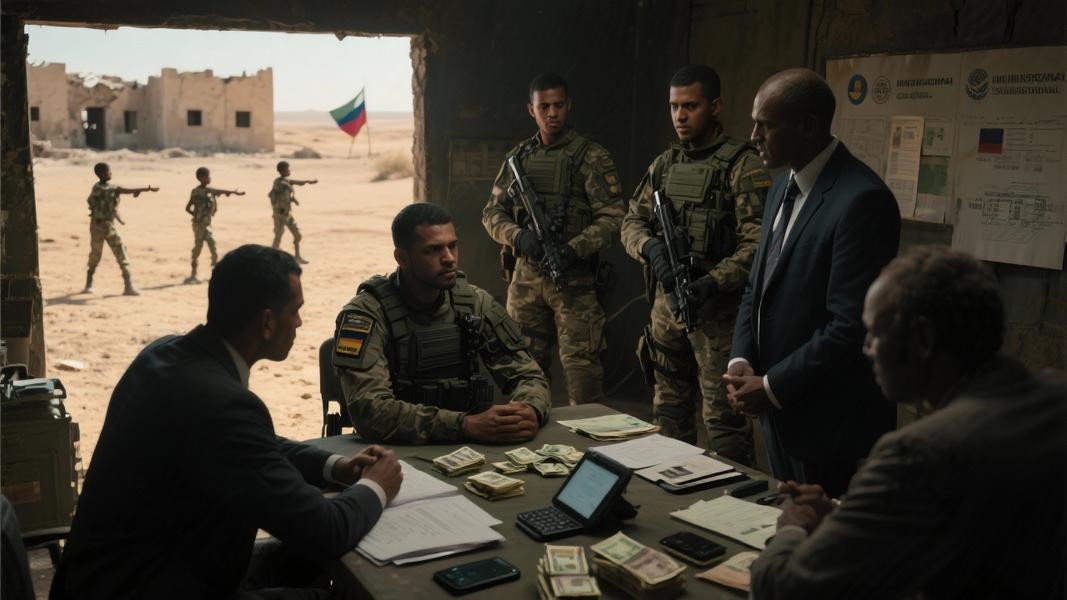
Since September 2024, hundreds of former Colombian military personnel have been recruited to join the RSF’s ranks. These veterans serve in various combat and support roles, including as infantry, artillery operators, drone pilots, vehicle operators, and, most disturbingly, as instructors training child soldiers.
The recruitment network is spearheaded by Alvaro Andres Quijano Becerra, a former associate of Colombia’s Norte del Valle Cartel, who has assembled a sophisticated operation. Quijano’s network includes companies that handle recruitment contracts and process funds for fighters deployed to Sudan.
Among those sanctioned are Claudia Viviana Oliveros Forero, who owns and manages A4SI, a key recruitment entity; Global Staffing S.A., a Panama-based company; Maine Global Corp S.A.S.; and several other individuals and businesses that facilitate the financial transactions supporting the operation.
Genocide and Mass Atrocities
Why now? The Treasury’s action comes after a series of horrific developments in Sudan’s civil war. With support from these Colombian fighters, the RSF captured the city of El Fasher in North Darfur on October 26, 2025, following an 18-month siege. What followed was nothing short of catastrophic.
The militia engaged in mass killings, ethnically targeted torture, and widespread sexual violence. The atrocities were so severe that on January 7, 2025, the U.S. State Department formally determined that members of the RSF had committed genocide.
“Supported by Colombian fighters, the RSF captured El Fasher after an 18-month siege, and subsequently engaged in mass killings of civilians, ethnically targeted torture, and sexual violence,” the Treasury noted in its announcement.
Financial Blockade
The sanctions mean that all property and interests belonging to the designated persons and entities within the United States or controlled by U.S. persons are now blocked. Additionally, any entities that are majority-owned by these sanctioned parties are also blocked.
These measures represent a significant escalation in U.S. efforts to financially weaken those responsible for the violence. Previously, the U.S. had sanctioned RSF leaders such as Abelrahim Hamdan Dagalo and imposed visa restrictions on others connected to human rights abuses.
“These are the first sanctions on individual Sudanese during the current conflict,” human rights observers have noted. The Treasury’s actions fall under a May executive order targeting those “destabilizing” and “undermining” Sudan’s transition to democracy.
Call for Peace
Beyond the sanctions, the United States has issued a clear message to external actors: stop fueling the fire. Officials are urging all outside parties to cease providing financial and military support to belligerents in Sudan’s devastating civil war.
The U.S. has endorsed a three-phase approach to ending the conflict, beginning with a three-month humanitarian truce, followed by a permanent ceasefire, and ultimately a transparent transition to a civilian-led government.
But the recruitment of foreign fighters suggests the conflict may be far from over. The Treasury’s sanctions attempt to disrupt one pipeline of military support, but questions remain about whether other channels might emerge to replace it.
For Sudanese civilians caught in the crossfire, these measures offer a glimmer of hope that international pressure might finally help stem the tide of violence that has claimed countless lives and displaced millions more.
