
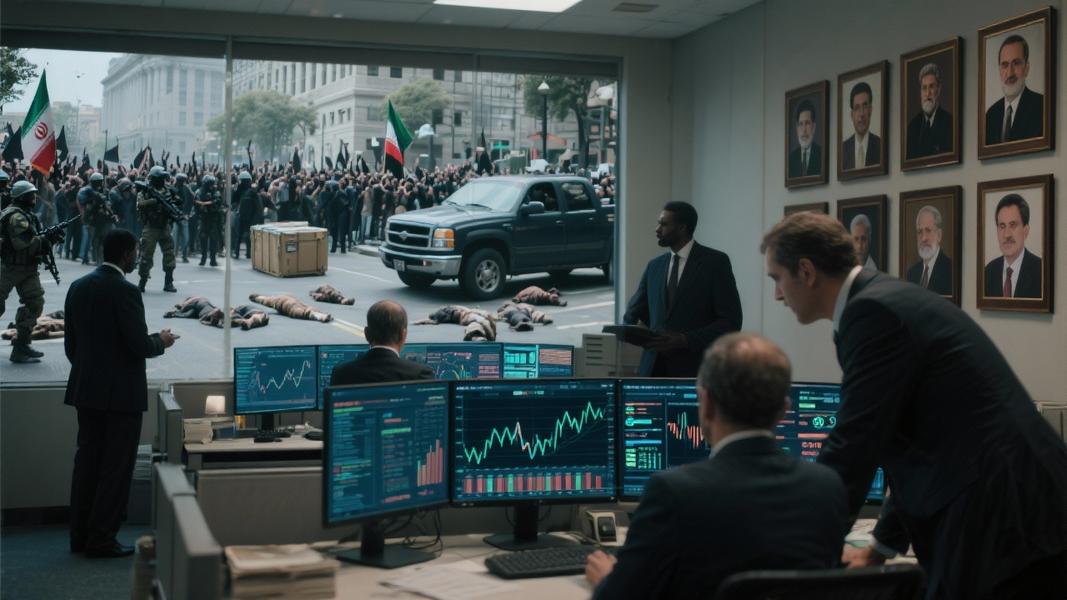
The U.S. Treasury Department has unleashed a new wave of sanctions against Iranian officials, targeting the country’s Interior Minister and several high-ranking military commanders for their roles in the deadly crackdown on peaceful protesters. The sanctions also extend to a notorious businessman accused of embezzling billions in oil revenue to fund the Iranian Revolutionary Guard Corps (IRGC).
In a statement released Wednesday, the Treasury’s Office of Foreign Assets Control (OFAC) designated Interior Minister Eskandar Momeni Kalagari for overseeing the Law Enforcement Forces responsible for the deaths of thousands of peaceful demonstrators across Iran. The action represents one of the most significant targeting of Iranian leadership since protests erupted following the contested elections.
Oil Money, Digital Assets, and “Rats on a Sinking Ship”
Perhaps most notable among the new designations is Babak Morteza Zanjani, born March 12, 1974, a businessman who embezzled billions from Iranian oil revenue and is now financing IRGC projects after his release from prison. Treasury officials claim Zanjani has pivoted to cryptocurrency operations to evade international financial restrictions.
“Rather than build a prosperous Iran, the regime has chosen to squander what remains of the nation’s oil revenues on nuclear weapons development, missiles, and terrorist proxies around the world,” said Treasury Secretary Scott Bessent in the announcement.
The sanctions also mark the first time OFAC has targeted IRGC-linked digital asset exchanges. Zedcex and Zedxion, connected to Zanjani’s operations, allegedly processed over $94 billion in transactions, including IRGC funds — highlighting the regime’s increasing reliance on cryptocurrency to circumvent traditional banking restrictions.
Bessent didn’t mince words about the Iranian leadership’s financial maneuvers. “Like rats on a sinking ship, the regime is frantically wiring funds stolen from Iranian families to banks and financial institutions around the world,” he declared. “Rest assured, Treasury will act.”
Targeting the Enforcers
Who else made the Treasury’s hit list? Several IRGC commanders responsible for violent protest suppression across Iran, including Majid Khademi of IRGC Intelligence, Ghorban Mohammad Valizadeh of Tehran’s Seyyad al-Shohada Corps, and provincial commanders Hossein Zare Kamali (Hamadan), Hamid Damghani (Gilan), and Mehdi Hajian (Kermanshah).
The 49-year-old Damghani, who commands IRGC forces in Gilan province, and the 47-year-old Hajian, who leads Law Enforcement Forces in Kermanshah, were specifically cited for their roles in brutal crackdowns that led to civilian casualties.
These designations fall under multiple Executive Orders, including E.O. 13553 for human rights abuses and E.O. 13224 for counterterrorism. They’re part of a broader campaign against the Iranian regime that has resulted in more than 875 designations throughout 2025 under the National Security Presidential Memorandum-2 (NSPM-2).
“President Trump stands with the people of Iran and has ordered Treasury to sanction members of the regime,” Bessent said. “Treasury will continue to target Iranian networks and corrupt elites that enrich themselves at the expense of the Iranian people.”
The practical effect? Assets belonging to these individuals that fall under U.S. jurisdiction are now frozen, and American citizens are prohibited from conducting business with them. But the broader impact may be symbolic — a message to Tehran that its crackdown on dissent and financial maneuvering hasn’t gone unnoticed.
For ordinary Iranians caught between an increasingly desperate regime and mounting international pressure, these sanctions represent both a validation of their struggle and a reminder of how deeply entrenched corruption has become in their country’s leadership. As the regime continues to transfer funds abroad, the question remains whether these measures will meaningfully constrain its ability to fund repression at home and destabilization abroad.
