
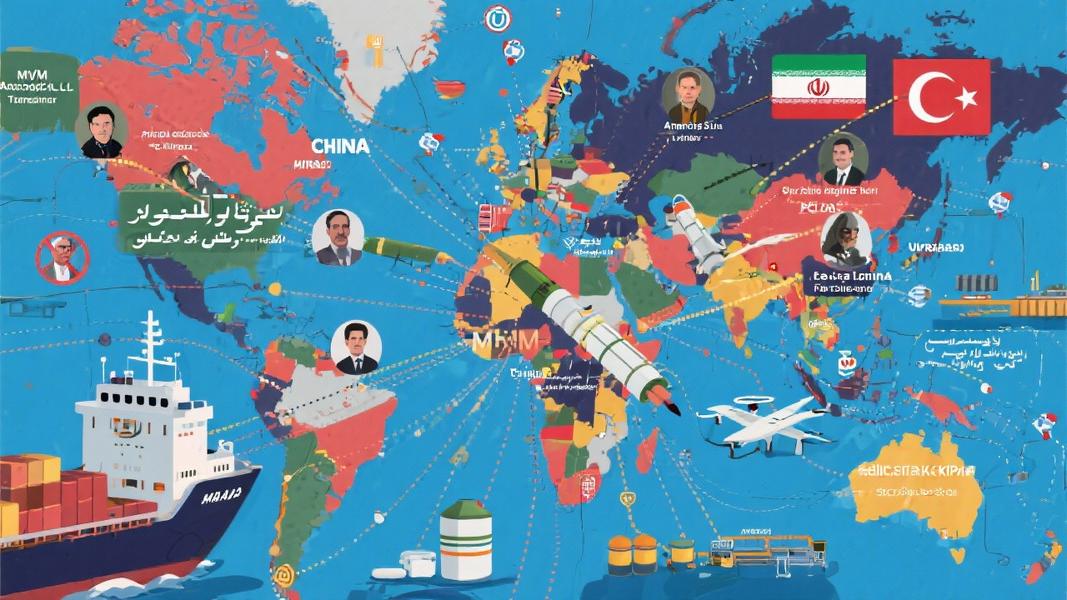
The U.S. Treasury Department has unleashed a sweeping crackdown on global procurement networks funneling critical materials to Iran’s weapons programs, designating 32 individuals and entities across eight countries in its latest bid to choke off Tehran’s access to missile and drone technology.
The sanctions, announced Tuesday, target sophisticated networks spanning from the United Arab Emirates to China and Germany that Treasury officials claim have been instrumental in Iran’s acquisition of ballistic missile propellants and unmanned aerial vehicle (UAV) components. The move represents the second round of penalties since the Trump administration’s controversial reimposition of UN sanctions against Iran in September.
“Across the globe, Iran exploits financial systems to launder funds, procure components for its nuclear and conventional weapons programs, and support its terrorist proxies,” a senior Treasury official stated. “At the direction of President Trump, we are putting maximum pressure on Iran to end its nuclear threat. The United States also expects the international community to fully implement UN snapback sanctions on Iran to cut off its access to the global financial system.”
The ‘MVM’ Missile Materials Network
At the center of Treasury’s crosshairs sits the so-called MVM partnership, a three-person venture that has allegedly coordinated the procurement of hundreds of metric tons of ballistic missile propellant ingredients from China since 2023. The materials—including sodium chlorate, sodium perchlorate, and sebacic acid—were destined for Parchin Chemical Industries (PCI), an entity under Iran’s Defense Industries Organization responsible for importing and exporting chemical goods.
Who runs this operation? Treasury identified three key individuals: Marco Klinge, based in the UAE; and Majid Dolatkhah and Vahid Qayumi, who operate between Iran and Türkiye. Each played specific roles, with Klinge handling procurement from India and China while serving as liaison with suppliers including the previously sanctioned China Chlorate Tech Co Limited.
Intelligence officials believe Dolatkhah served as the crucial link between PCI and Klinge, managing procurement operations from Türkiye, while the network methodically transported chemical precursors essential for missile propulsion systems.
UAV Component Production Pipeline
Equally troubling to counterproliferation experts is the network surrounding Kimia Part Sivan Company (KIPAS) and its subsidiaries, which Treasury alleges have produced and repaired UAV components for Iran’s Islamic Revolutionary Guard Corps-Qods Force (IRGC-QF).
As recently as early 2025, KIPAS subsidiary Iranian Baspar Puya Company (PARPO) reportedly manufactured hundreds of drone components while maintaining “frequent contact” with employees associated with the IRGC-QF. The company operated alongside ARIAPA, characterized by Treasury officials as a front company within the same production ecosystem.
Four KIPAS employees were specifically designated: Seyyed Ali Abtahi, who oversaw UAV component production facilities; Seyyed Mohammad Ruhani and Hosein Sayyadi Turanlu, both affiliated with the IRGC-QF and working on UAV electronics projects; and Ehsan Mohaghegh Dolatabadi, who managed logistics for component acquisition.
“Between mid-2024 and early 2025, Abtahi oversaw the production of UAV components,” Treasury noted in its designation. “In the spring of 2025, Iran-based IRGC-QF-associated KIPAS affiliate Seyyed Mohammad Ruhani worked with Iran-based, IRGC‑QF‑associated KIPAS affiliate Hosein Sayyadi Turanlu on the ARIAPA project pertaining to manufacturing UAV electronics.”
China Connection: Following the Money
How extensive is China’s role in these procurement networks? Quite substantial, according to Treasury officials.
Ma Jie, a China-based national, was designated for supporting the affairs of Mado, an Iranian defense manufacturer, by coordinating meetings between Iranian defense officials and Chinese suppliers. Ma holds leadership roles in multiple companies that have allegedly facilitated millions of dollars in transactions related to UAV engine production: Yiwu City Xianma in China, and Qian Xi Long and Hin Yun in Hong Kong.
The financial trail reveals a complex web of transactions. Qian Xi Long reportedly received hundreds of thousands of dollars from Turkish companies Arkedya, Intro Oto, Own Ucar, and Royal Yapi. The company then transferred over $450,000 to Hong Kong-based Yiren Zhuang Trading Co Limited for aluminum alloy castings and spark plug caps—components Treasury believes were destined for Iranian weapons programs.
Similarly, Hin Yun received significant payments from Turkish companies Loris Turizm Organizasyon, Ozkam Nakliyat Petrol, and Artas Gumrukleme as part of what Treasury describes as the Mado procurement network.
Ukrainian Front Companies and Maritime Smuggling
The sanctions also targeted Bahram Tabibi, an Iranian procurement agent who allegedly utilized Ukraine-based front companies—GK Imperativ Ukraina LLC and Ekofera LLC—to acquire and supply aerospace materials to Iran Aircraft Manufacturing Industries (HESA). These materials included attitude indicators and magnetometers, components crucial for advanced navigation systems.
Perhaps most dramatically, Treasury identified a bulk carrier vessel, now named HONESTAR (previously SHUN KAI XING), that was caught on June 20, 2025, attempting to transport a computer numerical control (CNC) machine to Iran. Such machinery is used to produce fiber optic gyroscopes—critical guidance systems for ballistic missiles and UAVs.
“The HONESTAR’s recent updates were likely orchestrated in an attempt to obfuscate their delivery of sensitive machinery to Iran,” Treasury explained. The vessel is currently stateless and reportedly flying false flags to evade detection.
The new sanctions represent the Biden administration’s implementation of National Security Presidential Memorandum 2, which directs the curtailment of Iran’s ballistic missile program and denial of assets to the IRGC. The action follows the controversial September 27 reimposition of UN sanctions on Iran, which many international allies have disputed.
Despite the comprehensive nature of these designations, questions remain about their effectiveness. Previous rounds of sanctions have slowed but not halted Iran’s weapons programs, and the international community remains divided over the legitimacy of the “snapback” sanctions reinstated unilaterally by the United States. Still, Treasury officials believe disrupting these procurement networks represents a significant blow to Iran’s ability to advance its missile and drone capabilities at a time of heightened regional tensions.
