
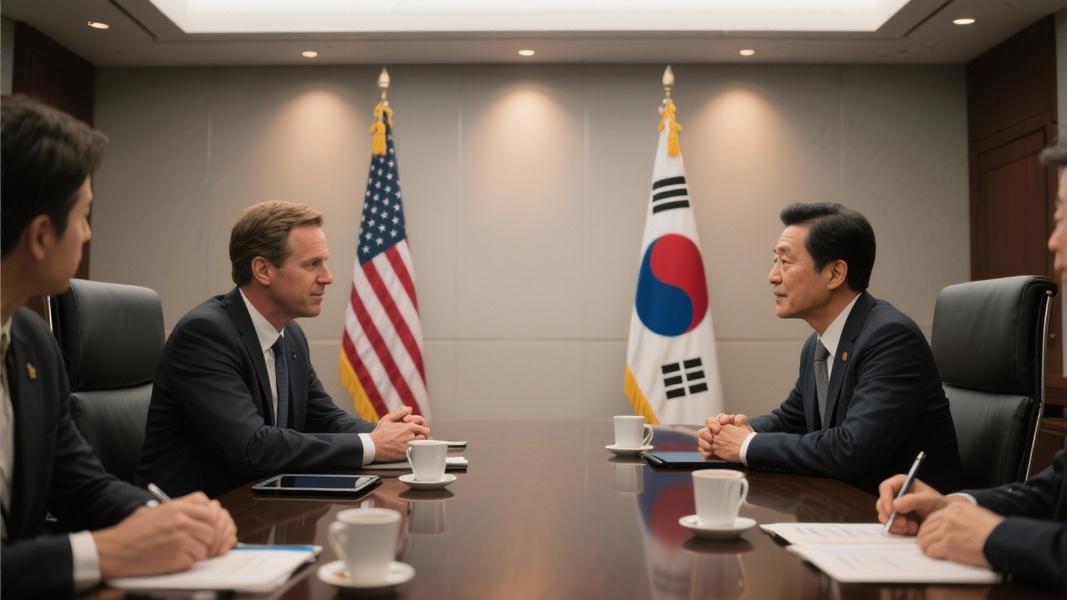
Treasury Secretary Scott Bessent met with South Korea’s Deputy Prime Minister Koo Yun Cheol on Monday, expressing concerns that the recent depreciation of the Korean won doesn’t align with the country’s robust economic fundamentals.
The high-level discussion, which took place during Koo’s visit to Washington for a critical minerals ministerial meeting, underscored the Biden administration’s growing focus on economic partnerships in Asia as global supply chains face unprecedented pressures. Bessent emphasized that “excess volatility in the foreign exchange market is undesirable,” while reaffirming South Korea’s position as a vital U.S. ally in the region.
Currency Concerns Amid Strong Partnership
The won’s recent performance has raised eyebrows in Washington, particularly given South Korea’s otherwise stellar economic indicators. “Secretary Bessent noted that the recent depreciation of the Korean won was inconsistent with Korea’s strong economic fundamentals,” according to a Treasury Department statement.
Why the concern about currency fluctuations? For the U.S., stable currency markets prevent competitive devaluations that could disadvantage American exports and workers – a priority that crosses partisan lines in Washington.
Both officials also discussed the implementation of the Korea Strategic Trade and Investment Deal, a signature achievement of the Trump administration that Bessent indicated should proceed smoothly. The Treasury Secretary highlighted that this agreement would “further deepen the U.S.-South Korea economic partnership and promote the revitalization of America’s industrial might.”
Critical Minerals Take Center Stage
The bilateral meeting took place against the backdrop of a broader ministerial summit on critical minerals that Bessent convened with finance ministers from G7 nations and key observer countries including South Korea, India, Mexico, and Australia.
Critical minerals – particularly rare earth elements essential for everything from smartphones to fighter jets – have become a focal point of economic security discussions as nations seek to reduce dependence on China, which dominates global supply chains for many of these resources.
“Attendees expressed a strong, shared desire to quickly address key vulnerabilities in critical minerals supply chains,” the Treasury Department noted following the ministerial meeting.
South Korea’s Koo made a notable contribution to the discussions, even as his country participated in an observer capacity. The Korean finance minister underscored “the need to reinforce global value chain linkages based on countries’ comparative advantages and highlighted the importance of recycling critical minerals” – suggesting a more nuanced approach than simply reshoring all production.
That approach seems to align with Bessent’s thinking. The Treasury Secretary expressed optimism that nations would pursue what he termed “prudent derisking” rather than full “decoupling” from China in critical minerals supply chains – a distinction that reflects the complex reality of global economic interdependence.
The stakes couldn’t be higher. With electric vehicles, renewable energy, and advanced defense systems all dependent on secure supplies of these minerals, the outcome of these discussions could shape industrial policy for decades to come.
As the Biden administration navigates these choppy economic waters, partnerships with technologically advanced allies like South Korea will likely remain crucial – regardless of currency fluctuations that may come and go.
