
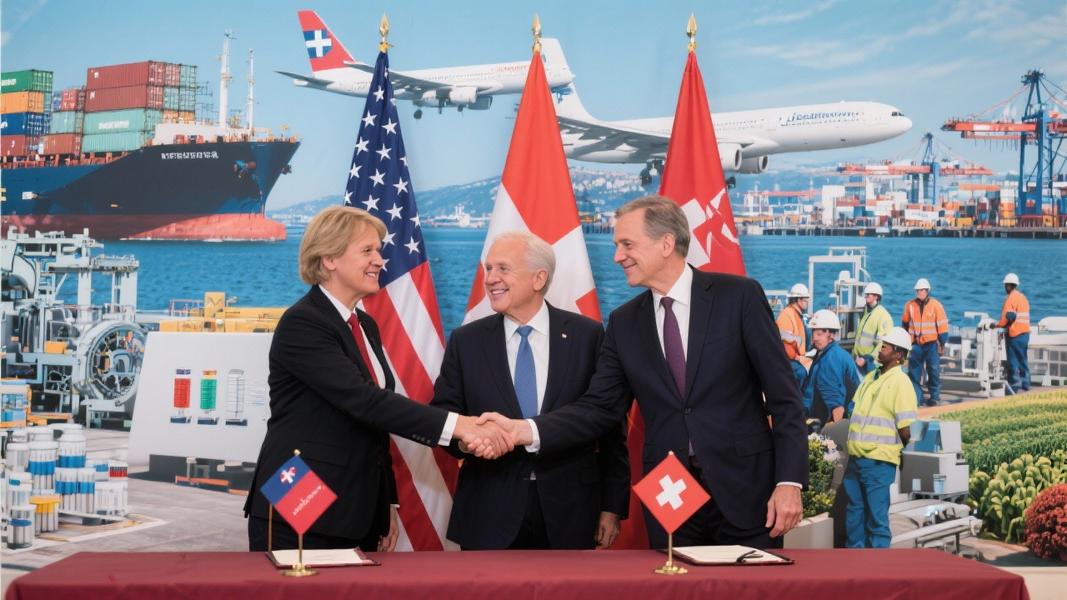
The United States has struck a “historic” trade agreement with Switzerland and Liechtenstein that aims to completely eliminate the current $38.5 billion trade deficit by 2028. The deal represents one of the most ambitious bilateral trade efforts in recent years, focusing on rebalancing economic relationships with key European partners.
Under terms finalized Friday, Switzerland has committed to a massive $200 billion investment plan in the United States over the next four years, while securing a significant reduction in tariffs on Swiss goods to 15% — a concession that Swiss negotiators have pursued for months. The agreement comes amid broader efforts to reshape America’s international trade relationships and boost domestic investment.
Economic Impact and Investment Goals
“The U.S. goods trade deficit with Switzerland and Liechtenstein was $38.5 billion in 2024. This deal aims to eliminate that deficit by 2028,” administration officials confirmed in announcing the agreement. The ambitious timeline has raised eyebrows among some economic analysts who question whether such a dramatic shift can be achieved in just four years.
What’s driving this sudden economic rapprochement? Beyond the headline numbers lies a complex web of strategic interests, including Switzerland’s desire for preferential market access and America’s push for increased foreign direct investment in manufacturing and technology sectors.
The Swiss commitment represents a substantial economic bet on the American market. “Switzerland announced plans on Friday to invest $200 billion in the United States through 2028 as it finalized a hard-wrought deal to slash tariffs on Swiss goods to 15%,” according to details outlined by officials familiar with the negotiations.
Strategic Implications
The agreement with Switzerland and Liechtenstein — while not America’s largest trading partners — signals a potential template for future trade deals with other European nations. By focusing on deficit reduction through guaranteed investment commitments rather than solely on tariff adjustments, negotiators have crafted what some see as a new model for bilateral economic relationships.
Swiss industries, particularly pharmaceuticals, precision instruments, and luxury goods manufacturers, stand to benefit substantially from the reduced tariff structure. The 15% rate represents a significant improvement over previous trade terms, though it falls short of the complete elimination that some Swiss business leaders had hoped for.
Still, the deal has faced criticism from some trade experts who question whether the investment commitments are merely repackaging of previously planned expenditures. Others wonder if the deficit elimination target is realistic given the structural nature of Swiss-American trade patterns.
The agreement notably includes Liechtenstein, the small principality that maintains a customs union with Switzerland, though the microstate accounts for only a fraction of the overall trade relationship.
As implementation begins, both sides will face the challenge of translating diplomatic promises into concrete economic outcomes — a process that will likely define whether this “historic” deal truly lives up to its billing, or simply becomes another footnote in the complex history of international trade negotiations.
