
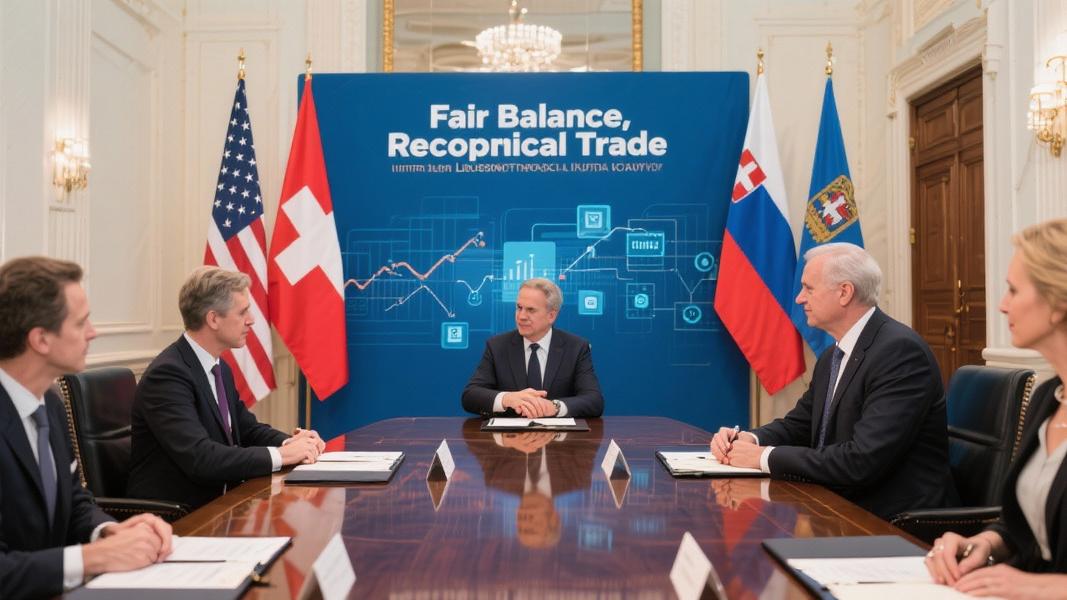
In a significant shift in global trade dynamics, the United States, Switzerland, and Liechtenstein have announced a comprehensive trade framework that promises to reshape their economic relationships while delivering substantial investments to American shores. The deal aims to create a “dynamic and balanced trading relationship” that will generate high-paying jobs and economic growth across all three nations, according to a joint statement released by the White House.
Major Investment Commitments
At the heart of the agreement lies an ambitious investment pledge: Switzerland has committed to facilitating at least $200 billion in investments across all 50 U.S. states over the next five years, with a focus on creating manufacturing and R&D jobs. Not to be outdone by its much larger neighbor, Liechtenstein — a microstate of just 38,000 people — has promised to direct at least $300 million in investments to the United States while increasing its U.S.-based private sector employment by 50% during the same period, as outlined in the framework.
The agreement includes mechanisms for the U.S. to verify whether its European partners are meeting these commitments. American officials will monitor investment progress and may adjust “reciprocal tariffs” accordingly — essentially creating a compliance lever to ensure the promised capital actually materializes.
Tariff Structure and Market Access
Under the new framework, Switzerland and Liechtenstein will eliminate duties on all U.S. industrial goods, seafood, and certain agricultural products. They’ll also establish tariff rate quotas for other American agricultural exports, potentially opening significant new markets for U.S. farmers and producers.
What will American consumers see? The U.S. plans to apply a 15% tariff rate on most Swiss and Liechtenstein goods (combining most-favored-nation and reciprocal tariffs), though certain products listed in a special annex will face only the standard MFN rate, according to the framework.
The agreement also addresses critical sectors like pharmaceuticals and semiconductors. The U.S. has promised that combined MFN and Section 232 tariffs on these products from Switzerland and Liechtenstein won’t exceed 15%, and will “positively consider” the agreement’s impact when making national security determinations under Section 232 of the Trade Expansion Act of 1962, as stated in the document.
Workforce Development and Standards Alignment
Beyond trade and investment, the agreement includes provisions for enterprises to promote training and apprenticeship programs for U.S. workers in high-growth sectors. The three nations will cooperate on workforce development initiatives, with Swiss and Liechtenstein companies likely to bring their renowned apprenticeship models to American workers.
Could this finally bridge the gap between European and American regulatory standards? The agreement takes significant steps in that direction. Switzerland has committed to working with the U.S. to facilitate the recognition of Federal Motor Vehicle Safety Standards and ease acceptance of FDA-cleared or approved medical devices — potentially removing longstanding barriers to U.S. exports in these sectors.
The U.S. and Switzerland will also grant conformity assessment bodies in each other’s territories equal treatment, a technical but crucial provision that should streamline product approvals and reduce duplicative testing requirements.
Digital Economy and Data Flows
The agreement embraces the digital economy with several forward-looking provisions. Switzerland and Liechtenstein have committed to continue refraining from imposing digital services taxes, a point of friction in other U.S. trade relationships.
All three nations have agreed to facilitate trusted cross-border data flows, address data localization requirements, and explore mechanisms for privacy framework interoperability. They’ve also committed to refrain from imposing customs duties on electronic transmissions and to support a permanent WTO moratorium on such duties — positions that align with U.S. digital trade priorities.
Economic Security Cooperation
In an era of increasing geopolitical tension, the agreement includes notable provisions on economic security. The participants will strengthen cooperation on addressing “non-market policies of third countries” — diplomatic language that typically refers to concerns about China’s economic practices.
Switzerland and Liechtenstein have also agreed to cooperate with the U.S. on investment reviews based on national security considerations and to work together on supply chain security in sectors of shared interest. The framework acknowledges that “effective enforcement of economic and trade sanctions serves the Participants’ shared interests.”
Agriculture and Labor Provisions
American farmers stand to gain from several provisions. Switzerland has committed to working with the U.S. to address specific measures restricting market access
