
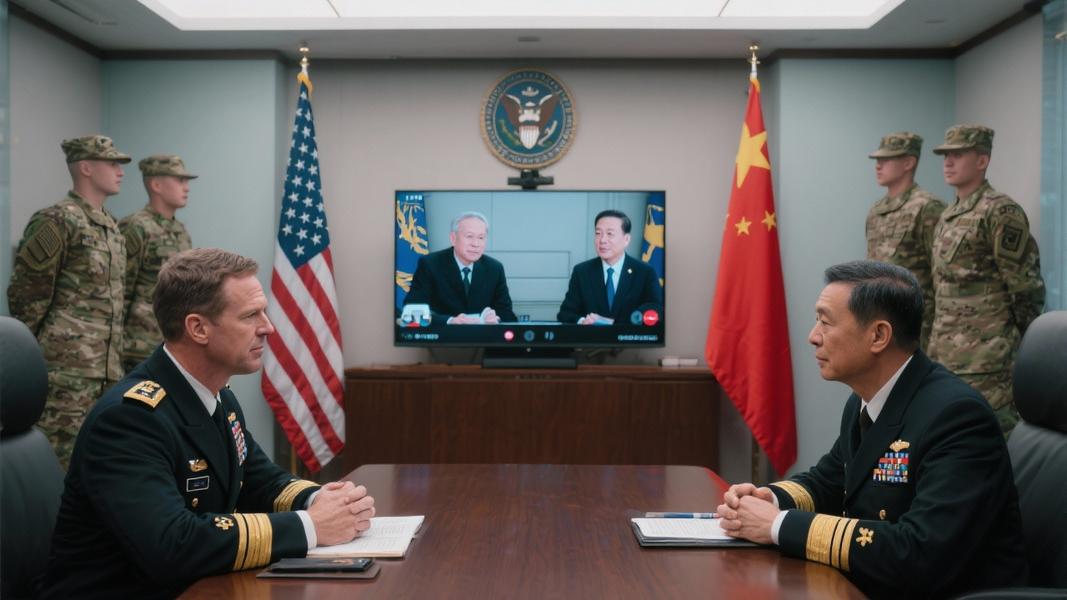
U.S. Secretary of War Hegseth Delivers Tough Message to China in First Direct Contact
In his first direct communication with Chinese military leadership since returning to office under President Trump’s second term, Secretary of War Pete Hegseth delivered a carefully calibrated message to Beijing: the United States doesn’t want conflict but won’t back down in the Asia-Pacific region.
The September 9 call with China’s Minister of National Defense Admiral Dong Jun marked a significant diplomatic moment as tensions between the two superpowers continue to simmer. “Secretary Hegseth made clear that the United States does not seek conflict with China nor is it pursuing regime change or strangulation of the PRC,” according to a readout from the Department of War. “At the same time, however, he forthrightly relayed that the U.S. has vital interests in the Asia-Pacific, the priority theater, and will resolutely protect those interests.”
Diplomatic Dance Following Military Parade
The call didn’t come easily. Hegseth had initially proposed the conversation to follow Beijing’s September 3 World War II anniversary parade, but Chinese officials reportedly remained hesitant due to concerns over Hegseth’s previous statements about China, as revealed in diplomatic circles.
That hesitation isn’t surprising given Hegseth’s unambiguous stance at the 2025 Shangri-La Dialogue earlier this year. “Let me be clear: Any attempt by communist China to conquer Taiwan would result in devastating consequences for the Indo-Pacific and the world,” Hegseth warned during his address. “We are not going to sugarcoat it. The threat China poses is real. And it could be imminent.”
The call appears to be laying groundwork for a potential summit between President Trump and Chinese President Xi Jinping, though no official announcements have been made. Still, military-to-military communication represents a crucial channel between the competing powers.
South China Sea Tensions Remain Flashpoint
What’s driving the underlying friction? Hegseth has been particularly vocal about China’s activities in the South China Sea, where Beijing continues to expand its military presence despite international objections.
“These actions betray China’s fundamental lack of respect for its neighbors and challenge sovereignty, freedom of navigation, and overflight,” Hegseth stated at Shangri-La. “Any unilateral attempt in the South China Sea to change the status quo by force or coercion is unacceptable.”
The U.S. has maintained a significant naval presence in the region, conducting freedom of navigation operations that regularly draw protests from Beijing. Meanwhile, regional allies including Japan, Australia, and the Philippines have strengthened their defense cooperation with Washington.
Can these two military powers find a sustainable path forward? The resumption of high-level military dialogue suggests both sides recognize the dangers of miscommunication, even as fundamental disagreements persist.
For now, the message from Washington remains consistent: engagement without appeasement. As the Biden-to-Trump transition continues to reshape America’s global posture, this carefully choreographed diplomatic dance with China may prove to be one of the administration’s most consequential foreign policy challenges.
