
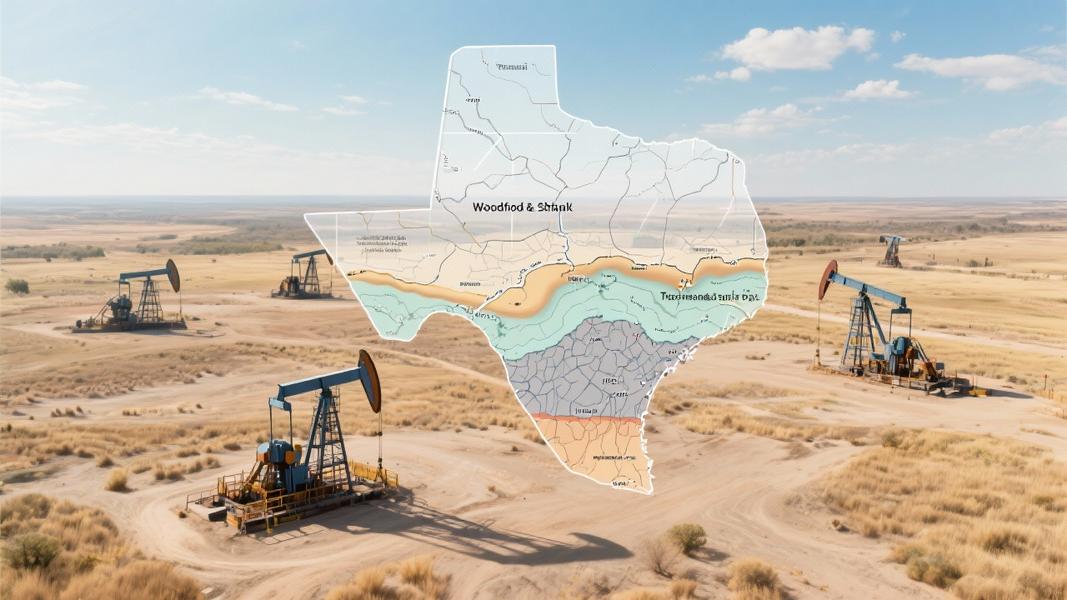
The Permian Basin just got richer. A new U.S. Geological Survey study has revealed an estimated 1.6 billion barrels of undiscovered, technically recoverable oil and 28.3 trillion cubic feet of natural gas hidden within the Woodford and Barnett Shales stretching across Texas and New Mexico.
This significant find, announced by the USGS, adds to the already impressive energy portfolio of the Permian Basin, long considered one of America’s most productive oil and gas regions. The assessment focused specifically on resources that haven’t yet been tapped by industry but could be extracted using current technology.
“The U.S. economy and our way of life depend on energy, and USGS oil and gas assessments point to resources that industry hasn’t discovered yet. In this case, we have assessed there are significant undiscovered resources in the Woodford and Barnett shales in the Permian Basin,” said Ned Mamula, director of the USGS.
Adding to an Energy Powerhouse
How significant is this discovery in the bigger picture? While substantial, it’s actually modest compared to the basin’s overall reserves. The Permian’s proven, technically recoverable reserves in just the Wolfcamp and Bone Spring Play formations are estimated at a staggering 50 billion barrels of crude and nearly 300 trillion cubic feet of natural gas.
Still, the new assessment represents important potential additions to America’s domestic energy supply at a time when global markets remain volatile. The USGS used its geology-based assessment methodology to identify these resources across the region, as detailed in their official publication.
This isn’t the first time the USGS has examined the Permian Basin’s potential. The agency has conducted several assessments of undiscovered oil and gas in various formations throughout the region, with the most recent activities noted in 2026 and 2025.
Mapping America’s Energy Future
The USGS assessment is part of a broader effort to understand America’s domestic energy resources. The agency has created detailed cell maps for each oil and gas assessment unit in the Permian Basin Province to illustrate the degree of exploration and production activity, as documented in their national data catalog.
These findings come at a crucial moment in America’s energy landscape, as debates continue about the balance between fossil fuel development and renewable energy transitions. The discovery of significant untapped resources in the Woodford and Barnett shales could influence energy policy and investment decisions for years to come.
Industry analysts note that while 1.6 billion barrels sounds impressive — and it is — the technical challenges of extracting these resources remain substantial. Not all technically recoverable resources ultimately prove economically viable to produce, especially as market conditions fluctuate.
The USGS National and Global Oil and Gas Assessment Project continues to examine promising regions across the country, with the Permian Basin Province receiving particular attention due to its long history of production and ongoing potential.
For a region that’s been pumping oil since the 1920s, the Permian Basin continues to surprise even veteran geologists with its seemingly endless capacity to yield new energy discoveries — a testament to both advancing technology and the remarkable geological formations that have made this dusty corner of the American Southwest an energy juggernaut for generations.
