
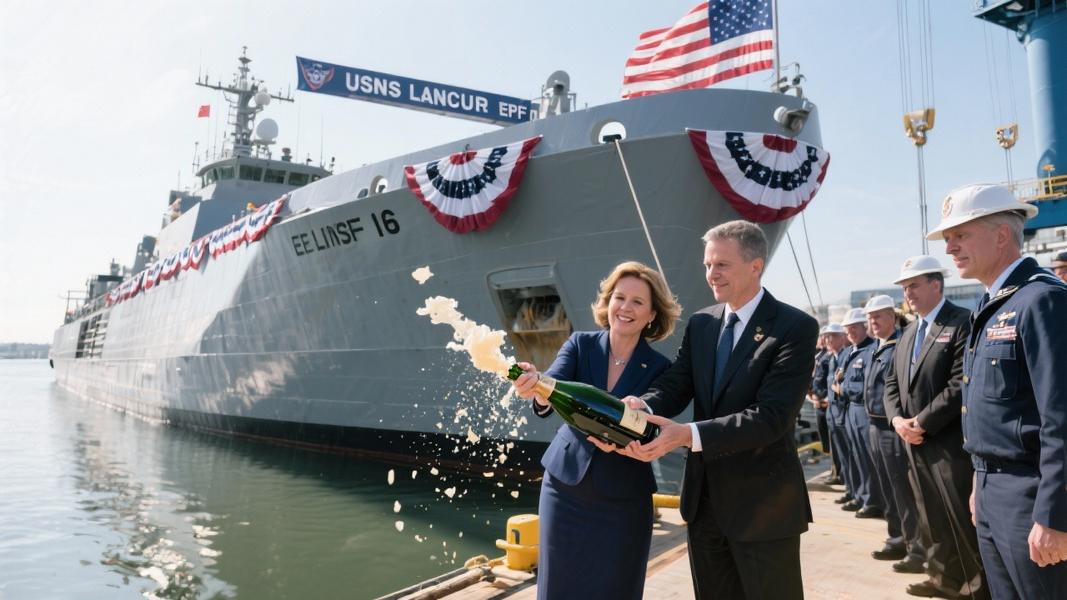
The U.S. Navy will christen its final Spearhead-class Expeditionary Fast Transport vessel this week, marking a significant milestone for a program that has evolved from basic transport to advanced medical capability at sea.
The future USNS Lansing (EPF 16) will be christened Wednesday morning at Austal USA’s shipyard in Mobile, Alabama, with Michigan Governor Gretchen Whitmer and Representative Lisa McClain serving as the ship’s sponsors. The ceremony represents the vessel’s transition from construction to testing and trials, a critical step before joining the Military Sealift Command’s operational fleet.
Michigan Roots Run Deep
Named for Michigan’s capital city, USNS Lansing is the first Navy vessel to bear the name of a manufacturing hub that has supplied military equipment since the Civil War. The connection isn’t just symbolic — it reflects what Navy officials describe as a strategic partnership with American industrial centers.
“This ship highlights the success and importance of our Maritime Statecraft initiative, encompassing a national, whole-of-government effort to restore the comprehensive maritime power of our Nation,” Secretary of the Navy Carlos Del Toro noted during the vessel’s keel laying ceremony last September.
Under Secretary of the Navy Hung Cao emphasized the connection between shipbuilders and the vessel’s future crew. “As we christen the future USNS Lansing, we celebrate another symbol of the unbreakable linkage that ties the workmanship of our shipyard workers to those of our American mariners who will man these ships,” Cao stated in advance of the ceremony.
Not Just Another Transport Ship
What sets the Lansing apart from earlier vessels in its class? It’s all about medical capability at sea.
As the third and final “Flight II” variant of the Spearhead class, USNS Lansing represents a significant evolution from the program’s original concept. While maintaining the EPF’s hallmark speed and shallow draft, the Flight II configuration adds substantial medical facilities, including two operating rooms and support for up to 147 patients — essentially creating a floating hospital that can deploy at over 30 knots.
The vessel can be configured as a pure transport, a Role 2E (enhanced) medical platform, or a hybrid of both. With a planned crew of 31 civilian mariners, it can accommodate up to 155 embarked forces or a full Expeditionary Medical Unit, making it remarkably versatile for a vessel of its size.
“The future USNS Lansing is one step closer to joining the U.S. fleet and Military Sealift Command to answer the call to action, any ocean, any time,” Cao added.
Force Multiplier at Sea
The Navy has increasingly recognized these vessels as essential components of its distributed maritime operations concept. EPFs can transport approximately 419 short tons over 1,200 nautical miles at speeds averaging 33 knots — significantly faster than traditional military sealift vessels.
Beyond their speed, the technical improvements in the Flight II variant include enhanced support for V-22 Osprey operations and improved launch and recovery capabilities for 11-meter rigid hull inflatable boats, expanding the ship’s utility in various mission profiles.
“Our EPFs are force multipliers for our combat logistics fleet,” Secretary Del Toro has emphasized when discussing the program’s strategic importance.
The christening ceremony itself follows naval tradition, with the ship’s sponsors breaking a bottle of sparkling wine across the bow. It’s a symbolic moment that marks the vessel’s identity before it undergoes extensive testing.
Strategic Timing
The christening comes at a moment when the Navy is highlighting its 250-year tradition of maritime dominance. “From seabed to space, the Navy delivers power for peace – always ready to fight and win,” notes the service in materials related to the ceremony.
With global tensions rising in multiple theaters, ships like USNS Lansing represent a flexible capability that can respond to humanitarian crises or support combat operations without requiring major port facilities.
After Wednesday’s christening, USNS Lansing will undergo sea trials before eventual delivery to Military Sealift Command. While it’s the final planned vessel of its class, the lessons learned from the Spearhead program — particularly the medical enhancements of the Flight II variants — may influence future Navy acquisitions.
For the shipbuilders in Mobile and the mariners who will eventually crew her, USNS Lansing represents something more immediate: the culmination of years of design evolution and the beginning of a new vessel’s service life in a Navy that increasingly values speed, flexibility, and distributed capabilities across the world’s oceans.
