
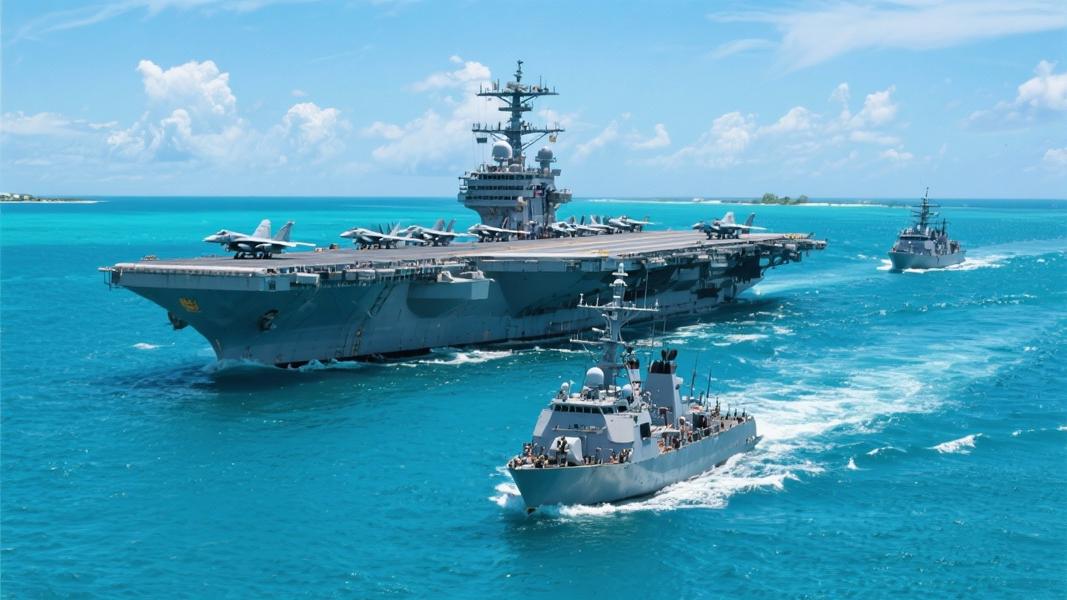
The Pentagon is sending one of America’s most advanced aircraft carriers to the Caribbean in a dramatic escalation of its fight against drug trafficking networks operating in the Western Hemisphere.
The USS Gerald R. Ford Carrier Strike Group has been ordered to deploy to the U.S. Southern Command area of responsibility, marking a significant shift in military assets toward combating what officials describe as an increasingly dangerous narco-terrorism threat close to American shores.
Military Muscle Against Drug Networks
Secretary of War Pete Hegseth directed the deployment following a presidential directive aimed at dismantling Transnational Criminal Organizations (TCOs), according to a statement released by the Pentagon on Thursday. “In support of the President’s directive to dismantle Transnational Criminal Organizations (TCOs) and counter narco-terrorism in defense of the Homeland, the Secretary of War has directed the Gerald R. Ford Carrier Strike Group and embarked carrier air wing to the U.S. Southern Command (USSOUTHCOM) area of responsibility (AOR),” the statement read.
The Ford is the Navy’s newest and most technologically advanced aircraft carrier, featuring electromagnetic catapults instead of the traditional steam-powered launch systems. Its deployment represents an extraordinary commitment of military resources to what has traditionally been a law enforcement domain.
Why send such a powerful naval asset to fight drug smugglers? Military analysts suggest the move signals a fundamental shift in how the United States views the narcotics threat — elevating it from a criminal justice issue to a matter of national security. The carrier strike group brings with it significant surveillance capabilities, aircraft that can intercept suspicious vessels, and special operations forces that could potentially conduct raids.
The deployment comes amid escalating U.S. military action in the region. In recent weeks, American forces have conducted a series of strikes against alleged drug-smuggling boats in Caribbean waters, according to defense officials.
Venezuela Connection
Multiple defense sources have indicated that the carrier’s presence is at least partly intended as a military pressure campaign against Venezuela, which U.S. intelligence agencies have long identified as a major transit point for narcotics heading to American and European markets.
The timing has raised eyebrows across Latin America, where some governments have expressed concern about potential U.S. military interventionism. Venezuelan President Nicolás Maduro has repeatedly accused Washington of plotting an invasion, claims the State Department has dismissed as propaganda.
Still, the deployment represents the largest show of U.S. naval power in the Caribbean in decades. Defense Department officials have emphasized that the primary mission remains focused on drug interdiction rather than regime change.
“These forces will enhance and augment existing capabilities to disrupt narcotics trafficking and degrade and dismantle TCOs,” a senior defense official stated in a briefing with reporters.
A New Front in the Drug War
The Ford Strike Group’s arrival marks a significant expansion of U.S. Southern Command’s capabilities. SOUTHCOM has traditionally operated with far fewer resources than other geographic commands like Indo-Pacific Command or European Command.
The Pentagon has characterized the narco-terrorism threat as increasingly sophisticated, with drug cartels utilizing technologies ranging from homemade submarines to encrypted communications networks. The deployment represents what one defense official described as “bringing overwhelming force to bear on these criminal enterprises.”
Critics have questioned whether military assets designed for great power competition are appropriate tools for drug interdiction. Some security experts point to decades of militarized drug policy that has failed to significantly reduce the flow of narcotics into the United States.
Secretary Hegseth has defended the decision, emphasizing that today’s transnational criminal organizations represent a hybrid threat that blends criminal enterprise with terrorist tactics and poses a direct threat to American communities devastated by drug addiction.
As the Ford Strike Group steams toward the Caribbean in the coming days, the message seems clear: what was once primarily a law enforcement problem has now become a military one — with America’s most advanced naval assets leading the charge.
