
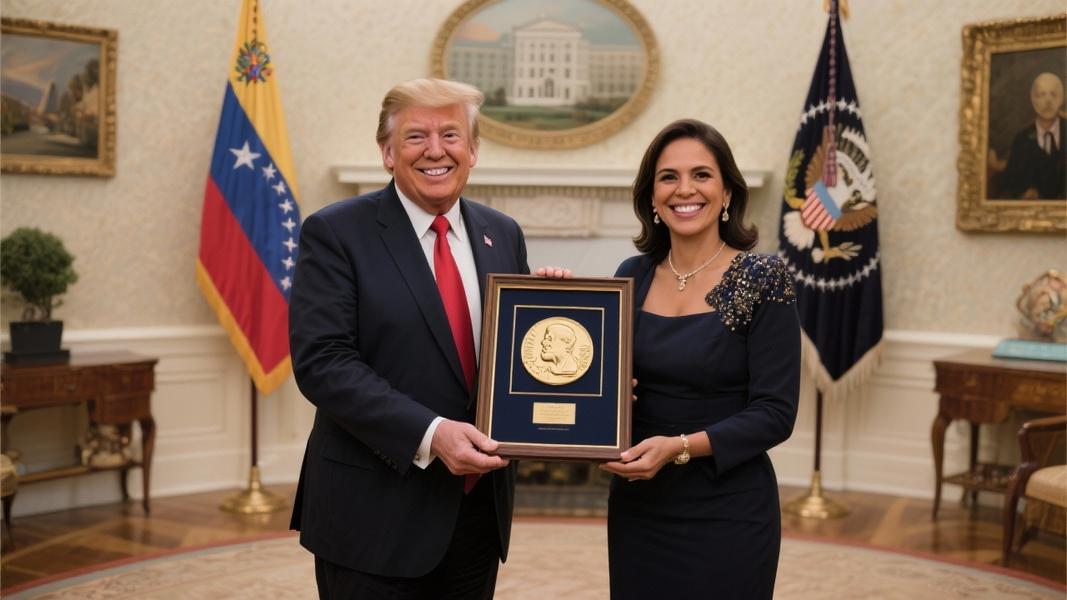
In a striking symbolic gesture, Venezuelan opposition leader María Corina Machado presented her Nobel Peace Prize medal to former President Donald Trump during a White House ceremony on January 15, 2026, honoring what she called his “unique commitment” to Venezuela’s struggle for democracy.
The unexpected gift marked a dramatic chapter in Venezuela’s long-fought battle for political freedom, with Machado using one of the world’s most prestigious awards to publicly acknowledge Trump’s support for the opposition movement that eventually succeeded in restoring democratic governance to the oil-rich nation.
“This medal represents the sacrifice of millions of Venezuelans,” Machado said during the emotional East Room ceremony, offering it to Trump “as a recognition for his unique commitment with our freedom,” according to video footage of the event.
From Pariah to Honored Ally
The gesture carries particular weight given the contentious history between Trump and various international institutions during his first term. Critics have often painted Trump as dismissive of global cooperation, yet here was a Nobel laureate — recognized by the same international establishment — crediting him with a crucial role in Venezuela’s democratic transition.
For Trump, who appeared genuinely moved by the presentation, the moment offered a powerful counternarrative to criticisms of his foreign policy approach. Standing beside Machado, the former president called Venezuela’s democratic restoration “one of the great freedom movements of our time.”
What makes the gesture especially notable is the Nobel Committee’s traditional reluctance to recognize partisan political figures, particularly those from major powers who intervene in regional conflicts. Machado’s decision to physically transfer her medal — rather than simply offering verbal thanks — created a dramatic visual that immediately ricocheted across diplomatic circles.
A Long Road to Freedom
Venezuela’s path from authoritarian rule to its current democratic government required years of struggle against the entrenched Maduro regime. Machado, once dismissed by Maduro supporters as a fringe figure, emerged as the movement’s most recognizable leader after earlier opposition figures were imprisoned or forced into exile.
The opposition’s eventual success came through a combination of internal resistance, international pressure, and strategic diplomacy — with the Trump administration’s sanctions policy playing what many analysts consider a decisive role in weakening the regime’s hold on power.
But wasn’t this the same Trump who once expressed admiration for strongmen leaders? Indeed, critics have pointed to this apparent contradiction, though supporters argue his Venezuela policy demonstrated a more nuanced approach to promoting democracy than he’s typically credited with.
Machado’s Nobel, awarded just months after Venezuela’s successful democratic transition, recognized her “extraordinary courage in the face of persecution” and “unwavering commitment to peaceful democratic change” — qualities she now symbolically shares with the former American president.
As the ceremony concluded, attendees witnessed something rare in today’s polarized political environment: a moment of genuine bipartisan appreciation, with congressional leaders from both parties applauding as Machado placed the gold medallion in Trump’s hands — a tangible symbol of how dramatically Venezuela’s fortunes have shifted in just a few short years.
