
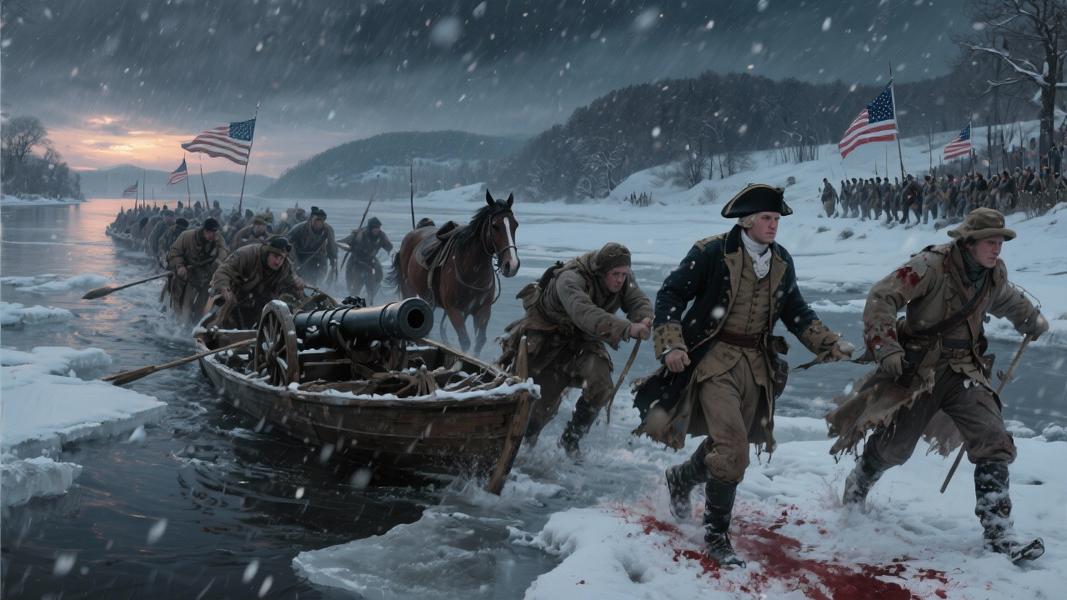
In the bitter cold of Christmas night 1776, George Washington made a decision that would alter the course of American history. Rather than retreat in the face of mounting defeats, he led 2,400 Continental Army soldiers across the ice-choked Delaware River during a raging storm, launching a daring attack that would revitalize the struggling Revolution.
The crossing itself was a logistical nightmare. Washington’s army — stretching nearly one mile with horses, artillery, wagons and exhausted men — battled treacherous conditions as they pushed through the darkness. Ice formations delayed their crossing until nearly 4 AM, putting the entire mission at risk, according to military records from the period.
A Revolution on the Brink
Just days earlier, on December 18, Washington’s forces had dwindled to fewer than 3,000 soldiers fit for duty. “The Enemy threw over a large body of Troops, which pushed us from place to place till we were obliged to cross the Delaware with less than 3000 Men fit for duty,” Washington wrote, noting enemy forces exceeded 10,000 men by most accounts. The situation appeared desperate.
Robert Morris, a key financier of the Revolution, captured the sentiment of that difficult year when he remarked, “The year is over, I am heartily glad of it and hope you nor America will ever be plagued with such an-other.”
Why risk everything on such a dangerous winter offensive? Washington recognized that retreat might prove more dangerous than attack. Two supporting columns under Generals Ewing and Cadwallader failed to cross the river due to ice conditions, but Washington pressed forward with his main force, determined to maintain the element of surprise despite deteriorating weather.
The Battle Unfolds
Around 8 AM on December 26, Washington’s forces charged into Trenton, catching the 1,500 Hessian mercenaries — German soldiers hired by the British — completely unprepared. When warned of the approaching Americans, Hessian commander Colonel Johann Rall reportedly dismissed the threat. “Let them come,” he said. “We will go at them with the bayonet.”
Those would prove to be fateful words. After just two hours of fighting, the Continental Army had secured a decisive victory, capturing nearly two-thirds of the entire Hessian force while suffering minimal casualties themselves. The battle’s outcome transformed the Revolutionary War’s momentum at a critical juncture.
In the aftermath, Washington showed remarkable restraint, ordering humane treatment of Hessian prisoners — a strategic decision that both reflected his character and served practical purposes in the broader conflict. He later expressed his gratitude to his men, offering “thanks to the Officers and soldiers for their spirited and gallant behavior,” as documented in military communications.
Washington himself seemed to understand the weight of his decisions during this pivotal moment. “I shall not be deprived… of a comfort in the worst event, if I retain a consciousness of having acted to the best of my judgment,” he once reflected.
Legacy of a Crossing
The immediate impact was undeniable. In a jubilant letter after the battle, Washington reported: “I have the pleasure of congratulating you upon the Success of an Enterprize, which I had formed against a Detatchment of the Enemy lying in Trenton, and which was executed yesterday Morning.”
Beyond the tactical victory, the Battle of Trenton provided something perhaps even more valuable: hope. Morale among Continental troops soared, inspiring re-enlistments at a time when many soldiers’ terms of service were set to expire. What might have been the Revolution’s darkest hour instead became a turning point that reinvigorated the American cause.
The crossing of the Delaware — immortalized in Emanuel Leutze’s famous painting — stands today as a testament to military audacity, leadership under pressure, and the power of decisive action when facing overwhelming odds. For a revolution that seemed all but lost in the waning days of 1776, Washington’s Christmas gamble delivered exactly the gift America needed.
