
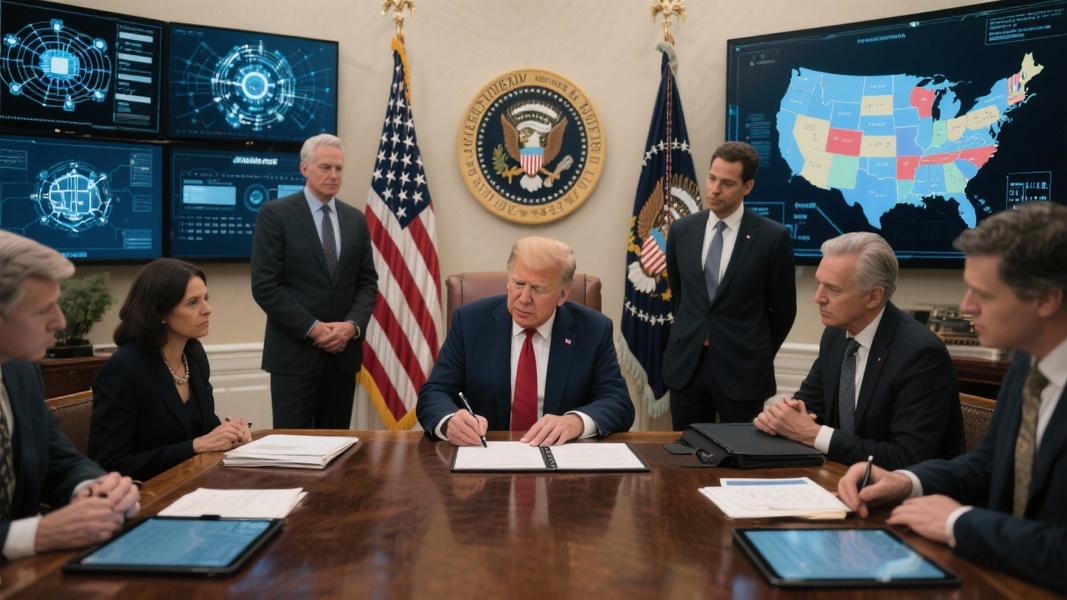
The White House has moved to assert federal dominance over artificial intelligence regulation, issuing a sweeping executive order that puts states on notice: fall in line with national AI policy or face legal challenges and potential funding cuts.
In an executive order signed December 11, 2025, the administration declared that “United States leadership in Artificial Intelligence (AI) will promote United States national and economic security and dominance across many domains.” The directive establishes a framework to challenge state AI laws deemed inconsistent with federal priorities — a move that dramatically shifts the regulatory landscape.
Federal Hammer Coming Down on State AI Laws
The order doesn’t mince words. It directs the Attorney General to establish an AI Litigation Task Force within 30 days, specifically to challenge state laws that could be deemed unconstitutional barriers to interstate commerce or otherwise in conflict with national AI policy. “By the authority vested in me as President by the Constitution and the laws of the United States of America, it is hereby ordered,” the document begins, before outlining a comprehensive strategy to override state-level AI restrictions.
Within 90 days, the Secretary of Commerce must evaluate existing state AI regulations and identify those that conflict with federal policy — particularly laws requiring “alteration of truthful AI outputs,” according to the directive.
What happens to states that don’t comply? They could lose significant federal funding. The order explicitly states that “States with onerous AI laws identified pursuant to section 4 of this order are ineligible for non-deployment funds, to the maximum extent allowed by Federal law.” This includes potential cuts to the Broadband Equity, Access, and Deployment (BEAD) Program — a particularly powerful leverage point for states dependent on federal telecommunications funding.
Reversing Previous Administration’s Approach
The December order represents a dramatic pivot from earlier AI policies. It explicitly references Executive Order 14179 from January 23, 2025, which the White House claims “revoked my predecessor’s attempt to paralyze this industry” and has since led to “trillions in investments.”
That earlier January directive had already signaled a shift away from the Biden administration’s more cautious approach to AI development. The Biden-era Executive Order 14110 had prioritized what it called “safe and secure” AI development, establishing specific thresholds for AI models requiring additional oversight — including those trained using more than 10^26 computing operations.
The Biden administration had also focused on national security concerns, limiting foreign involvement in AI data centers on federal sites and implementing reporting requirements for major AI investments. But the current administration views these measures as obstacles rather than safeguards.
State vs. Federal Showdown Looming
Why target state regulations now? The executive order argues that fragmented state laws create compliance challenges for AI companies, potentially “embed bias” in AI systems, and overreach beyond state borders. A Policy Notice explaining these threats is expected within 90 days.
Legal battles appear inevitable. The creation of a dedicated AI Litigation Task Force signals the administration is preparing for court challenges from states that have invested significant political capital in their own AI regulatory frameworks.
Industry observers note that California, New York, and several other states have recently passed comprehensive AI legislation that could now be in the federal crosshairs. These laws typically include transparency requirements, bias protections, and liability frameworks that the current administration may view as impediments to innovation.
Can states successfully defend their regulatory authority? Constitutional questions about federal preemption and interstate commerce will likely dominate the coming legal landscape.
As the dust settles on this dramatic policy shift, one thing is clear: the battle over who controls America’s AI future has moved from corporate boardrooms and legislative chambers to the federal courts. “This order sets our Nation on the path to ensure that future frontier AI can, and will, continue to be built here in the United States,” read a previous executive order on AI infrastructure — though the vision of exactly what that path should look like has clearly evolved.
