
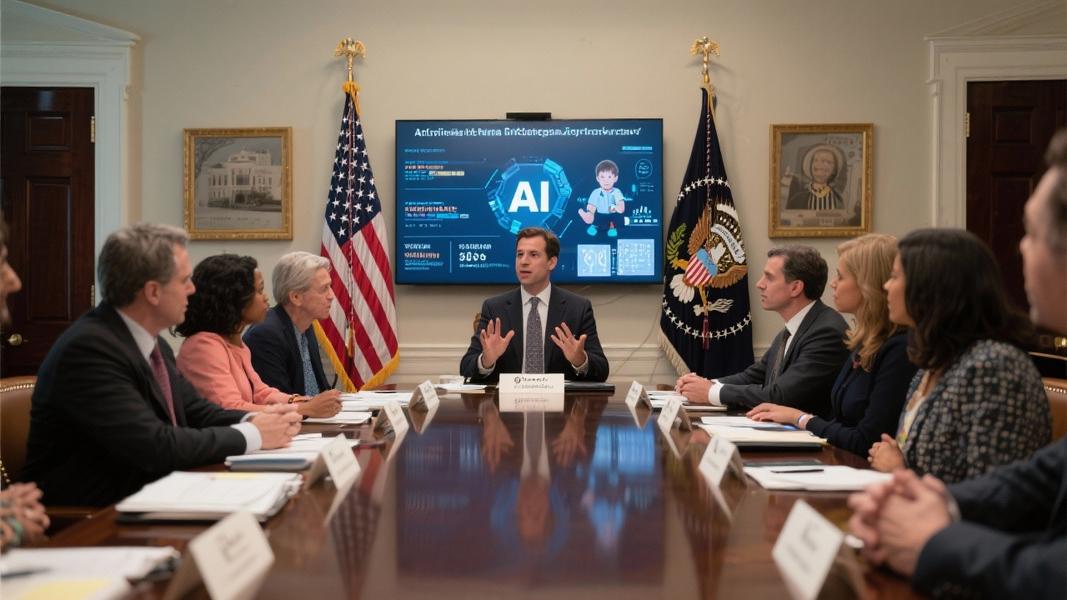
In a bid to prepare America’s youth for an AI-driven future, the White House is doubling down on artificial intelligence education with remarkable early results. The third White House AI Education Task Force meeting, chaired by Office of Science and Technology Policy (OSTP) Director Michael Kratsios on December 11, 2025, brought together cabinet officials, educators, and parents to tackle AI’s growing role in K-12 classrooms.
The Presidential AI Challenge — a cornerstone initiative highlighted during the meeting — has already attracted over 5,000 students and 1,000 educators from all 50 states. It’s part of a broader push to demystify AI technologies for American families and educators.
“The goal in all of our AI education efforts is to demystify these amazing technologies. If America’s families, young people, and educators know how AI works, then they can understand what the technology is good at, and good for, and what it’s bad at, and bad for, and why,” said Kratsios during the meeting. “When they understand these tools, then they can fully take advantage of AI applications with confidence and responsibility.”
High-Level Commitment to AI Education
The task force itself reflects the administration’s serious approach, featuring heavyweight government officials including the Secretaries of Agriculture, Labor, Education, Energy, the Director of the National Science Foundation, the Assistant to the President for Domestic Policy, the Special Advisor for AI & Crypto, and the Chief of Staff to the First Lady.
This isn’t just about teaching kids to code. According to Kratsios, it’s about preparing them for a fundamentally transformed workplace: “The president believed that we had to get an AI executive order out on K-12 education, and how critical it was to make sure that America’s students are prepared for the jobs of the future,” he explained. “Whether you’re a doctor, whether you’re a lawyer, whatever you’re going to be doing, you will be using this technology to do your job.”
The meeting builds upon President Trump’s Executive Order on Advancing Artificial Intelligence Education for American Youth, which forms part of America’s AI Action Plan. That plan focuses on three main pillars: innovation, infrastructure, and international partnerships.
From Policy to Classroom Reality
How exactly will these high-level initiatives translate to actual learning experiences? The Departments of Labor, Education, NSF, and Commerce have been tasked with prioritizing AI skill development across education and workforce funding streams. This includes integration into career and technical education programs that reach millions of American students.
Kratsios is no newcomer to national AI initiatives. As a senior leader within OSTP, he previously established the American Artificial Intelligence Initiative and the National Quantum Coordination Office, which brought together universities, industry, and national labs to advance research in these fields.
In recent Senate testimony, he emphasized that many of the AI Action Plan’s education components are already in motion. “A lot of the efforts around retraining, re-skilling and K through 12 education that are mentioned in the action plan are very much in progress,” Kratsios testified, adding that his office is working to identify and remove regulatory barriers that might hinder AI progress.
But are schools and teachers ready for this technological shift? That’s a question the task force is actively addressing through initiatives like the Presidential AI Challenge, which aims to build AI literacy from the ground up.
For now, the administration seems determined to ensure that when it comes to artificial intelligence, American students won’t just be consumers of the technology — they’ll understand it well enough to shape its future. As one education participant in the task force meeting put it: “The jobs these kids will have in 15 years don’t even exist yet. Understanding AI isn’t optional anymore — it’s as fundamental as reading.”
