
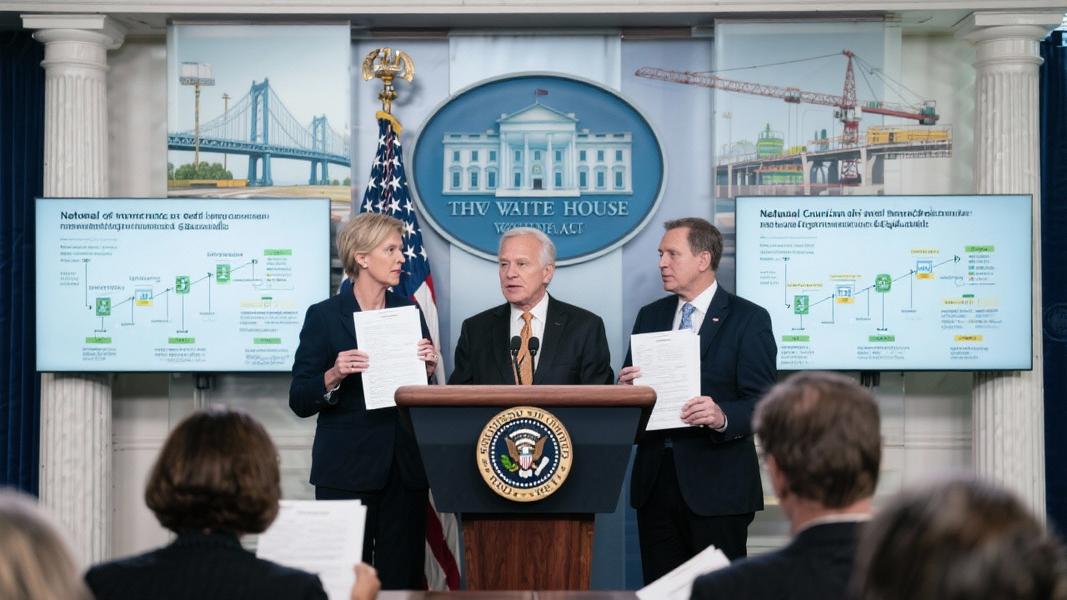
The White House unveiled sweeping changes to environmental review processes Thursday, marking what officials call a “historic reform” of federal permitting that could dramatically accelerate infrastructure and energy projects nationwide.
Council on Environmental Quality (CEQ) Chairman Katherine Scarlett announced updated guidance that replaces regulations rescinded earlier this year, providing federal agencies with what she described as “a clear and consistent roadmap” to streamline environmental reviews under the National Environmental Policy Act (NEPA).
“There’s been a consensus across all three branches of government that we need permitting reform,” Scarlett said in a statement. “Now, at the direction of President Trump, Federal agencies have a clear and consistent roadmap to get us there.”
Regulatory Revolution
The guidance comes after a rapid series of changes that began in April, when CEQ formally rescinded all its NEPA implementing regulations — regulations that had governed environmental reviews for decades. The move effectively transferred authority to individual federal agencies to establish their own NEPA procedures by February 2026, a dramatic shift in environmental policy that followed legal challenges questioning CEQ’s authority to issue binding regulations.
What’s remarkable about this overhaul? For the first time in over 50 years, multiple federal agencies have updated their environmental review procedures, with the first wave completed on June 30. The changes align with recent statutory amendments to NEPA passed by Congress in 2023 and the Supreme Court’s decision in Seven County Infrastructure Coalition v. Eagle County, which further limited the scope of environmental reviews.
“On June 30, 2025, the first tranche of Federal agencies updated their NEPA implementing procedures in consultation with CEQ, delivering historic reforms in record time,” the White House noted in its announcement.
Energy Sector Leads the Way
The Department of Energy moved quickly to implement the new approach, finalizing new procedures that took effect July 3. The DOE replaced its previous regulations with what it calls a “flexible, guidance-based framework” specifically designed to speed up energy infrastructure projects.
“These changes are designed to simplify environmental reviews, clarify interagency responsibilities and support the timely development of energy infrastructure,” according to a Holland & Knight analysis published last month.
The Federal Energy Regulatory Commission (FERC) has also jumped on board, unanimously revising its NEPA implementation regulations following President Trump’s Executive Order 14154, “Unleashing American Energy.” The commission removed references to the now-rescinded CEQ regulations and issued a staff guidance manual that officials say will enable more efficient permitting processes.
“Today, FERC voted unanimously to revise its regulations on the implementation of the National Environmental Policy Act (NEPA) and issued a staff manual outlining the revised procedures,” the commission announced in July.
From Regulation to Guidance
The shift away from centralized regulation began earlier this year when CEQ published an interim final rule in the Federal Register removing its regulations, effective March 27. This followed legal challenges that questioned the agency’s authority to issue binding NEPA regulations in the first place.
CEQ also published a memorandum in February “directing federal agencies… to modify their regulations consistent with the 2023 Builder Act,” according to a Greenberg Traurig analysis released in July.
But does this decentralized approach risk inconsistency across government? The White House insists CEQ will maintain coordination through interagency working groups and regular consultations as federal agencies develop their own procedures.
“Through interagency working groups and regular consultation meetings, CEQ continues to work with other Federal agencies for consistency as they establish or revise their respective NEPA implementing procedures,” the White House stated. “This historic effort to restore common-sense to NEPA will unleash American energy dominance and strengthen American leadership across critical sectors.”
Critics worry the changes could weaken environmental protections, while supporters maintain that the reforms simply eliminate redundancies and unnecessary delays that have plagued infrastructure projects for decades. Either way, the impact of this regulatory reshuffling will likely be felt across industries for years to come.
