
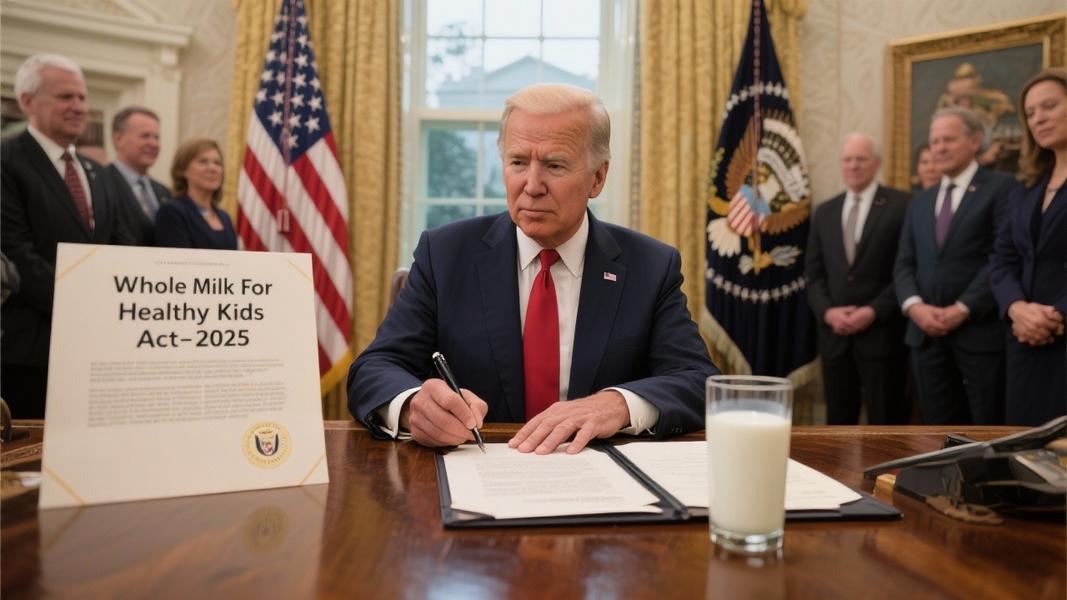
Whole milk is making a comeback in America’s school cafeterias after years of being sidelined by federal nutrition guidelines.
President Biden signed the Whole Milk for Healthy Kids Act of 2025 into law on January 14, significantly expanding milk options in the National School Lunch Program. The bipartisan legislation amends the Richard B. Russell National School Lunch Act to permit schools to offer both flavored and unflavored whole milk alongside reduced-fat, low-fat, fat-free, and lactose-free options — effectively reversing restrictions that had limited most schools to offering only lower-fat varieties in recent years.
A Bipartisan Dairy Coalition
The bill, formally known as S.222, was introduced last January by Sen. Roger Marshall (R-KS) with an unusually diverse group of cosponsors. The coalition included Republicans like Sens. Chuck Grassley and Joni Ernst alongside Democrats including Sens. Peter Welch, John Fetterman, and Kirsten Gillibrand — a rare display of cross-party cooperation in today’s divided Congress.
“Schools may offer students flavored and unflavored organic or nonorganic whole, reduced-fat, low-fat, and fat-free fluid milk and lactose-free fluid milk,” the legislation states, giving school nutrition directors significantly more flexibility than they’ve had in years.
Why such broad support for a seemingly simple change? The answer lies at the intersection of nutrition science, agricultural economics, and evolving perspectives on dietary fat.
Shifting Nutritional Guidance
The law also contains a technical but important provision: milk fat will no longer be considered saturated fat for compliance purposes under the program. That change reflects evolving nutritional understanding about dairy fats, which some recent studies suggest may not have the negative health impacts once attributed to them.
Another practical change expands who can authorize special milk accommodations. Previously, only physicians could approve alternative milk options for students with special dietary needs. Now, parents and legal guardians can also provide such consent — a change likely to reduce bureaucratic hurdles for families seeking accommodations.
Interestingly, no companies were found to have formally lobbied on the bill, though dairy industry groups have long advocated for the return of whole milk to school cafeterias.
A Dairy Debate
The milk wars in school nutrition have been bubbling for years. Whole milk was largely removed from schools during the Obama administration’s nutrition overhaul, which emphasized lower-fat options as part of efforts to combat childhood obesity.
But dairy farmers and some nutritionists have pushed back, arguing that whole milk’s fat content helps children feel fuller longer and that many kids simply prefer the taste — leading them to drink more milk overall and get more of its calcium and vitamin D.
Will students actually choose whole milk when it returns to lunch lines? That remains to be seen. But for the first time in nearly a decade, they’ll at least have the option when they head back to school next fall.
