
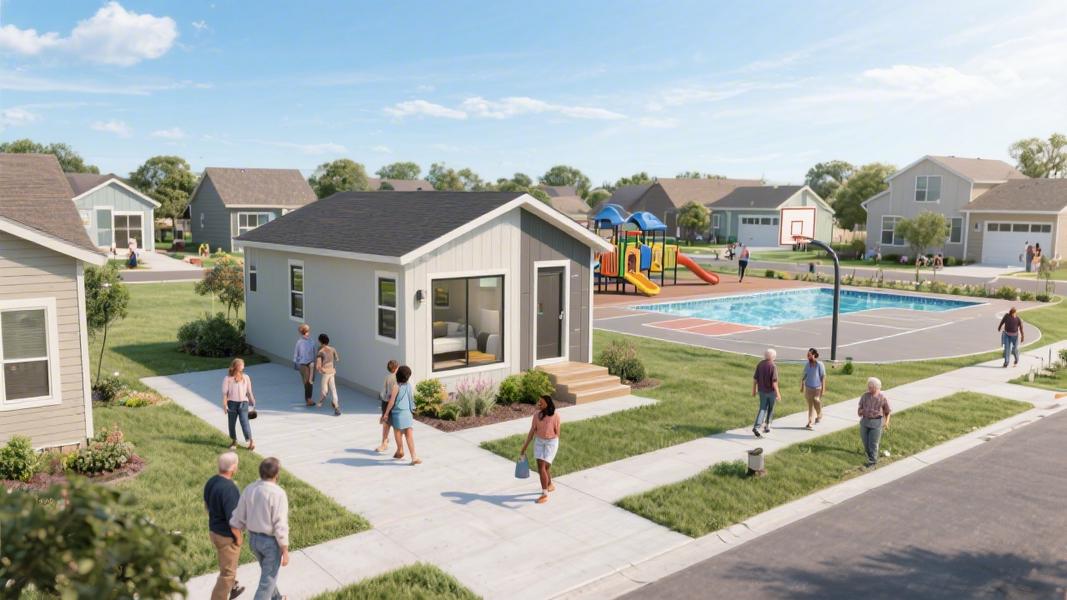
In North Texas, a growing number of homebuyers are doing the math — and deciding that smaller is smarter. Way smarter.
As average home prices in the Dallas-Fort Worth region hover in the mid-to-high $300,000 range, a quiet but significant shift is underway. Compact homes — some barely cracking 650 square feet — are emerging as a legitimate path to ownership for buyers who’ve been priced out, pushed aside, or simply fed up with the traditional market. New state legislation is accelerating the trend, and builders are starting to take notice in a serious way.
One Buyer, 650 Square Feet, and a Point to Prove
DeJay Price didn’t need a mansion. She needed a place to call her own. Price purchased a compact home in Princeton, a small city northeast of Dallas, for around $160,000 — a one-bedroom, two-bath layout with a loft, all tucked into just over 650 square feet. “I wanted to have a space that I could make my own,” she said.
That sentiment — ownership, autonomy, a foothold — is exactly what’s driving demand for compact housing across the region. It’s not about minimalism as a lifestyle brand. It’s about survival in a market that has, for many working Texans, become functionally inaccessible.
“You can’t beat the value, especially since I have access to the city, but I don’t have to pay the price,” Price added. At roughly half the cost of a conventionally sized new home, it’s hard to argue with her logic.
The Numbers Behind the Movement
Here’s where it gets interesting. Building a standard home in Texas in 2026 costs between $150 and $225 per square foot — and in Dallas specifically, that range climbs to $170–$215 per square foot, meaning a 2,000-square-foot home runs anywhere from $340,000 to $430,000 before you’ve bought a single piece of furniture, according to data compiled by real estate analysts. For a lot of buyers, that’s simply not a number that fits on any budget spreadsheet they can honestly write.
Compact and manufactured homes tell a very different story. The average sale price of a new manufactured home in Texas as of 2026 sits at $122,500 — with single-section models averaging $86,700 and double-section units around $146,900, excluding land and setup costs that typically run between $20,000 and $60,000. Prefab home kits, meanwhile, start at roughly $41.50 to $85.10 per square foot, though turnkey costs can multiply that figure by three to five times, noted one Texas builder resource.
Still, even at the high end, the gap between compact and conventional is enormous. In North Richland Hills, for instance, average tiny home costs in 2026 fall between $36,271 and $53,143, with the full range spanning from roughly $10,963 to $91,358, according to local contractor data. That’s not a rounding error. That’s a different universe.
A Law That Could Change Everything
What’s really poised to reshape the landscape — literally — is Texas Senate Bill 15, which took effect last September. The law limits large cities from requiring lot sizes bigger than roughly 3,000 square feet in certain new subdivisions. Before SB 15, minimum lot requirements in many municipalities ran between 5,000 and 7,500 square feet, effectively making compact housing developments economically impossible or legally prohibited in most desirable areas.
Paired with Senate Bill 785, the legislative package creates what housing advocates and builders are calling a genuinely favorable environment for small-footprint housing — the kind of policy shift that doesn’t happen often, and when it does, tends to move markets fast. “So that is going to open up a lot more communities like this,” said Bobby Franklin, a realtor with North Texas Market Insider, referencing the new law’s potential reach.
That’s not hype. When you reduce the minimum land required to build, you reduce the land cost embedded in every home price. It’s the kind of structural fix that zoning reform advocates have been pushing for years in high-cost cities across the country — and Texas just did it statewide.
Builders Are Paying Attention
One North Texas homebuilder is already putting that philosophy into practice. He’s constructing 42 compact homes in a community called Bit O’Heaven in Azle — designed to be low-maintenance, built to last, and priced affordably, even if that means slimmer profit margins on his end. His motivation, he says, is personal.
“I’ve seen a lot of single mothers and widows that live in mobile homes, and they’re treated like second-class citizens,” he told reporters. “They should have the ability to have a nice place to live… and a nice community.” It’s a blunt assessment of what affordable housing often looks like in practice — and a pointed argument for why the compact home movement is about more than square footage.
That said, it’s not that simple. Compact homes still face skepticism from buyers conditioned to equate size with value, from lenders who can be reluctant to finance non-traditional structures, and from communities that have long used zoning as a quiet but effective tool to keep certain housing types — and certain residents — out. SB 15 chips away at that last obstacle, but the others remain.
What’s on the Market Right Now
For buyers curious about what’s actually available, the options are more varied than most people expect. In the Dallas market, tiny homes under $100,000 include models like the Nomad 24′ at 204 square feet, the Escher from New Frontier Design ranging from 250 to 400 square feet, the K240 from Kubed Living at 240 square feet, and the Vista Boho from Escape Traveler at 187 square feet, among others.
These aren’t roughing-it cabins. Many feature modern finishes, smart storage design, and energy-efficient systems — the kind of thoughtful engineering that becomes necessary, and often innovative, when you’re working with less.
A Different Kind of Texas Dream
The Texas dream has always had a certain scale to it — big land, big houses, big ambitions. But for a growing number of buyers, the dream has been quietly renegotiated. What matters now is access. Stability. A deed with your name on it.
DeJay Price has that now, in 650 square feet in Princeton. The builder in Azle is trying to give it to 42 more families. And if Texas lawmakers and local builders continue moving in the same direction, the smallest homes on the block may end up carrying some of the heaviest meaning — proof that sometimes, in a market this unforgiving, less really is more.
