
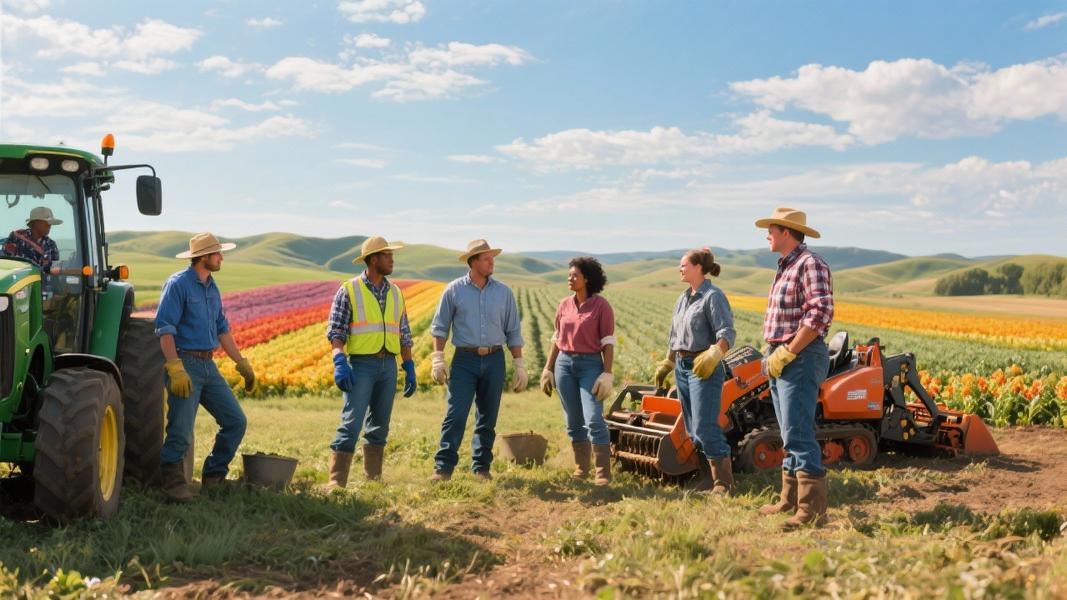
As farm machinery rumbles through fields across America this fall, a sobering reality hangs in the air: the work that feeds a nation remains among its deadliest professions. This week marks National Farm Safety and Health Week, a decades-old tradition with the urgently relevant 2025 theme: “Safety First, Avoid the Worst.”
Running from September 21-27, this annual observance comes at a critical time as harvest season intensifies across rural America. The statistics paint a stark picture: agriculture maintains its unfortunate status as America’s most dangerous occupation, with a fatality rate of 18.6 per 100,000 workers — the highest among all U.S. industries, according to recent data from the U.S. Bureau of Labor Statistics.
A Deadly Profession Behind America’s Food Supply
The numbers are staggering. In 2022 alone, 417 agricultural workers lost their lives on the job, as documented by Clemson University researchers. “Agriculture is among the most demanding and hazardous industries in the United States,” notes a White House presidential message released Monday. “From managing powerful equipment to preparing for unpredictable and extreme weather, farmers face unique challenges each and every day.”
In Wisconsin, a state with deep agricultural roots, the situation reflects the national crisis. “Our state continues to experience roughly 25 to 40 farm workplace fatalities every year,” according to materials from the Wisconsin Farm Extension. “Earlier research suggests that roughly one in five Wisconsin farms experiences a serious injury annually. Around 80% of those cases require medical attention. And yet, nearly every one of these injuries and deaths is preventable.”
What makes farm work so consistently dangerous? The answer lies partly in the seasonal pressure that defines agricultural life. Most injuries occur during the busiest periods — planting, growing, and harvest seasons — when farmers are most likely to take shortcuts that compromise safety.
“When busy, distracted, in a hurry, or under stress, we often take shortcuts that may lead to injury,” explains the Clemson University agricultural safety team. “Most agricultural-related safety incidents are due to human error and therefore preventable.”
Beyond Empty Slogans: The Push for Real Safety
Safety experts stress that meaningful change requires more than awareness campaigns. “A safety slogan doesn’t change much by itself,” notes Wisconsin Farm Extension materials. “What matters is how safety shows up in the everyday choices we make on the farm. This includes actions that build safety into daily habits, decisions, and equipment choices… Real safety means making physical, tangible changes that protect people at the source.”
The human toll extends far beyond the individual farmer. According to the National Institute for Occupational Safety and Health (NIOSH), about 100 agricultural workers suffer a lost-work-time injury every day, with farmers nearly twice as likely to die on the job as the average U.S. worker.
“National Farm Health and Safety Week serves as a reminder that practicing farm safety is more than an individual responsibility; safe farms protect entire families and communities,” explains the Farmers.gov official blog.
A Presidential Tradition Since World War II
The tradition of officially recognizing farm safety at the national level dates back to the Roosevelt administration. “Farm Safety Week has been officially recognized by U.S. Presidents dating back to 1944, when Franklin D. Roosevelt signed the first proclamation during World War II,” according to Wisconsin agricultural officials.
In 2024, President Biden continued this tradition by declaring September 15-21 as National Farm Safety and Health Week. “I call upon the people of the United States — including America’s farmers; ranchers; and agriculture-related institutions, organizations, and businesses — to reaffirm a dedication to farm safety and health,” the presidential proclamation stated.
How can farmers navigate the practical aspects of safety during their busiest season? This year’s observance offers free educational webinars focused on specific risks, including equipment safety, health and wellness, generational farming communication, confined space hazards, and ATV/UTV operation – all available through the National Education Center for Agricultural Safety and Agri-Safe.
For nearly 250 years, American agriculture has fed a nation through the “hard work, dedication, and vital contributions of our incredible farmers, ranchers, and foresters,” as the White House message acknowledges. The challenge now facing rural America is how to preserve both this agricultural heritage and the lives of those who sustain it.
In the end, the message of National Farm Safety and Health Week boils down to a simple truth: behind every statistic is a family, a community, and a piece of America’s food system. “We must continue to prioritize their safety and health,” the White House emphasizes — because the cost of not doing so is measured not just in dollars, but in lives.
