
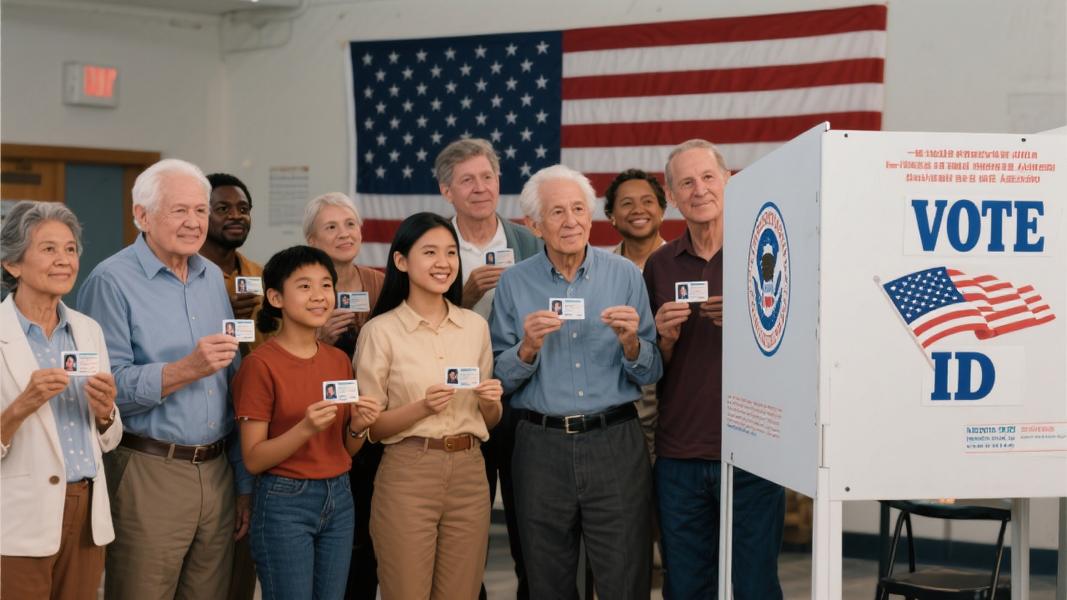
The battle over voter identification has reached a new level of intensity as Republicans champion the SAVE America Act, a sweeping election reform bill that would fundamentally reshape how Americans register to vote in federal elections.
At its core, the legislation would require all voters to present photo identification at polling places and provide documentary proof of citizenship when registering to vote. President Donald Trump has made the bill a centerpiece of his administration’s electoral agenda, declaring, “Nothing is more fundamental than the integrity and security of our elections.”
What the SAVE Act Would Do
The legislation, formally introduced as H.R.22 in the House, would establish nationwide requirements for voters to prove citizenship using specific documents like a REAL ID-compliant identification card, U.S. passport, or birth certificate when registering to vote. States would be prohibited from processing federal voter registration applications without such documentation.
Senators John Cornyn, Mike Lee, and Representative Chip Roy are the primary sponsors of the bill, which has gained significant momentum in recent weeks. The legislation would also mandate that states either share voter rolls with the Department of Homeland Security or require voters to present proof of citizenship again at polling places, according to election law experts.
“It is ridiculous that we need to pass a bill to ensure that Americans alone are the ones voting in our federal elections, but thanks to Joe Biden’s reckless open-border policies and Democrat-run sanctuary cities, this is the reality we live in,” Senator Cornyn stated when introducing the legislation.
Concerns About Voter Disenfranchisement
Critics argue the bill could prevent millions of eligible voters from casting ballots. More than 21 million Americans—disproportionately people of color, women who have changed their names after marriage, young voters, and the elderly—may lack ready access to the required documentation, claims the Campaign Legal Center.
The timing of the push has raised eyebrows among voting rights advocates. With midterm elections approaching, the amended version of the SAVE America Act would impose significant new barriers to voter registration that could disenfranchise millions of eligible voters before they even reach the polls.
Is this solution searching for a problem? Experts at the Bipartisan Policy Center note that noncitizen voting is already exceptionally rare, and that there are less burdensome methods to verify voter eligibility through back-end systems rather than placing the onus on individual voters.
The Path Forward
The bill, also filed as H.R.7296 in a slightly different form, continues to gain support among Republicans who view it as essential to election integrity. The requirements would represent one of the most significant changes to federal election law in recent years.
That said, the legislation faces significant hurdles in a closely divided Congress, where Democrats have consistently opposed similar measures, characterizing them as unnecessary barriers to voting that would disproportionately affect marginalized communities.
As the debate intensifies, both sides claim to be protecting democracy—one by securing the ballot box against potential fraud, the other by ensuring access to it remains unobstructed. What’s clear is that how Americans register and vote could look dramatically different if the SAVE America Act becomes law.
