
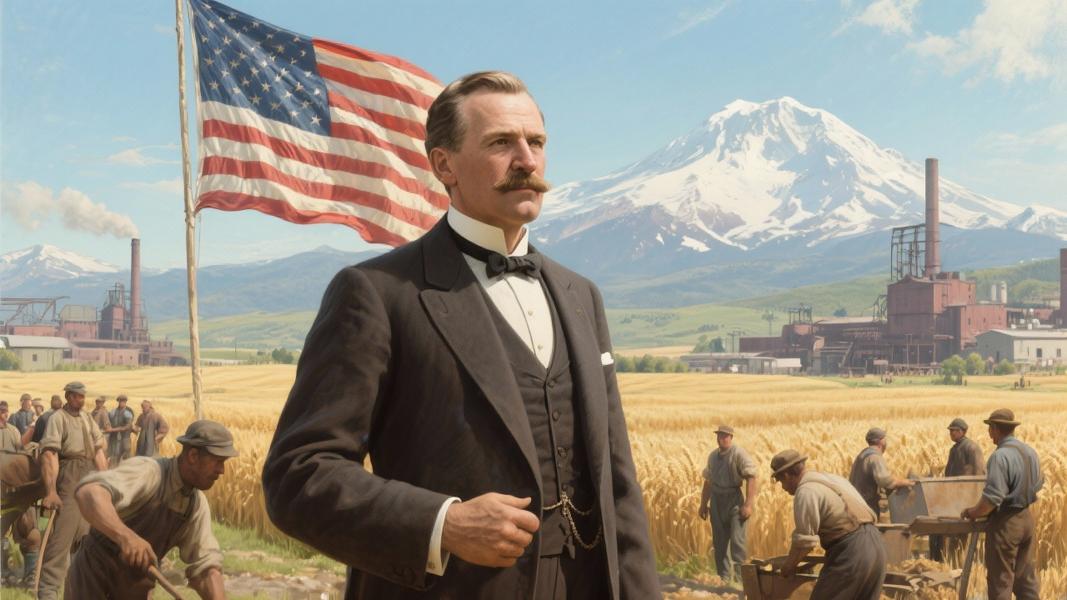
William McKinley’s presidential legacy stands as a pivotal turning point in American history, transforming the United States from a continental power into a global empire. His administration, bookended by economic prosperity and tragic assassination, reshaped American foreign policy in ways that continue to reverberate more than a century later.
Born in Niles, Ohio, McKinley rose to national prominence after serving in the Civil War and authoring the McKinley Tariff of 1890. After serving as governor of Ohio from 1891 to 1895, he secured the Republican nomination for president in 1896 on a platform championing protective tariffs and the gold standard. In a decisive victory, McKinley captured 271 electoral votes to William Jennings Bryan’s 176, winning the popular vote by a margin of 51% to 47%.
Economic Prosperity Through Protectionism
McKinley wasted no time implementing his economic vision. Upon taking office, he immediately pushed through the Dingley Tariff in 1897 — the highest protective tariff in American history to that point — and strengthened the gold standard through legislation. These policies, controversial at the time, sparked what many historians note was immediate economic prosperity, with American exports and domestic markets growing more than in any previous four-year period.
As Ohio’s governor, McKinley had already demonstrated his economic priorities, proposing laws that protected railroad workers and addressed child labor issues. But it was the Gold Standard Act of 1900 that perhaps most solidified his economic legacy, placing America firmly on the gold standard during a period when silver-backed currency had powerful political advocates.
The Birth of American Imperialism
“We must have more ships. They must be under the American flag, built and manned and owned by Americans,” McKinley declared, articulating a vision that would transform American foreign policy. “These will not only be profitable in a commercial sense; they will be messengers of peace and amity wherever they go.” This expansionist mindset guided his administration toward what would become the Spanish-American War.
How did a president initially focused on domestic economic policy end up presiding over America’s emergence as a colonial power? The answer lies in the Spanish-American War of 1898, a conflict that lasted just 10 weeks but fundamentally altered America’s global position.
The war resulted in decisive American victory, with U.S. forces destroying the Spanish fleet and seizing Manila and Puerto Rico. Spain was compelled to relinquish control of Cuba, Guam, Puerto Rico, and the Philippines — the latter purchased for $20 million. McKinley’s decision to annex these territories marked a dramatic shift toward American imperialism, extending U.S. influence far beyond its continental borders.
McKinley was particularly adamant about the annexation of Hawaii, telling his secretary George Cortelyou, “We need Hawaii just as much and a good deal more than we did California. It is manifest destiny.” This statement revealed the president’s expansionist vision that would guide American foreign policy for generations.
McKinley had an uncanny ability to detect public sentiment. As “Uncle Joe” Cannon, later Speaker of the House, once quipped, McKinley “kept his ear so close to the ground that it was full of grasshoppers.” This political instinct helped him navigate the complex public reactions to overseas expansion.
A Legacy Cut Short
McKinley’s presidency was tragically cut short when he was assassinated by a left-wing anarchist in 1901, just months into his second term. The assassination came at a moment when the United States was emerging as a world power, having acquired overseas territories, won a war against Spain, and engaged in establishing international trade norms.
His domestic achievements in tariff policy and establishing the gold standard were matched by his foreign policy transformations. McKinley’s vision of American economic and military power projected globally created the foundation for the “American Century” that would follow.
The restoration of Mount McKinley’s name in recent years serves as a reminder of the complicated legacy of America’s 25th president — a man who championed economic prosperity at home while dramatically expanding American influence abroad, forever changing the nation’s relationship with the wider world.
