
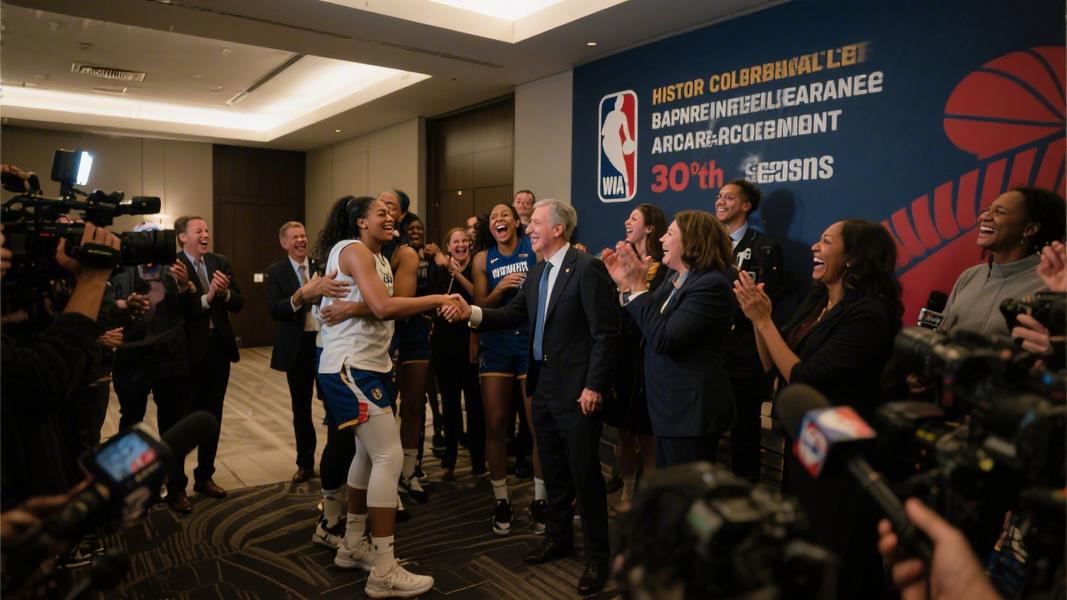
The clock ran out — and then kept running. The WNBA and its players’ union blew through a self-imposed deadline Monday without a new collective bargaining agreement, leaving the league’s 2026 season in genuine uncertainty and raising the specter of a work stoppage that nobody wants but nobody seems willing to prevent.
The league had set March 10 as the hard cutoff for reaching a new CBA — the point at which any further delay would begin disrupting the 2026 schedule. Both sides sat down for a grueling 12-hour bargaining session that day. They emerged with nothing signed. The core sticking point, as it has been throughout these talks, is money: specifically, how much of the league’s growing revenue flows back to the players who generate it.
Eleven Hours In, Still Miles Apart
One ESPN source put it bluntly, and it’s hard to argue with the math: “Often, things tend to get done at the 11th hour. We’re getting awfully close to the 11th hour when it comes to bargaining.” That was before Tuesday’s session. Now, it’s fair to ask whether the 11th hour has already passed.
The Women’s National Basketball Players Association had been pushing an ambitious framework. The union proposed a salary cap of approximately $12.5 million per team for 2026, with average player salaries hovering around $1 million and a maximum salary ceiling of $2.5 million. Those numbers represent a seismic jump from what players currently earn — and that’s exactly the point.
The league’s counteroffer tells a different story. The WNBA floated a supermax base salary of roughly $1.13 million, pegged at 20 percent of a $5.65 million salary cap in Year 1 — a figure the union reportedly countered with a cap just under $9.5 million. The gap between those two numbers isn’t just a negotiating distance. It’s a philosophical divide about what the WNBA is, and what it owes the women who built it.
United Front, Fractured Picture
That’s the catch. Beneath the union’s public solidarity, there’s a real tension between the league’s superstar earners — players like Caitlin Clark and A’ja Wilson, whose marketability has helped drive a historic surge in WNBA viewership — and the broader roster of players who see far less of that money. The league knows this. And according to the union, it’s trying to exploit it.
“In every CBA negotiation, the goal of the league and teams is to divide the players,” the WNBPA said in a statement. “These negotiations are no different. We remain united and focused on delivering a transformational CBA for all members of this union and are committed to negotiating for as long as it takes.” Strong words. Whether they hold is another matter entirely.
Still, the union’s resolve appears genuine — at least for now. The WNBPA’s proposals aren’t just about superstars getting paid. They address housing stipends, travel conditions, and baseline quality-of-life standards for players who, outside of a handful of marquee names, are not living lavishly on their WNBA contracts alone.
What Happens Now
What’s at stake isn’t just the 2026 schedule — it’s the league’s momentum. The WNBA has spent the last two years riding an extraordinary wave of public interest, fueled in large part by generational talent and record-breaking ratings. A strike, or even a prolonged public standoff, could puncture that goodwill in ways that are hard to walk back. Reported negotiations have already missed one deadline. Missing another would send an unmistakable signal.
Both sides have acknowledged that a transformational deal is possible. Revenue sharing — the mechanism by which players would receive a direct cut of league-wide revenues — remains the thorniest issue, and the one neither side has publicly budged on in any meaningful way. That’s where the real fight is. Salaries are a symptom. Revenue sharing is the disease, or the cure, depending on which side of the table you’re sitting on.
The WNBA is no longer a niche product fighting for legitimacy. It’s a league with genuine commercial power, a sold-out arenas problem, and a broadcast deal that reflects real market demand. The players know it. The league knows it. The question is whether both sides can translate that shared understanding into a contract before the lawyers start talking about something nobody wants to say out loud: a work stoppage in the middle of women’s basketball’s most important moment in decades.
As one union official’s words still echo: they’re committed to negotiating for as long as it takes. The 2026 season may end up being the measure of exactly how long that is.
