
A Florida man who hid in the bushes at Trump International Golf Club with a loaded rifle has been sentenced to life in prison for the attempted assassination of former President Donald J. Trump.
Ryan Wesley Routh, 59, received the maximum sentence — life plus 84 months — from U.S. District Judge Aileen M. Cannon following his conviction on all five counts related to the September 2024 assassination attempt in West Palm Beach, Florida. The sentencing marks the conclusion of a case that prosecutors described as a direct assault on America’s democratic process.
A Sniper’s Hide at the Golf Course
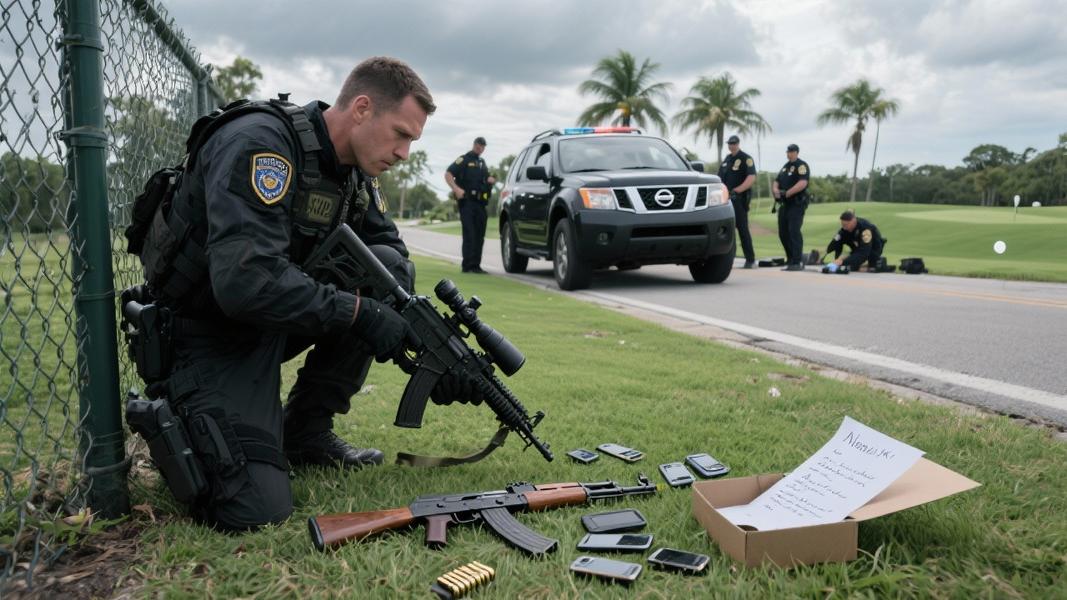
On September 15, 2024, a Secret Service agent patrolling ahead of Trump’s golf party made a chilling discovery: Routh was lying in wait with an AK-47 style rifle pointed through the fence at the sixth green where the former president was about to play. The agent, fearing for his life and Trump’s, fired at Routh, who fled the scene but was later apprehended on Interstate 95.
“This was an assassination attempt on Donald Trump but I am so sorry I failed you,” Routh wrote in a handwritten confession letter addressed “Dear World” that was discovered during the investigation.
The evidence against Routh was overwhelming. Law enforcement recovered a Norinco SKS rifle with a scope, 19 rounds of ammunition, steel armor plates, and a camera pointing at Trump’s intended location. Investigators also found multiple burner phones, stolen license plates, and a list of international flights with directions to Miami International Airport.
Months of Planning
What made the case particularly disturbing? Prosecutors demonstrated that Routh spent months meticulously planning the attack, traveling across the country while researching Trump’s movements, studying sniper tactics, and mapping escape routes.
Cell phone records revealed that between August and September 2024, Routh’s phone accessed cell towers near Trump International Golf Club and Mar-a-Lago on multiple occasions, suggesting extensive surveillance of the former president’s routines.
“The investigation was immense and left no stone unturned,” said Special Agent in Charge Brett Skiles of the FBI Miami Field Office. “The FBI worked shoulder to shoulder with the Secret Service, ATF, the Palm Beach Sheriff’s Office, and the Martin County Sheriff’s Office… covering leads across the country and around the globe.”
Political Violence “Un-American”
The assassination attempt came just two months after another gunman, Thomas Crooks, fired several shots at Trump during a Pennsylvania rally, wounding him on his right ear before being killed by a Secret Service agent. That close call in July 2024 heightened security concerns around the former president during the heated election season.
During sentencing, prosecutors successfully argued for a terrorism enhancement, maintaining that Routh’s motive was explicitly political — an attempt to prevent voters from having the option to elect Trump in the 2024 presidential election.
Routh’s defense team challenged this characterization, arguing there was insufficient evidence his actions were intended to influence or retaliate against the government. The judge ultimately rejected this argument.
Official Condemnation
Attorney General Pamela Bondi didn’t mince words: “Ryan Routh’s heinous attempted assassination of President Trump was not only an attack on our President — it was a direct assault against our entire democratic system.”
U.S. Attorney Jason A. Reding Quiñones for the Southern District of Florida echoed this sentiment, saying, “This life sentence reflects a fundamental truth: political violence is un-American and will never be tolerated. An attempted assassination of a presidential candidate is an attack on our democratic process and the rule of law itself.”
The verdict and sentencing drew particular attention for its bipartisan condemnation. FBI Director Kash Patel called it “a despicable attack on our democratic system,” while Assistant Attorney General John A. Eisenberg stated that Routh had attempted to “cast our Nation into what would have been one of its darkest periods.”
A Warning Against Political Violence
The case highlights the growing concerns about political violence in America’s increasingly polarized landscape. Since 2016, threats against public officials have increased dramatically, according to federal law enforcement statistics.
Could this sentencing deter future attempts? Security experts remain concerned about copycat attacks, particularly as the political climate grows more heated.
Eisenberg’s statement at the sentencing perhaps best captured the government’s message: “Today’s sentence is a resounding rejection of political violence and a clear reminder that we resolve our differences through civil discourse, democratic elections, and lawful protest, not by force.”
With Routh now sentenced to spend the remainder of his life behind bars, the case closes another troubling chapter in American political history — one where the peaceful transfer of power, the cornerstone of American democracy, was nearly derailed by a man with a rifle hiding in the bushes of a Florida golf course.
