
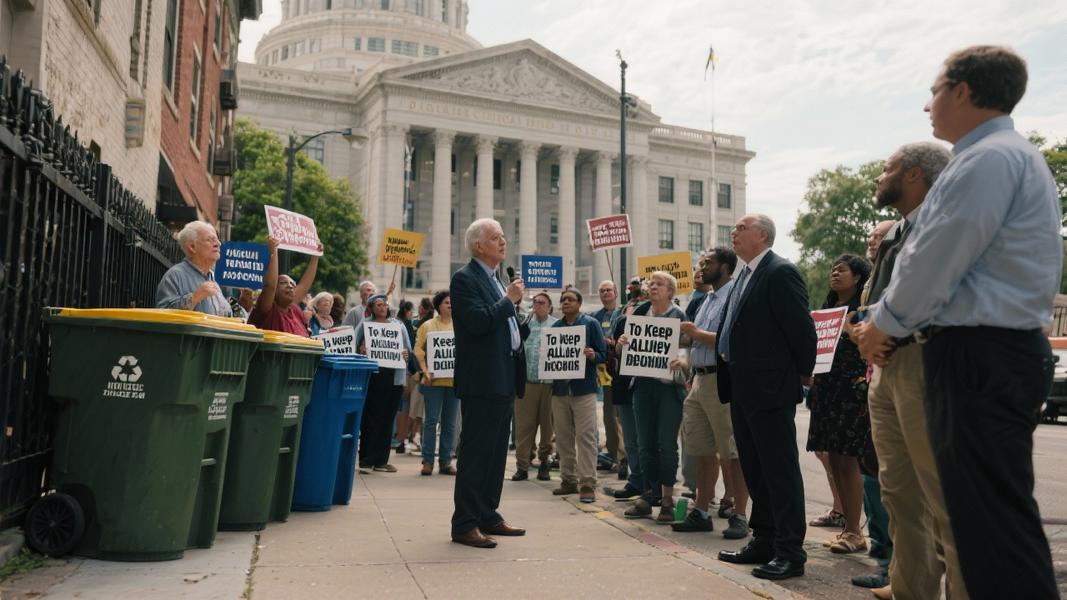
In a rare show of civic solidarity, a staggering 93% of Dallas residents who responded to a city survey have voiced their support for keeping alley trash pickup service, throwing a wrench into the city’s plans to transition thousands to curbside collection.
The survey, which reached out to 43,000 residents and garnered a 23% response rate, revealed that 60% of respondents are even willing to pay more to maintain the current alley pickup service they’ve long relied on. This overwhelming opposition comes in response to the City of Dallas’ July 2025 announcement that over 26,000 households would be switched from alley to curbside pickup beginning January 2026 — a plan that quickly sparked a petition gathering more than 10,000 signatures.
Safety Concerns vs. Public Pushback
City officials maintain the changes are necessary for worker safety. Sanitation Director Cliff Gillespie cited troubling incidents where workers have been “pinned and run over, near misses for electrocution and severe fire injury” while navigating the city’s narrower alleys. The transition plan specifically targets alleys 9 feet wide or less, dead-end alleys at least 200 feet long, and unpaved gravel alleys.
“We understand that many residents who are being asked to change the way they set out their garbage and recycling will be frustrated by this transition,” Gillespie acknowledged. “Change is difficult, especially when it affects weekly routines that have been in place for many years.”
The implementation would occur in two phases — approximately 19,000 customers beginning January 16, 2026, followed by another 7,000 on July 20, 2026. What’s particularly controversial is that according to city code, the sanitation director has the authority to make this change without city council approval.
Residents Push Back
For many Dallas residents, particularly older ones, the proposed change isn’t just inconvenient — it’s potentially impossible.
“It will be necessary to drag them across the front yard across St. Augustine grass,” resident Sally Braden testified at a recent council meeting. “I am in my mid-70’s. My husband is 81. We would not be able to drag the bins to the front.”
The level of agreement among residents has become a talking point itself. “When was the last time 93% of anyone in this country agreed on anything?” resident Jeffrey Helfrich asked the council, highlighting the rare consensus on this issue.
Councilmember Phil Roth emphasized the scale of opposition, noting, “Hundreds have shown up and told you no, thousands wrote letters and told you no, 12,000 sent a petition and told you no.”
A Question of Equity
The debate has also raised questions about service equity across the city. Councilmember Adam Bazaldua pointed out what he sees as an imbalance: “We have 60% of our city paying for a premier service that minority are benefiting from.”
This isn’t the first time Dallas has attempted to modify its trash collection system. A more ambitious 2024 proposal would have transitioned all 94,000 alley pickup customers to curbside service, but was postponed after similar public outcry.
Alternative proposals have since emerged. Options presented at a February briefing included transitioning fewer than 10,000 customers, transitioning fewer than 5,000 customers based on survey responses, or conducting further research without making any immediate changes.
What Happens Next?
For now, the standoff continues. Dallas City Manager Kim Tolbert has indicated the city will report back to the council with a new plan in three to six months, suggesting officials are reconsidering their approach in light of the overwhelming public response.
Still, with the sanitation director technically having the authority to proceed regardless of council input, residents remain anxious about what will ultimately happen to a service many consider essential.
As Dallas navigates this unexpectedly contentious issue, one thing is clear: in a city where consensus is rare, trash collection has managed to unite neighbors in a way few other issues could — proving that sometimes, it’s the most mundane aspects of city life that residents hold most dear.
