
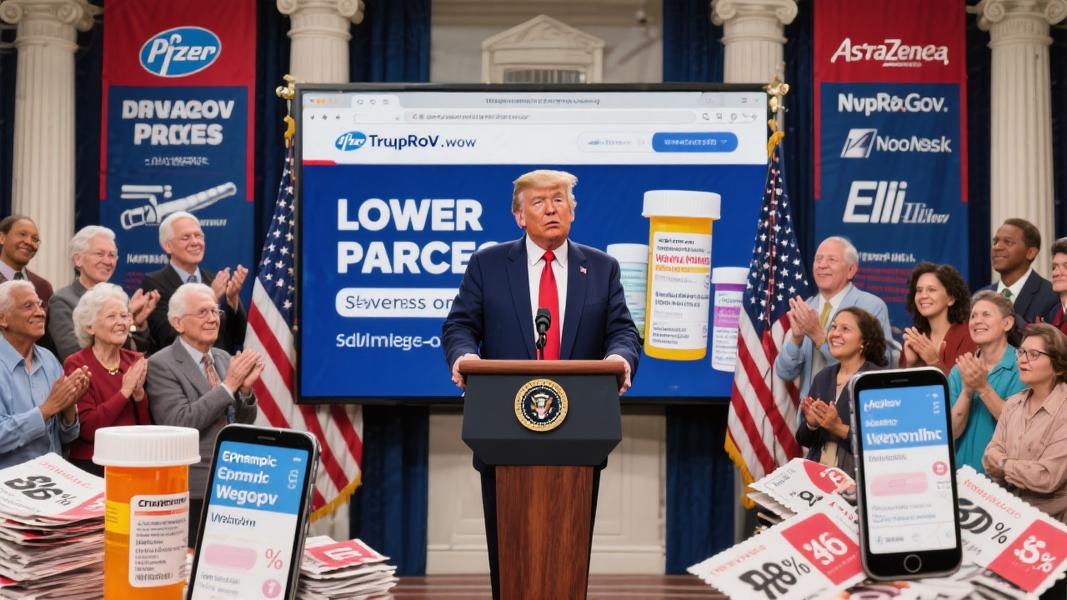
In a sweeping move that could reshape America’s prescription drug landscape, President Donald Trump has launched TrumpRx.gov, a government portal designed to deliver most-favored-nation pricing on popular medications directly to U.S. consumers.
The initiative, announced on February 5, 2026, connects patients with pharmaceutical manufacturers offering dramatic discounts — some as high as 93% off retail prices. It represents the fulfillment of Trump’s long-standing promise to force drug companies to offer Americans the same lower prices available in other developed countries.
How it works
TrumpRx doesn’t sell medications directly. Instead, it functions as a portal, directing consumers to manufacturers’ own sales platforms where they can purchase medicines at steeply discounted cash prices. The site currently features deals from five major pharmaceutical companies: AstraZeneca, Eli Lilly, EMD Serono, Novo Nordisk, and Pfizer, with more expected to join in coming months.
The administration secured these most-favored-nation pricing agreements through a combination of executive action and direct negotiation with manufacturers. Each participating company has agreed to offer Americans the lowest prices available in other economically advanced nations.
What does this mean for the average patient? The savings are substantial. A quick scan of the website reveals eye-popping discounts on some of America’s most sought-after medications. Fertility drug Gonal-F, previously $1,449, is now free. Popular weight loss treatments have seen their prices slashed by over 80% — Wegovy pills dropping from $1,349 to $149 monthly, while Ozempic pens now cost $199 instead of $1,028.
Big Pharma’s surprising participation
Why would pharmaceutical giants voluntarily slash their U.S. prices? The answer lies in a complex calculus of public relations, market retention, and regulatory pressure.
Pfizer, one of the program’s most enthusiastic participants, is offering discounts averaging 50% (and reaching up to 85%) across more than 30 branded medications for conditions ranging from migraines to rheumatoid arthritis. “For far too long, Americans have shouldered a disproportionate share of the global cost of innovation to help develop breakthroughs for the entire world,” said Albert Bourla, Pfizer’s Chairman and CEO, in a statement that seemed to acknowledge the longtime criticism of U.S. drug pricing practices.
Industry analysts suggest the participating companies are making a strategic calculation: better to voluntarily offer discounts through a direct-to-consumer model than face more aggressive government intervention that could permanently alter their pricing power.
Questions remain
Will these discounts remain sustainable? Critics point out that the current program relies on manufacturers’ continued voluntary participation, leaving it vulnerable to changes in corporate strategy or political leadership.
There’s also the question of insurance integration. TrumpRx purchases are primarily cash transactions outside insurance networks, meaning patients must weigh immediate savings against potential impacts on deductibles and out-of-pocket maximums.
Nevertheless, for the over 100 million Americans who take medications now available through TrumpRx, the immediate impact could be transformative. A three-month supply of insulin that once cost over $3,000 might now be obtained for less than $600 — a difference that could literally be life-saving for patients who have been rationing their medications.
As more manufacturers join the platform in coming months, TrumpRx may well represent the most significant disruption to prescription drug pricing in decades — a rare case where American consumers find themselves paying less, not more, than their counterparts around the world.
