
Texas officials have ramped up efforts to combat two looming agricultural threats along the southern border: water scarcity and an invasive livestock pest that could devastate the cattle industry.
Governor Greg Abbott and U.S. Agriculture Secretary Brooke Rollins convened in Mission, Texas, on Friday for a roundtable focused on enforcing the U.S.-Mexico Water Treaty, a critical agreement for South Texas farmers who depend on consistent water deliveries for citrus production. “Thank you to President Trump for stepping up and doing more than any other President has ever done to enforce this treaty,” Abbott declared. “The urgency of it was heard at this roundtable today. We have an obligation to ensure more water goes to the men and women who grow crops in our state.”
Water Treaty Negotiations Show Progress
Water uncertainty has long plagued South Texas agriculture, but recent diplomatic efforts appear to be yielding results. “Uncertainty over water deliveries from Mexico negatively impact South Texas especially,” Rollins noted. “The State Department, USDA, and IBWC engaged our Mexican government counterparts to negotiate. Recent treaty negotiations have resulted in significant increases in deliveries and improvements in the reliability of the water cover. It’s time to make a change, and that’s what we’re working to do.”
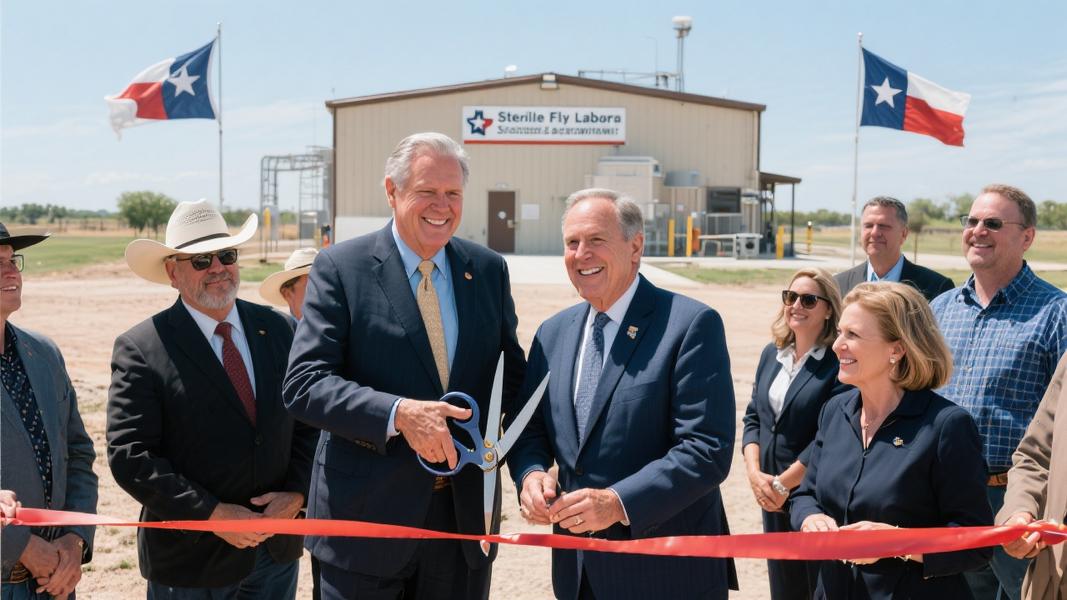
The visit also highlighted another border challenge with potentially devastating consequences: the New World Screwworm (NWS), a parasitic fly that poses a billion-dollar threat to U.S. livestock. The day’s agenda included the grand opening of a sterile fly dispersal facility at Moore Air Base in Edinburg — the first such U.S. facility in decades.
New Facility Tackles Invasive Pest Threat
“America is going to take care of ourselves, including dealing with the approach of screwworm as it gets closer to our border,” Abbott emphasized during the ceremony.
The new facility can disperse up to 100 million sterile flies per week — a critical component of the strategy to prevent the pest from establishing itself north of the border. How does it work? The sterile flies mate with wild screwworms but produce no offspring, effectively reducing the population over time. The Edinburg facility receives larvae from Panama, processes them, and prepares them for targeted distribution.
Congressman Tony Gonzales, who joined the event, has championed the bipartisan STOP Screwworms Act alongside Senators John Cornyn and Ted Cruz to fund the sterile fly production efforts. “Thank you, Secretary Rollins and Governor Abbott, for their continued partnership in safeguarding Texas’ agriculture, livestock, and wildlife industries,” Gonzales said.
Stephen Diebel of the Texas & Southwestern Cattle Raisers Association attended the facility opening and stressed its importance. “The value of equipping the U.S. to combat the threat of New World screwworm cannot be overstated,” Diebel remarked. “As Texans and cattle producers, we celebrate the opening of the sterile fly dispersal facility at Moore Airfield Base, strengthening our nation’s ability to protect our cattle herd health, food security and economy which would suffer from any incursion of New World screwworm.”
Comprehensive Response Strategy
The threat is serious enough that southern ports were closed to livestock last year, and the federal government has invested $100 million in research, traps, and surveillance. But Secretary Rollins expressed confidence in preparedness efforts while acknowledging the gravity of the situation.
“I don’t want to underplay it because it is a big threat to our country, but I believe we’re as prepared as we could possibly be, if that happens, to deal with it, to move toward eradication,” Rollins stated.
The current facility is just the beginning. USDA is constructing a $750 million factory nearby that will produce approximately 300 million sterile flies weekly by the end of 2027. Additionally, the agency is spending $21 million on a facility in Mexico as part of what Rollins described as a “whole-of-government approach” to combat the pest.
“This sterile fly dispersal facility was a high priority project, and our team delivered it in record time,” Rollins explained. “This new facility is a monumental achievement for our domestic preparedness efforts, but we are also diligently working to stop the spread of screwworm in Mexico, conduct extensive trapping and surveillance along the border, increase U.S. response capacity, and encourage innovative solutions.”
For South Texas farmers and ranchers caught between water scarcity and emerging pest threats, the dual announcements represent rare good news in their ongoing struggle to maintain agricultural production in one of the country’s most challenging environments.
