
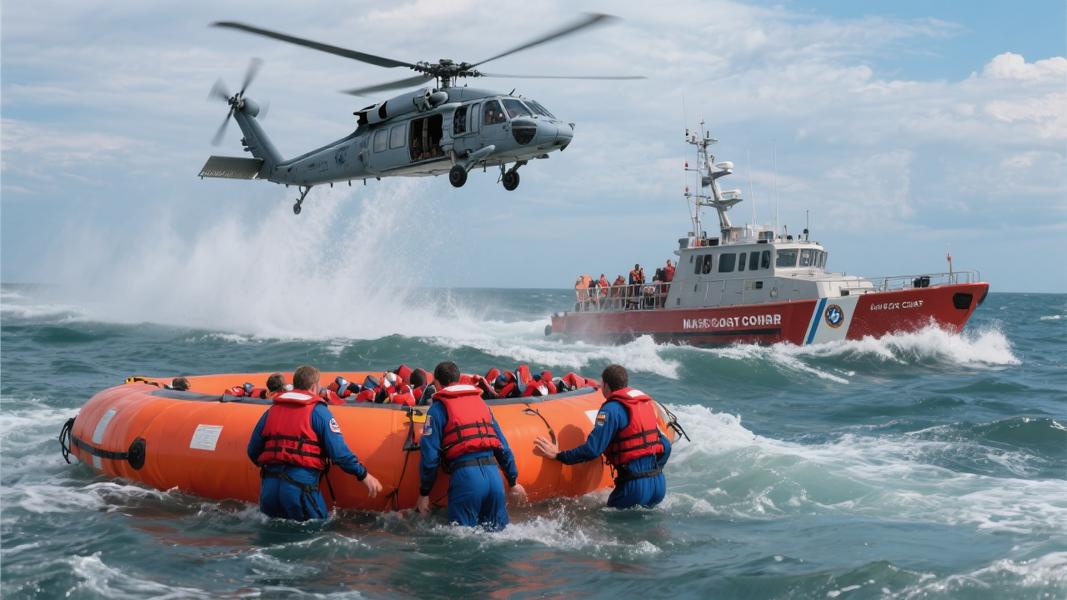
A hundred people adrift at sea, miles from shore, with rescue potentially hours away. It’s the kind of nightmare scenario the U.S. Coast Guard trains for but hopes never to face.
That’s why in August 2025, the Department of Homeland Security’s Science and Technology Directorate (S&T) partnered with the Coast Guard and VIKING Life-Saving Equipment A/S to test an innovative solution: a mass rescue flotation device capable of supporting 100 people in open water. The test, conducted at Coast Guard Station Oregon Inlet, marks a significant step forward in maritime rescue capabilities for what experts call “black swan” events — rare catastrophes with devastating consequences.
Compact Device, Enormous Potential
“The U.S. Coast Guard has an important mission. They perform rapid search, rescue, and response,” said Travis Brown, S&T Program Manager for the Maritime Safety and Security Program, who oversaw the testing. “Sometimes these missions are performed in environments that are not easily accessible, like far from shore. That can make them even more complicated.”
The device itself is remarkably compact — weighing just 100 pounds — but deploys into a stable platform large enough for 100 survivors. During the test, a Coast Guard MH-60T helicopter dropped the unit into open water, where it rapidly inflated and maintained stability even under the intense downwash from the helicopter’s rotors. Coast Guard rescue swimmers were able to quickly board the platform, demonstrating its potential in real-world scenarios.
What makes this innovation particularly crucial? While the vast majority of Coast Guard search and rescue operations occur within 20 miles of shore, there’s a significant capability gap for emergencies that happen farther out at sea. The S&T initiative specifically aims to address rescue scenarios 25 to 100+ miles offshore, where conventional resources may be stretched thin or unavailable.
Preparing for the Unthinkable
The Coast Guard’s Mass Rescue Operations (MRO) program exists precisely to prepare for these low-probability but high-consequence incidents — situations where standard search and rescue capabilities simply aren’t enough. According to official Coast Guard documentation, these operations require extensive coordination with industry stakeholders and specialized equipment.
This isn’t just theoretical planning. In 2025 alone, the Coast Guard rescued 5,220 lives and assisted nearly 20,000 people across its various missions. The service also responded to multiple contingencies, including devastating floods in the Pacific Northwest, Texas, and Alaska.
Could technology be the answer to pushing these impressive numbers even higher? The Coast Guard seems to think so. The service invested $350 million in robotics and autonomous systems last year, including $2 million for specialized UAVs and mini-SPUR robots designed to operate in confined spaces.
“I think the key takeaway from today, is this is an example of how S&T can bring industry, federal partners, and the DHS component together to deliver an innovative solution to help the end user achieve success in its mission,” Brown explained. “In this case, we are helping the USCG close a capability gap in extremely complex rescue operations.”
For those caught in maritime disasters, these technological advances could mean the difference between life and death. And while the Coast Guard hopes never to deploy this 100-person flotation device in a real emergency, knowing it’s available brings a new level of preparedness to one of America’s most demanding rescue services.
