
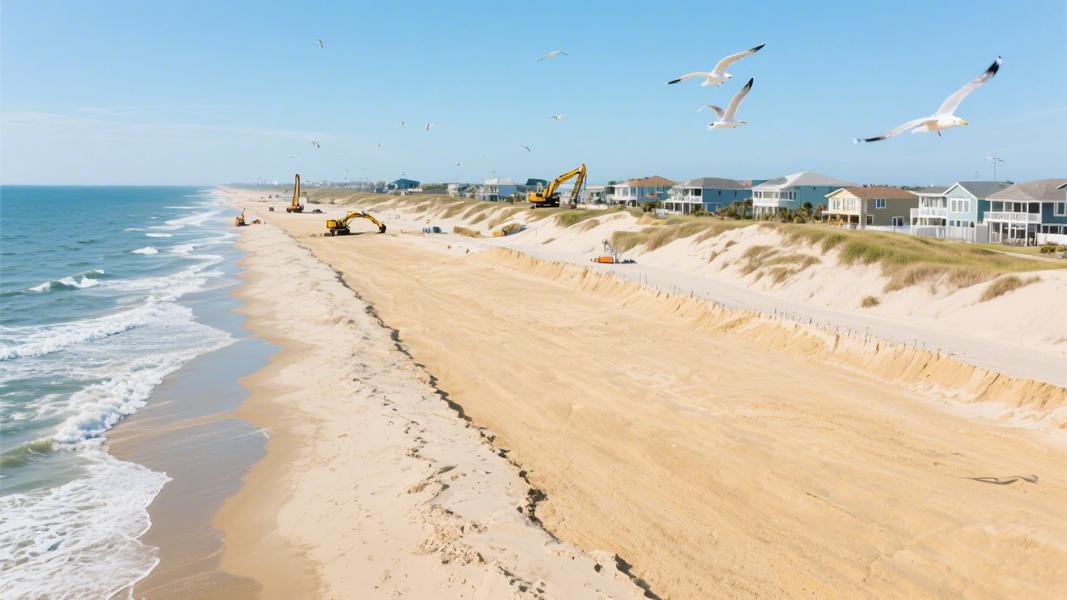
Galveston’s West Beach gets massive sand replenishment as erosion protection project wraps up
Nearly 400,000 cubic yards of sand restores vulnerable shoreline
West Galveston Beach has received a major facelift. Texas Land Commissioner Dawn Buckingham announced the completion of a significant beach nourishment project on February 17, 2026, that added hundreds of thousands of cubic yards of sand to combat coastal erosion on the island’s western shore.
The CAP 204 West Galveston Beach Nourishment Project — a partnership between the Texas General Land Office (GLO), City of Galveston, and U.S. Army Corps of Engineers (USACE) — placed 378,268 cubic yards of beach-quality sand along a 5,300-foot stretch from Sunbather Lane to Jane Road, just before Beach Access 12. The project utilized sand dredged from the Galveston Ship Channel in what officials call a “beneficial use” approach to channel maintenance.
“As a proud Texan who called Galveston Island home for more than a decade, ensuring West Galveston beach continues to thrive and is safeguarded from storms will always be a top priority,” Buckingham said in a statement. “I am proud of the work that’s been done by the City of Galveston and the U.S. Army Corp of Engineers.”
The project’s origins trace back to June 2025, when Galveston officials requested USACE assistance to address erosion concerns on the island’s west end. After completing a feasibility study that determined federal interest, the USACE Galveston District officially announced the project on July 15, 2025.
Building resilience against storms and erosion
Why does Galveston need so much sand? The island’s beaches face constant erosion from waves, storms, and rising sea levels — a growing concern for a community that relies on its shoreline for both tourism and storm protection.
Carlos Tate, USACE Galveston District Project Manager, explained the value of such projects: “These beach nourishment projects are a very standard USACE practice for slowing down the natural process of erosion along beachfront and coastal areas. They’re also a great way for local communities to benefit from the work we’re already doing through routine maintenance.”
Construction, overseen by Great Lakes Dredge and Dock Company, began in September 2025. The project reached a significant milestone when the GLO announced the addition of over 93,000 cubic yards of sand in a progress update prior to completion.
The scale of the project, while impressive, isn’t unprecedented for Galveston. A previous nourishment effort in 2017 placed over 1 million cubic yards of sand along nearly 4 miles of shoreline at the Galveston seawall at a cost of approximately $18.67 million, according to records.
USACE Galveston District Public Affairs Chief Carlos Gomez highlighted the dual benefits of such projects. “These ‘beneficial use’ beach nourishment projects are environmentally and economically responsible ways to use the dredged material from our routine maintenance to benefit local communities,” Gomez noted. “They also improve eroded coastlines by adding more buffer zones to protect our coastal communities against severe storms.”
City officials expressed gratitude for the state and federal partnership. “The City of Galveston is grateful for the working relationship we have with the Texas General Land Office and Commissioner Buckingham,” said Byron Maxwell, Galveston City Manager. “We look forward to many more projects such as this to improve our beaches for both our residents and all Texans.”
For Commissioner Buckingham, who previously lived on the island, the project represents both personal and professional commitment. “Preserving its beautiful shorelines is a mission that is dear to my heart and essential for the future of the island’s vibrant coastal community,” she remarked during the project’s progress. “At the GLO, we will continue to combat encroaching erosion and fortify the Texas coast from damage caused by tropical storms and hurricanes.”
