
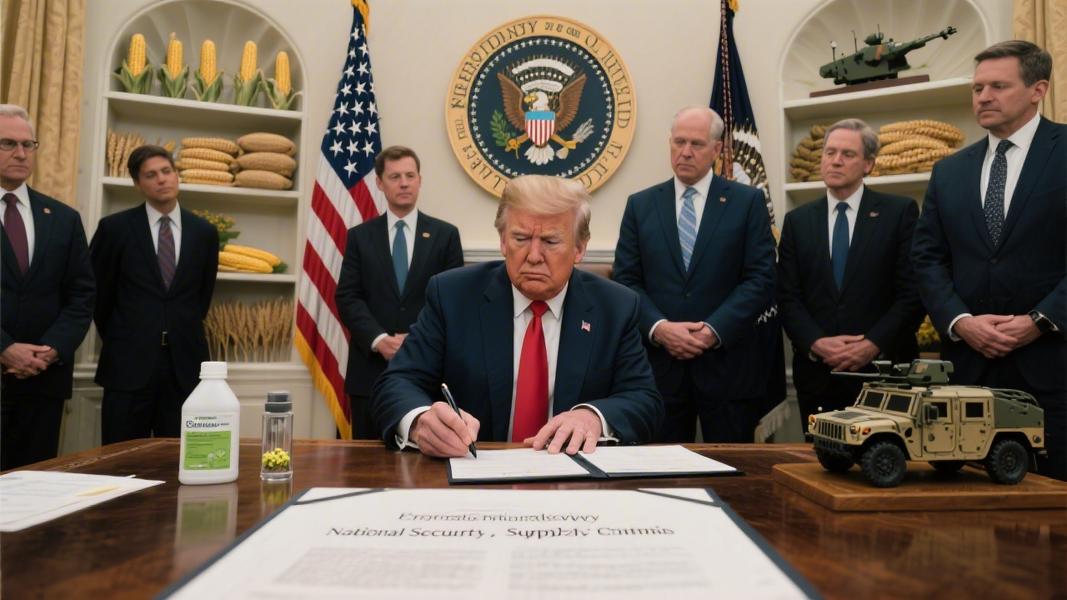
President Trump invoked the Defense Production Act Wednesday to secure domestic production of elemental phosphorus and glyphosate herbicides, declaring them critical to national security and America’s agricultural foundation.
The executive order, signed February 18, 2026, delegates authority to the Secretary of Agriculture to prioritize contracts and allocate materials necessary for ensuring continued supply of these products. The dramatic move comes amid growing concerns about America’s reliance on a single domestic producer for materials deemed essential to both military operations and food security.
“Today, President Donald J. Trump signed an Executive Order mobilizing the Defense Production Act to protect domestic production of elemental phosphorus and glyphosate-based herbicides — two critical inputs essential to military readiness and America’s agricultural strength, respectively,” the White House announced in a fact sheet released alongside the order.
Military Applications and Agricultural Necessity
Why phosphorus? The element serves multiple defense applications that might surprise many Americans. It’s a crucial component in smoke screens, illumination devices, and military incendiaries. Beyond battlefield applications, phosphorus is integral to semiconductors used in radar systems, solar cells, sensors, and various optoelectronics vital to modern defense infrastructure. The White House also highlighted its importance in lithium-ion battery chemistries that power numerous weapons systems.
On the agricultural front, glyphosate-based herbicides — which also depend on elemental phosphorus for production — remain the most widely used crop-protection tools across American farms. These herbicides enable efficient food production and help ensure “the availability of healthy, affordable food options within reach for American families,” according to the administration’s statement.
Supply Vulnerability
The order comes at a critical juncture. The United States currently has only one domestic producer of elemental phosphorus and glyphosate-based herbicides — reportedly Mosaic, whose stock has surged 22.21% year-to-date following the announcement, according to market analysis.
That’s the problem. With U.S. needs far exceeding current domestic output, the White House expressed grave concern that any interruption to this limited supply chain “could leave our defense industrial base and food supply vulnerable to hostile foreign actors,” as noted in the order.
Under the executive order, the Secretary of Agriculture will work in consultation with the Secretary of War to determine proper allocation of these materials and ensure production meets national defense requirements. The order grants authority “to require the performance of contracts or orders related to these materials to promote the national defense.”
The move represents one of the most significant uses of the Defense Production Act during Trump’s current term, extending its reach beyond traditional defense manufacturing into agricultural supply chains — a reflection of how modern security concerns increasingly blur the lines between military readiness and food security.
Still, questions remain about the long-term solution to America’s phosphorus dependency. While the DPA provides immediate tools to secure production, it doesn’t address the fundamental vulnerability of relying on a single domestic producer for materials deemed critical to national security.
For farmers across America’s heartland, the executive order offers some reassurance that their primary weed control method won’t suddenly disappear. For defense planners, it provides breathing room to address supply chain vulnerabilities that have grown increasingly concerning in recent years.
