
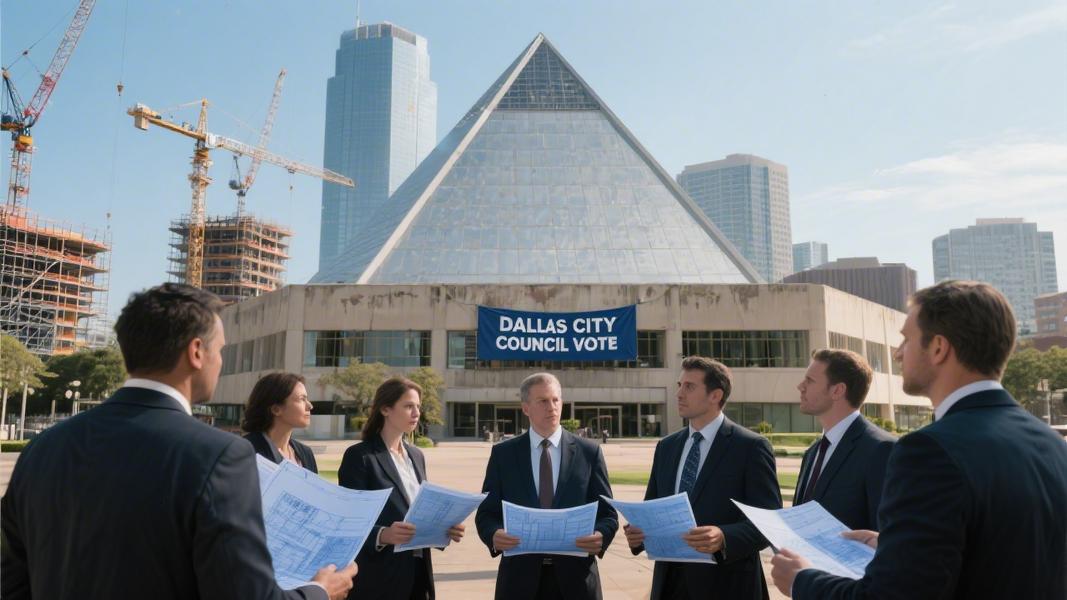
Dallas may be ready to walk out on one of its most iconic buildings — and the price tag for staying might be what finally slams the door. The city is now staring down a repair bill that could stretch past $1 billion, forcing a reckoning over the future of its landmark I.M. Pei-designed City Hall.
On February 23, the Dallas City Council’s finance committee voted unanimously to advance preliminary steps toward vacating City Hall — a 47-year-old architectural centerpiece that, by most accounts, is quietly falling apart. The moves include relocating 911 and 311 operations and other city staff while the city explores what, exactly, it wants to do with the site. A full council vote is scheduled for Wednesday, March 4.
How Did We Get Here?
The short answer: decades of deferred maintenance on a building that was never cheap to begin with. A new report from the Dallas Economic Development Corporation and engineering firm AECOM puts the full 20-year modernization cost at somewhere between $906 million and $1.14 billion — a number that includes $329 million in urgent repairs that are so serious, the building would need to be vacated just to complete them. That’s before anyone touches a light switch or replaces a ceiling tile for aesthetics.
The specifics are jarring. According to reporting on the AECOM breakdown, the facility needs roughly $211.4 million in HVAC, electrical, plumbing, and elevator upgrades alone. Structural work and garage repairs add another $61.5 million on top of that. And then there’s the asbestos — a not-so-small detail that makes simply working around the problems essentially impossible.
Relocating staff during any renovation scenario would cost an additional $133 million to $205 million, the report estimates. Factor in financing over two decades, and earlier projections of $152 million to $345 million start to look almost quaint.
Preservationists Are Alarmed
Not everyone is ready to write the building off. Sarah Crain of Preservation Dallas didn’t mince words when the new figures landed. “I was shocked to see the $1 billion number,” she said — and that reaction captures something real. Pei’s inverted-pyramid design, completed in 1978, isn’t just a city office building. It’s a piece of architectural history, the kind of structure that doesn’t get rebuilt once it’s gone.
But it’s not that simple. Sentiment doesn’t fix corroding pipes or aging electrical systems. And the gap between what preservation advocates want and what taxpayers can stomach is, at this point, measured in the hundreds of millions.
A Call for Transparency
Still, at least one council member wants to slow down before any irreversible decisions are made. Council Member Omar Bazaldua has been vocal about the need for more rigorous financial analysis. “Before we even consider abandoning City Hall, we should demand a truly apples-to-apples 20-year financial comparison, refined cost estimates, and an independent third-party validation,” Bazaldua said. It’s a reasonable ask — and one that reflects real anxiety about whether the city is being handed a complete picture or just the most convenient one.
The Dallas Economic Development Corporation’s report does represent the most comprehensive cost analysis the city has commissioned, but Bazaldua’s concern — that the numbers haven’t been stress-tested against a truly independent review — isn’t unfounded. Big infrastructure decisions made under fiscal pressure have a way of looking different in hindsight.
What Comes Next
The March 4 vote won’t be the final word on City Hall’s fate — but it could set the trajectory. If the council moves forward with vacating the building, the question of what replaces it, or what gets done with the land, opens up an entirely separate and politically charged conversation about downtown Dallas development and the city’s long-term identity.
For now, the estimates have done their job — they’ve made staying uncomfortable. Whether leaving turns out to be any better is a question Dallas hasn’t fully answered yet.
A billion-dollar building problem is easy to walk away from on paper. Walking away from a piece of the city’s soul is something else entirely.
