
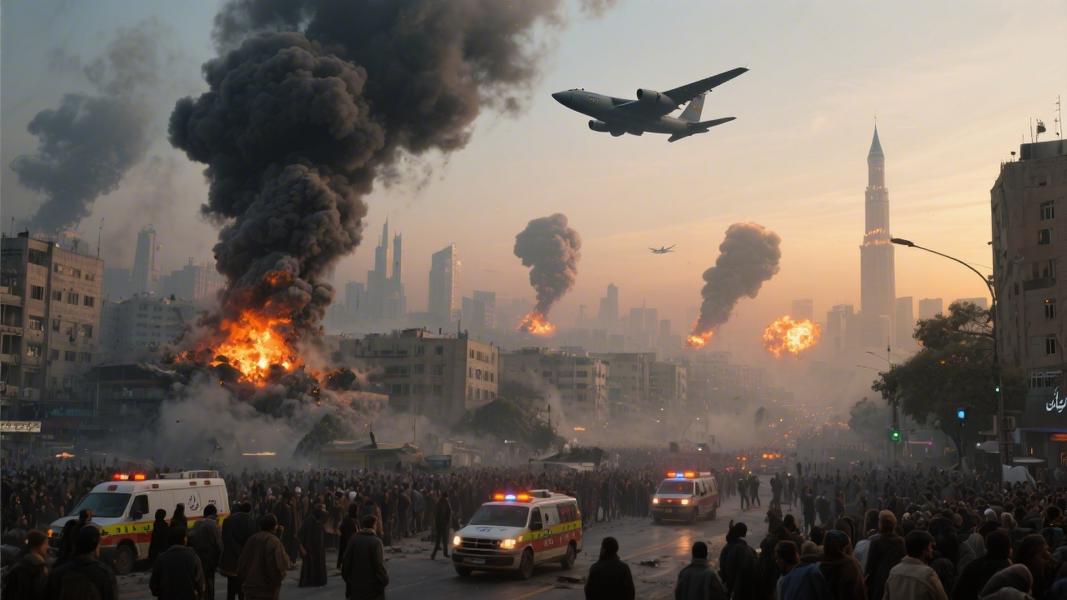
The Middle East woke up to a different world on Saturday. In the early hours of February 28, 2026, the United States and Israel launched coordinated military strikes against Iran — targeting nuclear facilities, ballistic missile infrastructure, radar systems, and, in a move that sent shockwaves through the region, sites associated with the Iranian leadership itself.
The operation, which the Trump administration has dubbed “Operation Epic Fury,” marks one of the most significant military escalations in the Middle East in decades. It didn’t come entirely out of nowhere. Iran had been teetering — economically hollowed out, internally restless, and facing months of pointed warnings from Washington. But the scale of what unfolded Saturday morning still caught much of the world off guard.
Trump Makes It Official
President Donald Trump broke the news himself, as has become custom, through a social media statement. Bluntly, he declared: “A short time ago the United States military began major combat operations in Iran.” No diplomatic throat-clearing. No hedging. Just that.
He followed up with a broader statement confirming the scope of the mission. The US, Trump said, was “undertaking a massive and ongoing operation to prevent this very wicked, radical dictatorship from threatening America and our core national security interests.” The framing was unmistakably Trumpian — but the military reality behind it was anything but rhetorical.
What Was Hit — and Why It Matters
The targets weren’t random. Nuclear facilities topped the list, reflecting the central anxiety that’s driven US-Iran tensions for years: the fear that Tehran is inching — or sprinting — toward a viable nuclear weapon. Alongside those, ballistic missile sites and radar installations were struck, effectively trying to blind and defang Iran’s offensive capabilities in a single, sweeping campaign.
That’s an enormous military undertaking. And it raises an obvious question: what comes next?
Iran’s Supreme Leader wasted little time answering, at least in tone. State media carried a defiant vow of a “crushing response” — language that, while predictable from Tehran’s playbook, carries genuine weight given the country’s arsenal of proxies, missiles, and regional leverage. Whether that response materializes as rhetoric or rockets remains to be seen.
A Crisis Long in the Making
Still, it would be wrong to treat Saturday’s strikes as arriving from a clear sky. Iran had been unraveling for months before the bombs fell — its economy in freefall, its streets increasingly restive, its government facing pressure from within and without. The US had been signaling the possibility of military action for weeks, and a substantial American military buildup in the region had done little to disguise Washington’s intentions.
That context doesn’t make the strikes less consequential. If anything, it makes them more so. A regime under internal strain, now absorbing external military blows, is unpredictable in ways that a stable adversary is not. The calculus here is genuinely complicated — and anyone who tells you otherwise probably hasn’t thought it through.
Israel’s Role
Israel participated directly in the strikes, confirming what many analysts had long assumed: that any US military action against Iran’s nuclear program would be a joint operation, not a solo American venture. For Israel, the threat of a nuclear-armed Iran has been an existential red line for years. Saturday’s strikes represent the most dramatic expression of that concern yet — a line crossed, or depending on your vantage point, a line finally enforced.
How the broader region responds — from Hezbollah in Lebanon to Iranian-backed militias in Iraq and Yemen — will shape what this moment ultimately means. The first night of strikes is the headline. The weeks that follow are the story.
As one analyst might put it: the easy part is already over.
