
The United States and Israel launched a sweeping military assault on Iran in the early hours of Saturday, killing Supreme Leader Ayatollah Ali Khamenei and striking military installations across the country in what may be the most consequential act of American military force in a generation.
U.S. Central Command confirmed that Operation Epic Fury commenced at 1:15 a.m. ET on February 28, 2026, targeting Islamic Revolutionary Guard Corps command facilities, air defense systems, missile and drone sites, and key airfields. The operation was coordinated across multiple fronts and represented a dramatic escalation in U.S. and Israeli pressure on Tehran — one that has been building for years.
A Strike That Reached the Top
The death of Khamenei, who had led the Islamic Republic for more than three decades, sent shockwaves through the region within hours of the first strikes. President Donald Trump confirmed the Supreme Leader’s death in a statement that pulled few punches: “Khamenei, one of the most evil people in History, is dead. This is not only Justice for the people of Iran, but for all Great Americans, and those people from many Countries throughout the World, that have been killed or mutilated by Khamenei and his gang of bloodthirsty THUGS.” Israeli officials separately confirmed the Supreme Leader’s death, citing intelligence assessments.
Iranian state media, meanwhile, reported at least 201 people killed and more than 700 injured, according to figures from the Red Crescent. Those numbers, analysts cautioned, are likely to climb.
Strikes hit targets in Tehran, Isfahan, Qom, Karaj, and Kermanshah. Khamenei’s personal compound was described as heavily damaged. The operation didn’t just clip the edges of Iran’s military apparatus — it went for the center of gravity.
What Washington Says It Wants
The objectives, as outlined by President Trump, are sweeping: prevent Iran from acquiring a nuclear weapon, destroy its missile arsenal and production infrastructure, degrade its network of regional proxies, annihilate its naval capabilities, and — perhaps most strikingly — achieve regime change. That last goal puts this operation in rare company among declared American military objectives.
Treasury Secretary Scott Bessent framed it in blunter terms on social media, writing that Trump had “unleashed Operation Epic Fury on the brutal Iranian regime” and had “called for all combatants to put down their weapons and receive amnesty.” It’s an unusual move — offering a surrender window while the bombs are still falling — but it signals that Washington sees this as more than a punitive strike. They’re thinking about what comes after.
Hardware in the Water, Fire in the Air
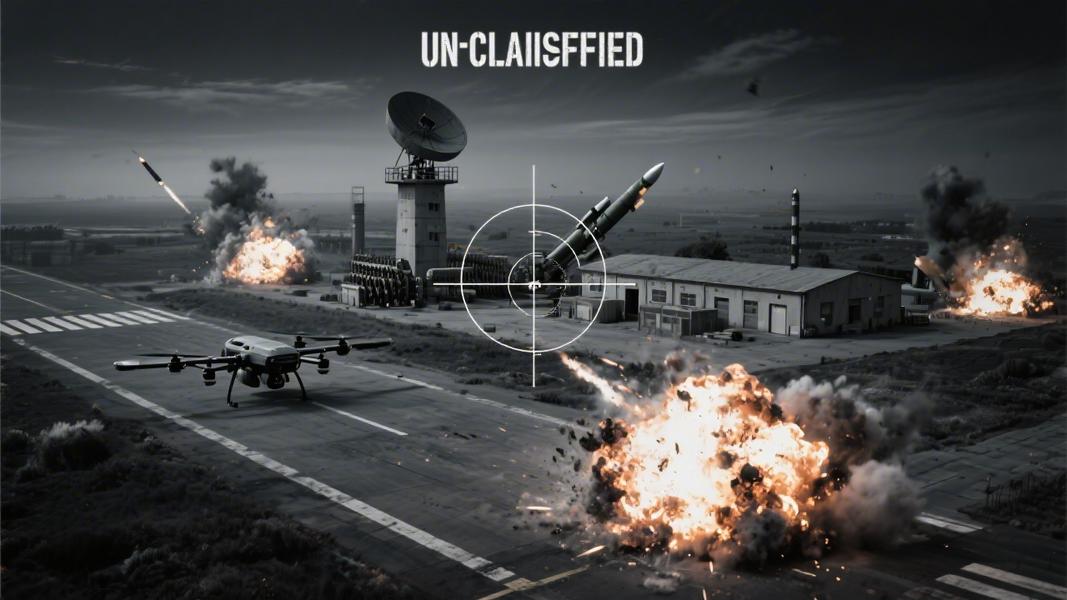
The military footprint is significant. The USS Spruance launched Tomahawk Land Attack Missiles from the Northern Arabian Sea, according to footage and video circulated by U.S. defense sources. Aerial imagery from CENTCOM showed precision strikes on a drone sitting on a runway, a radar tower reduced to rubble, a missile battery, and a building compound — each hit with the kind of clinical efficiency that’s become a signature of American air campaigns.
Still, clinical efficiency doesn’t mean clean consequences. Iran has already begun retaliating across the region. The U.S. Naval Institute noted that Tehran struck back swiftly, and the full scope of that retaliation is still unfolding as of this writing.
The Big Picture
How bad could this get? That depends on whom you ask — and where you’re standing. J.J. Green, a national security correspondent, put it plainly in a live broadcast Saturday morning: “This is a massive development. The U.S. and Israel carried out coordinated strikes on Iranian military and nuclear facilities around Tehran. And what we have been hearing as well is that the U.S. is intending, along with Israel, to take out the leadership of the Iranian government.” That intention, it now appears, has been at least partially realized.
But it’s not that simple. Removing a supreme leader doesn’t dissolve a state — and Iran’s Revolutionary Guard, its proxies in Lebanon, Iraq, Yemen, and Gaza, and its nuclear knowledge don’t disappear with one night of strikes, however devastating. The morning after a decapitation strike is often when the real complications begin.
What’s clear is that the Middle East woke up on Saturday to a fundamentally different strategic landscape. Whether Operation Epic Fury marks the beginning of the end for the Islamic Republic — or the beginning of something far harder to contain — is a question that no press release, however confident, can yet answer.
