
A FedEx driver convicted of kidnapping and killing a seven-year-old girl is now fighting for his life — and his lawyers are pointing to his brain.
In the penalty phase of Tanner Horner‘s capital murder trial in Texas, defense attorneys have mounted an aggressive campaign to spare him from the death penalty, presenting a portrait of a man shaped — and they argue, damaged — by forces beyond his control long before he ever crossed paths with Athena Strand. The six-year-old was abducted from her family’s home in November 2022 after Horner made a delivery there. Her body was found days later. He confessed. Now the only question left is whether he lives or dies.
A Brain Under Scrutiny
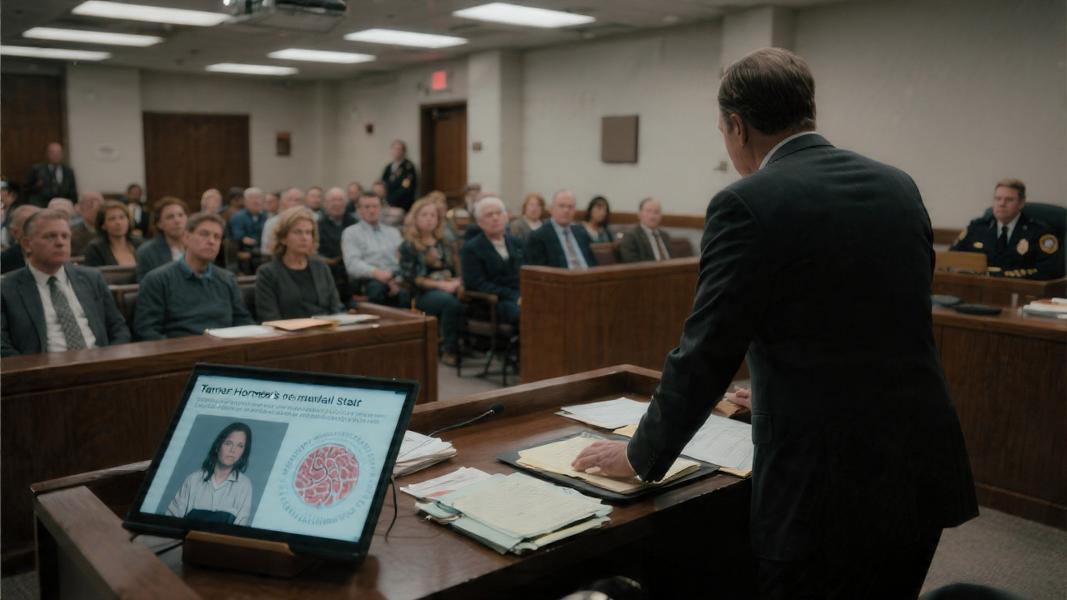
The defense’s central argument is stark: childhood lead exposure left Horner with measurable neurological damage, impairing the very architecture of his decision-making. It’s an argument that’s been used in death penalty cases before, with mixed results. Jurors tend to weigh it carefully — and skeptically. But Horner’s attorneys clearly believe the science is on their side, and they’ve spent considerable courtroom time trying to make that case stick.
Four medical experts took the stand to testify that Horner had significant underlying health and developmental issues that predated the crime by decades, documented in medical and psychiatric records stretching back to his early childhood. The picture they painted wasn’t of a calculating predator but of a person who had, in their telling, never quite been neurologically whole.
That’s a hard sell after a child is dead. But the defense pressed on.
Autism, Alcohol, and a Difficult Childhood
Beyond lead exposure, the defense highlighted a cluster of diagnoses and developmental challenges: autism spectrum disorder — formerly classified as Asperger’s syndrome — as well as fetal alcohol exposure. These weren’t framed as excuses, exactly. The strategy seemed more nuanced than that. Defense attorneys appeared to be building toward a broader argument: that Horner’s capacity for impulse control and moral reasoning was compromised in ways that should, at minimum, give jurors pause before sentencing him to death.
Fetal alcohol exposure in particular can cause lasting damage to the frontal lobe — the part of the brain most associated with judgment and self-regulation. Combined with lead toxicity and the cognitive challenges tied to autism, the defense argued, the result was a man who was, in a clinical sense, operating at a significant disadvantage from the very start.
A Mother’s Testimony
Then came the moment that likely hit the jury the hardest. Horner’s mother took the stand and described a son who had struggled his entire life — a child whose explosive meltdowns were dismissed as tantrums, who was bullied relentlessly, and who, in response, would hit his own head against surfaces in a kind of desperate, self-punishing spiral. She described the Asperger’s diagnosis that eventually gave a name to what the family had been witnessing for years.
She was emotional. She was, by multiple accounts, visibly shaken. And jurors, who had already sat through the prosecution’s evidence of what Horner did to a little girl, now had to sit with this too — the image of a small, struggling boy who grew into someone capable of something unthinkable.
Still, there’s a tension in all of this that no courtroom testimony can fully resolve. Difficult childhoods are tragically common. The vast majority of people who endure them — who carry lead in their blood, who grow up on the spectrum, who are bullied and misunderstood — do not abduct and kill children. The prosecution will lean on that reality, hard.
What Jurors Must Now Decide
The defense presented its case knowing the odds. Texas juries in capital cases are not easily moved by mitigation arguments, particularly in crimes involving children. The emotional weight in that courtroom runs in two directions simultaneously — toward the mother of the defendant and toward the family of the victim, who lost a daughter who was seven years old and had barely begun her life.
Jurors heard a mother describe her son being overwhelmed by the world around him, struggling to cope, struggling to belong. They’ve also heard what he did when Athena Strand opened the door.
In the end, the jury will have to decide whether the story of Tanner Horner’s damaged brain is a reason to spare him — or simply the explanation for how things went so terribly, irreversibly wrong.
