
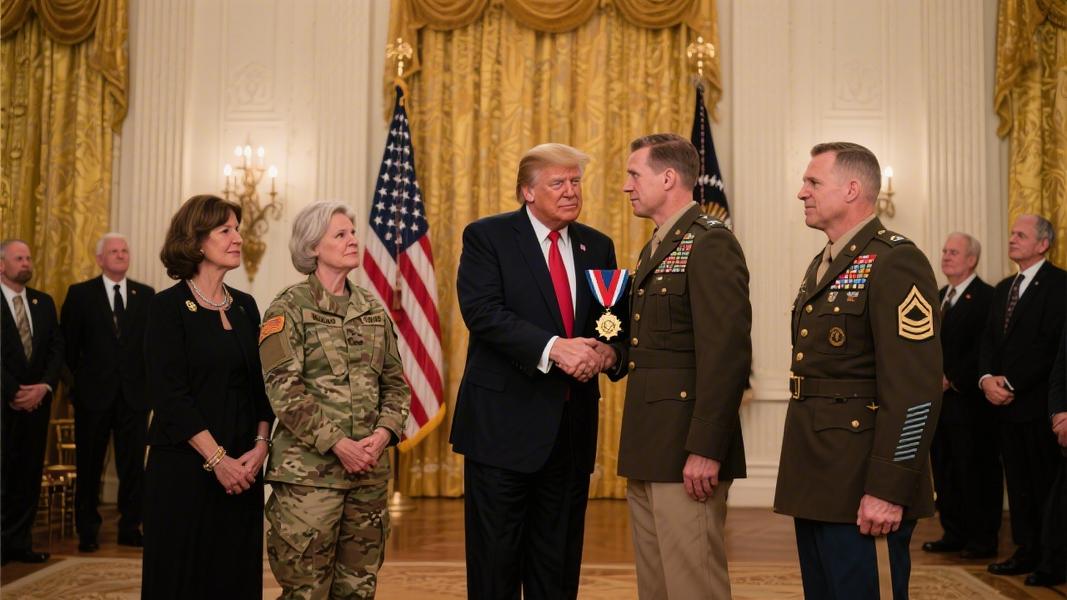
Three U.S. Army soldiers were honored Monday at the White House with the nation’s highest military distinction — two of them no longer alive to receive it themselves.
President Trump awarded the Medal of Honor to Master Sergeant Roderick W. Edmonds, Staff Sergeant Michael H. Ollis, and Command Sergeant Major Terry P. Richardson in a ceremony that underscored decades of battlefield sacrifice — from the snow-covered prison camps of World War II to the dusty outposts of Afghanistan. Two of the three recipients were honored posthumously, their medals accepted by family members who carried the weight of that moment for them. Fox 2 Detroit reported on the full details of the ceremony.
A Defiant Stand Behind Enemy Lines
Of the three stories told Monday, perhaps none was more striking than that of Roderick W. Edmonds. A senior noncommissioned officer held as a prisoner of war during World War II, Edmonds faced a Nazi commandant who demanded he identify and surrender the Jewish-American soldiers under his command. He refused. When the commandant pressed him the following morning at formation, Edmonds didn’t flinch. “We are all Jews,” he declared — putting his own life on the line to protect his men. It’s the kind of moment that doesn’t need embellishment. It speaks entirely for itself.
Twenty-Four Years Old. A Life Given for Another.
Then there’s Michael H. Ollis. He was just 24 years old when he died on August 28, 2013, at a combat outpost in Afghanistan. A suicide bomber had breached the perimeter, and Ollis made a split-second decision — he threw himself between the attacker and a Polish Army officer named Cierpica. He shot the insurgent. The vest detonated anyway. Ollis absorbed the blast and was killed. Cierpica walked away. That calculus — one life traded knowingly for another — is what the Medal of Honor was designed to recognize. It’s awarded, as noted in ceremony materials, for “conspicuous gallantry and intrepidity at the risk of one’s own life.”
Eighty-Five Men Who Made It Home
Command Sergeant Major Terry P. Richardson is the one soldier in Monday’s trio who lived to see the ceremony. On September 14, 1968, during a reconnaissance mission in Vietnam, his unit came under withering enemy fire. Richardson didn’t pull back. He pulled three wounded soldiers to safety, then called in air strikes with enough precision to turn the tide. By the end of that day, 85 fellow soldiers were alive because of what he did. Eighty-five. That number landed heavily in the East Room, and it should.
More Than a Ceremony
Still, Monday’s event carried an undercurrent that extended well beyond the medal presentations. A White House official confirmed ahead of the ceremony that Trump was expected to use the occasion to deliver his first live public remarks on Iran since the outbreak of hostilities — a geopolitical flashpoint that has consumed Washington in recent days. A Medal of Honor ceremony, then, serving double duty as a foreign policy moment. That’s Washington in 2025.
The Medal of Honor remains the United States’ highest military award — not handed out lightly, not awarded often, and never without a story behind it that most people couldn’t imagine living through. Monday’s ceremony honored three such stories, each separated by decades but bound by the same stubborn thread: ordinary men, extraordinary moments, and a refusal to look away when it mattered most.
Eighty-five soldiers made it home from Vietnam because of Terry Richardson. A Polish officer is alive today because of Michael Ollis. And somewhere in the history of American POW camps, Jewish soldiers survived a war because one man looked a Nazi commandant in the eye and said, simply, that they were all the same. That’s not mythology. That actually happened.
