
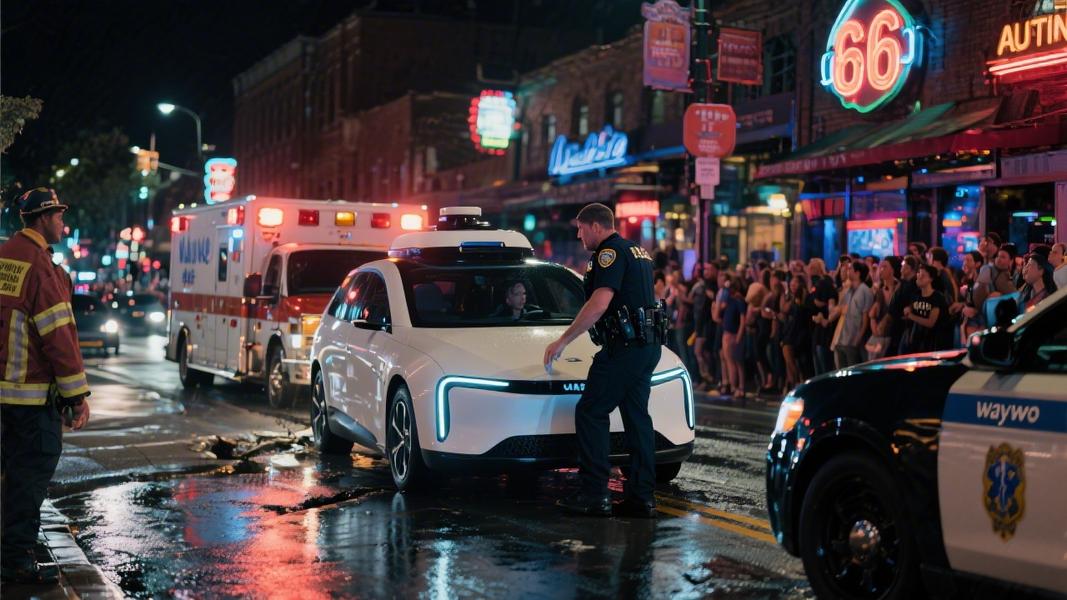
A Waymo robotaxi briefly blocked an ambulance racing toward a mass shooting on Austin’s 6th Street early Saturday morning — and it took a police officer stepping in to get the vehicle out of the way.
The incident unfolded around 1:59 a.m. outside Buford’s bar on West 6th Street, where a gunman opened fire into a crowd, killing two victims and himself and sending 14 others to the hospital. In the chaotic minutes that followed, a self-driving Waymo car ended up sitting perpendicular across the intersection at West 6th and Nueces Street — directly in the path of an oncoming ambulance. Video of the encounter, shared by Austin resident Matthew Turnage, spread quickly online and reignited a debate that cities across the country are only beginning to reckon with: what happens when autonomous vehicles meet real emergencies?
What the Video Shows
The footage is jarring in its mundanity. The Waymo isn’t speeding away or malfunctioning in any dramatic sense. It’s just… sitting there, idle and sideways, blocking the road while an ambulance waits. An Austin police officer eventually steps in to help clear the path. Waymo, for its part, said the vehicle had identified a road blockage and begun executing a U-turn before it “briefly yielded and was assisted by a nearby officer.” That’s a fairly clinical description of a moment that, visually, looks a lot more alarming.
The company added in a statement that it’s “dedicated to learning from this situation,” noting that its driver “operates in dense U.S. cities, smoothly navigating interactions with emergency vehicles at all hours.” Smooth, perhaps, until it isn’t.
The Shooting Itself
Let’s not lose the larger tragedy here. Three people are dead. The shooter — identified as Ndiaga Diagne — opened fire on the crowd before officers responded, returning fire and killing him. Fourteen others were hospitalized. It was, by any measure, one of the worst mass casualty events Austin has seen in years.
Austin EMS Chief Robert Luckritz said paramedics were on scene within 57 seconds of receiving the call — a remarkably fast response given the chaos of a late-night shooting on one of the city’s busiest entertainment corridors. “We had more than 20 assets, resources that responded to this event,” Luckritz said, adding that “in the grand scheme of the impact on the overall incident, we don’t believe it had any impact on patient outcomes.”
Does That Let Waymo Off the Hook?
Not entirely. Luckritz’s assurances are meaningful — 57 seconds is fast, and if EMS leadership says patient care wasn’t compromised, that carries weight. Still, the image of a driverless car stalling an ambulance at a mass shooting scene is the kind of thing that sticks. It doesn’t matter that the delay was brief. What matters is that it happened at all.
Authorities aren’t letting it slide, either. Officials have said they’re reaching out to Waymo to raise concerns about autonomous vehicle encounters during emergency responses — a conversation that’s probably overdue. Luckritz acknowledged that Austin EMS and its public safety partners “work very closely with the autonomous vehicle vendors that operate here in the city,” which suggests these interactions aren’t rare. They’re just usually not caught on camera at a shooting scene.
A Bigger Question Lurking Underneath
Here’s the thing about self-driving cars: they’re built to follow rules, and emergencies, by definition, break them. A human driver, confronted with an ambulance bearing down in the middle of a chaotic scene, makes a gut decision in a fraction of a second. A robotaxi runs a calculation. Sometimes those calculations are slower, or wrong, or produce a U-turn directly into an intersection where lives are on the line.
Waymo’s technology has logged millions of miles. Its safety record, in aggregate, is genuinely impressive. But Saturday morning in Austin is a reminder that averages don’t mean much to the paramedic who can’t get through an intersection. The question isn’t whether autonomous vehicles can handle normal traffic. It’s whether they’re ready for the moments when nothing is normal — and right now, that answer is still being written in real time, on real streets, with real consequences.
As Chief Luckritz put it, they don’t believe the Waymo incident affected patient outcomes. That may be true. But somewhere in Austin tonight, a family is grieving — and a driverless car is still out there, executing its algorithms, learning from the situation.
