
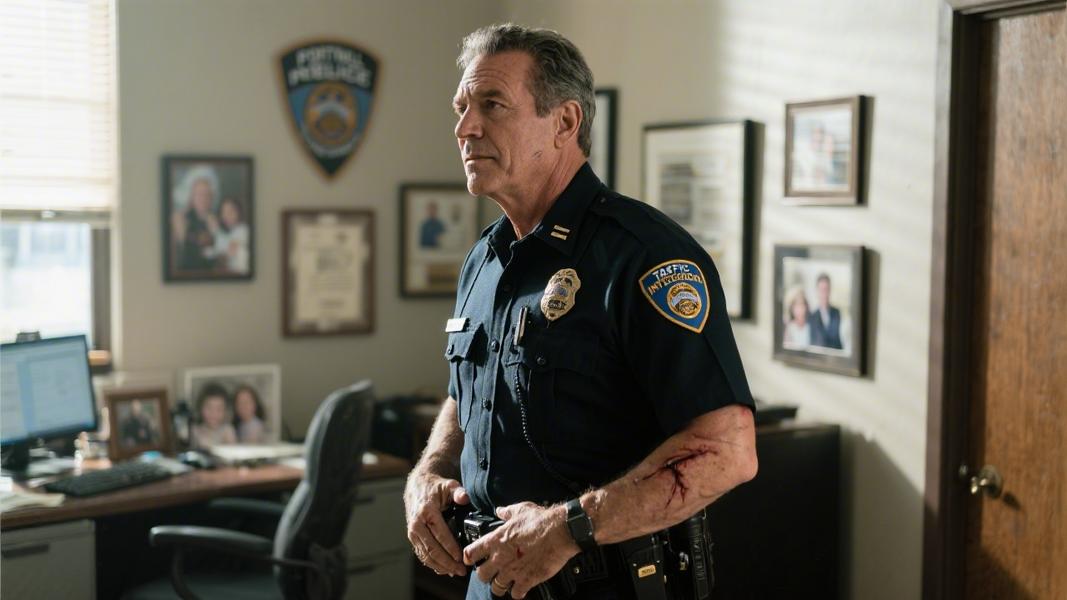
He was shot six times. One bullet hit him in the face, point-blank, in the dark, in the brush. He’s still here — and he went back to work.
Nearly a decade after one of the most harrowing officer-involved incidents in Fort Worth history, Detective Matt Pearce is reflecting on the ambush that should have killed him. On March 15, 2016, what began as a pursuit of a wanted fugitive ended in a wooded stretch near Vickery Boulevard and Bryant Irvin Road in rural West Fort Worth — with Pearce on the ground, bleeding from wounds to his arm, leg, back, and head, and a gunman standing over him. That the detective is alive to tell the story is, by any clinical measure, improbable. That he chose to return to the badge afterward says something else entirely.
From Traffic Stop to Ambush
The pursuit of Ed McIver, Sr. started as a vehicle chase before turning into a foot pursuit through dense woodland. Pearce, tracking the suspect’s movement, misjudged his position — and paid for it immediately. “All of a sudden, he pops back up and I see him pop back up and he shoots me literally like a movie scene and blows me backwards,” Pearce recalled. The moment, he’s said, unfolded with an almost surreal clarity. “I see the gun come up. And it’s so slow and so vivid that I can see the nose of that 9 millimeter bullet in the end of that barrel. And then that first round goes off.”
Six rounds struck him in total. Two in the arm. Two in the leg. One in the back. And then one more, delivered at point-blank range. “He basically walked up to me, put the gun to my head in the bushes, and pulled the trigger,” Pearce said. Body camera footage captured the incident — though Pearce has never watched it. He doesn’t need to. McIver, Sr. was killed in a subsequent shootout with officers. His son, Ed McIver, Jr., received two years of probation on a misdemeanor evading charge — no jail time — after Pearce himself testified at the trial.
The Wounds, the Surgery, the Odds
How bad was it? Doctors at the hospital reportedly told those close to Pearce that he shouldn’t have survived. Emergency room personnel documented multiple gunshot wounds upon arrival — bullets lodged in his chest and liver made him dangerously unstable en route to the operating room. A CT scan was performed in a narrow window before his condition deteriorated sharply. The surgery addressed his abdomen and chest. The recovery stretched across nearly two years.
The physical toll is permanent. “I’ve got some nerve damage in my right hand, walk with kind of a limp from some nerve damage in my right leg,” Pearce noted. But the visible injuries weren’t the only ones. “I think the biggest thing is when I came back to work, I was pretty angry about just what happened.” Therapy helped. So did time. Still, the memory hasn’t faded — and Pearce has made peace with that. “I don’t need video to remind me of what happened,” he said. “I remember it every single day.”
The Men Who Kept Him Alive
While Pearce lay in the brush, officers converged on the scene. Among the first to reach him was Jason Wilkes, now a gang unit commander with the Fort Worth Police Department. Wilkes stopped Pearce from bleeding out from the leg wound while Pearce — remarkably, improbably — remained conscious and was talking his fellow officers through how to treat him. Nine wounds across his body. One to the face. And he was giving instructions.
Miles away, his wife Laura Pearce was at home when breaking news interrupted the broadcast. A Fort Worth officer had been shot — life-threatening injuries. She described her first reaction as something closer to detachment than dread. “My first thought was not ‘oh my gosh it could be Matt’ — not even a thought at that point,” she said. “I don’t know if that was just like denial… the odds are it wouldn’t be him. There’s however many officers on duty at any given time.” That kind of math doesn’t comfort anyone for long.
Back to the Badge — By Choice
Here’s what makes Pearce’s story genuinely unusual: he didn’t have to come back. A medical retirement was on the table. Nobody would have questioned it — not after six gunshot wounds, two years of recovery, and permanent nerve damage. He came back anyway, taking a role as a traffic investigator. Off the clock, his world is his two daughters and their volleyball schedules. But the pull of the work never left.
“I’ve said since day one, if I had to go back and do this all over again knowing the outcome, I’d probably still do it because that’s the job,” Pearce explained. “It’s a calling. I would’ve never come back to it if I wasn’t completely passionate about it. I had no reason to. I could’ve walked away and medically retired and no one would’ve ever said a word to me about it. But that to me wasn’t why I was put on Earth. I was put here to do civil service.”
Ten Years On
As the ten-year anniversary of the shooting approaches in March 2026, Pearce has framed his survival in terms of faith as much as fortune. The medical explanations only go so far — bullets in the chest, the liver, the skull, and somehow none of them finished the job. For Pearce, there’s a reason for that. “It wasn’t done with me,” he’s said simply, speaking of his belief in God. “He wasn’t done with me.”
That’s not the kind of line a doctor can put in a chart. But for a man who looked down the barrel of a 9 millimeter in the dark and walked — limped — away, maybe it’s the only explanation that actually fits.
