
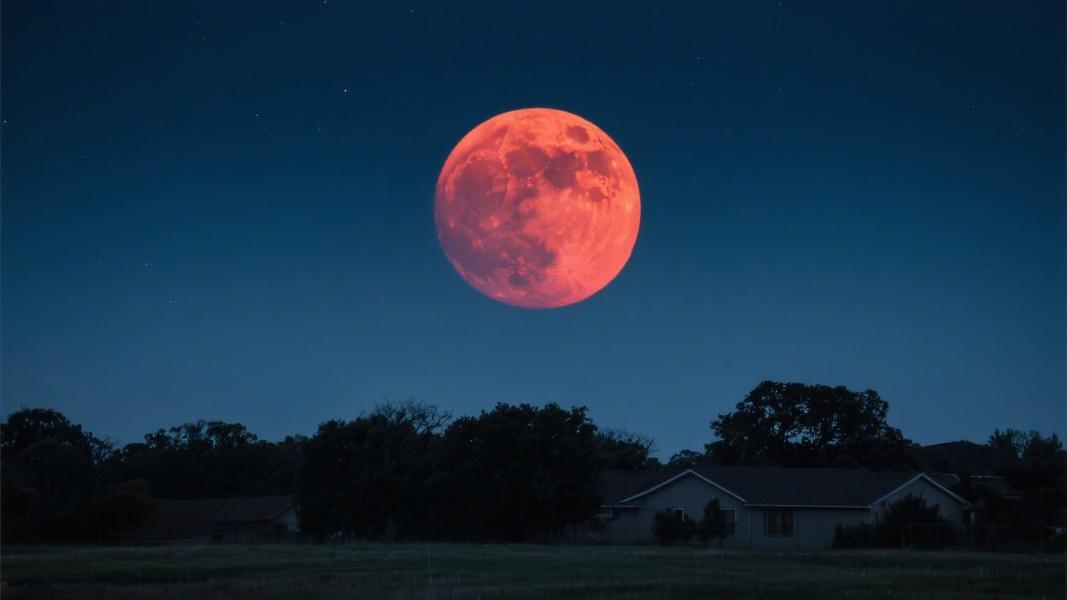
For a few hours before dawn on March 3, 2026, the sky over North Texas put on one of nature’s most quietly spectacular shows — and most people slept right through it. A total lunar eclipse, the kind that turns the moon a deep, unsettling shade of red, played out above the region from the early morning hours until nearly 7 a.m.
The event, widely referred to as a blood moon, drew amateur astronomers, photographers, and a handful of very tired night owls outside into the cold. It’s the sort of celestial moment that doesn’t require a telescope, a membership, or really anything except a clear sky and the willingness to set an alarm for an unreasonable hour. NASA confirmed the eclipse was fully visible to the naked eye — no equipment necessary.
What Actually Happened Up There
A lunar eclipse occurs when Earth slides directly between the Sun and the Moon during a full moon, casting its shadow across the lunar surface. The Moon doesn’t go dark, though. That’s the part people don’t always expect. Instead, it turns a vivid reddish-orange — the result of sunlight bending through Earth’s atmosphere and scattering across the Moon’s face. FOX 4 meteorologist Kylie Capps put it in terms that are hard to forget: the effect is like “the Earth projecting every sunrise and sunset in the world onto the moon at the same time.”
That’s not just poetic language. It’s essentially accurate physics. Every red and orange hue you’d see at the horizon during a sunrise or sunset anywhere on Earth — all of it, simultaneously — gets redirected onto the lunar surface. The result is that eerie, rust-colored glow that’s earned the blood moon its name.
The Timeline, For Those Who Kept Notes
In the Denton area — home to the University of North Texas — the eclipse began at 2:44 a.m. local time. Totality, the peak moment when the Moon sat deepest in Earth’s shadow, arrived at 5:33 a.m. with a magnitude of 1.150, meaning the Moon was well within the umbral shadow. The eclipse concluded at 6:57 a.m., giving the event a total runtime of 4 hours and 13 minutes for that location.
Zoom out to the full picture, and the numbers get even bigger. From the moment Earth’s penumbral shadow first touched the Moon to the moment it fully released it, the entire event spanned 5 hours and 39 minutes, with totality itself lasting 58 minutes. Not a brief cameo — a proper, lingering spectacle.
Watching It Live From Texas
Not everyone made it outside. Fortunately, the internet had it covered. Ray, the astrophotographer behind the popular Ray’s Astrophotography channel, launched a live stream from Texas beginning at 2:00 a.m. CST — a full 44 minutes before the eclipse even reached its first contact point. “The Blood Moon is here,” he announced at the start of the stream. “Join me LIVE from Texas as we watch the Total Lunar Eclipse unfold in real time.” Thousands did exactly that, watching from the warmth of their homes as the Moon slowly deepened into crimson.
Still, there’s something that a live stream can’t quite replicate — the strange, slightly disorienting experience of stepping outside at 3 a.m. and looking up to find the Moon looking wrong in the best possible way. Capps, who also covered the visual aftermath of the event, helped viewers understand why the colors look the way they do. For those who caught it in person, the explanation probably clicked the moment they looked up.
The Bigger Picture
Total lunar eclipses aren’t extraordinarily rare, but they’re not exactly routine either. The geometry required — Sun, Earth, and Moon in near-perfect alignment, with the Moon sitting inside Earth’s darkest shadow — has to be just right. When it works out, it works out spectacularly. No special glasses required, no risk of retinal damage, no gear beyond your own two eyes. Just a clear sky and a bit of patience.
For North Texas, the timing was demanding but not impossible. Early March, pre-dawn hours, temperatures that probably had most people reconsidering their life choices at 5 a.m. — and yet people showed up, set up tripods, opened laptops, and watched. Some things are worth losing a little sleep over. A moon that looks like it’s on fire might be one of them.
