
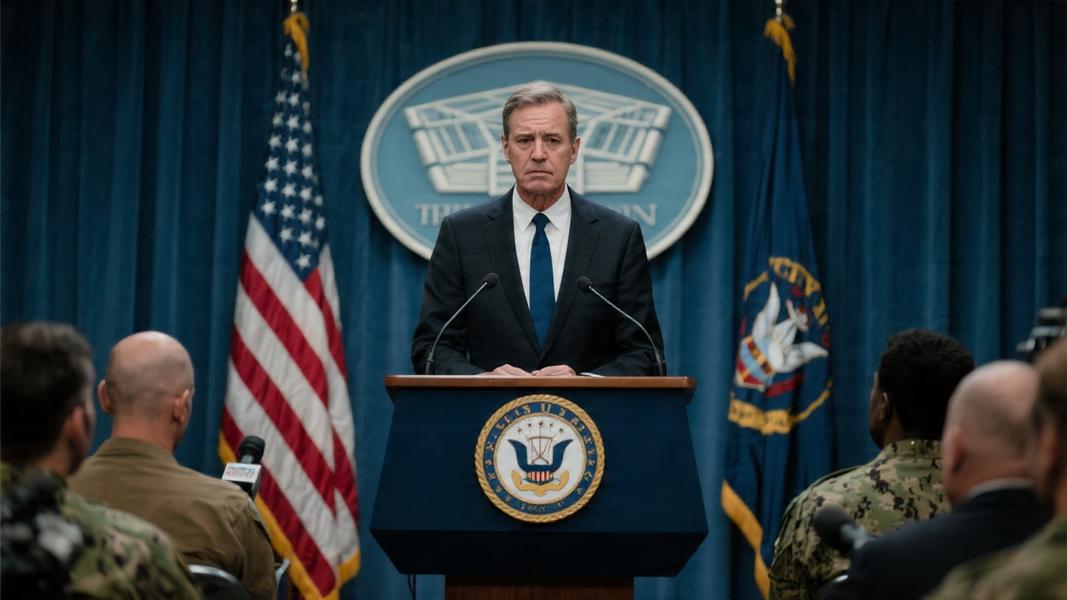
The Navy’s top civilian is out — and he’s not sticking around to clean out his desk. The Pentagon confirmed Friday that Secretary of the Navy John C. Phelan is leaving his post immediately, capping a tenure of barely over a year with an abrupt, no-frills exit.
Pentagon spokesperson Sean Parnell broke the news on social media, offering a brief but cordial farewell. “On behalf of the Secretary of War and Deputy Secretary of War, we are grateful to Secretary Phelan for his service to the Department and the United States Navy,” Parnell announced. The announcement offered no explanation for the timing, no transition period, and no indication of what comes next for Phelan himself.
Undersecretary Hung Cao will step into the role of Acting Secretary of the Navy, according to the same statement. It’s a significant responsibility — the Navy oversees nearly one million personnel and commands a staggering $263.5 billion annual budget.
A Short, Turbulent Tenure
Phelan was sworn in as the 79th Secretary of the Navy on March 25, 2025 — confirmed by the Senate just one day earlier with what looked like a healthy bipartisan mandate: a vote of 62 to 30. That kind of margin, in today’s political climate, is practically a standing ovation. He was, by any measure, expected to have some runway. He didn’t get it.
Early in his tenure, Phelan moved aggressively on cost-cutting. In April 2025, he ordered the termination of hundreds of millions of dollars in IT contracts and unrelated grants — a move aligned with the broader DOGE-era push to slash what the administration called wasteful spending. It was the kind of decisive action that tends to earn points inside the building. He was praised in some corners for it.
But it’s not that simple. A shadow had been hanging over Phelan since February, when CNN reported that his name appeared on a passenger manifest for Jeffrey Epstein’s private jet — a flight from London to New York City on March 3, 2006. The revelation put Phelan in a deeply uncomfortable club of public figures whose past associations with the disgraced financier have resurfaced at professionally damaging moments. Whether that disclosure played any role in Friday’s departure, the Pentagon isn’t saying.
Questions Without Answers
So what actually happened here? The Pentagon’s terse announcement — “effective immediately,” full stop — is the kind of language that raises more questions than it answers. Senior Cabinet-level officials don’t typically vanish overnight without a reason, even if that reason never makes it into the press release. Phelan’s office has not issued a statement of its own, at least not yet.
What’s clear is that the U.S. Navy now finds itself in a leadership transition at a moment of considerable geopolitical complexity, with Hung Cao taking the wheel in an acting capacity. Cao, a retired Navy captain and former Virginia congressman, has the background — but acting roles carry their own limitations, and the service branches have learned the hard way that extended vacuums at the top can have real operational consequences.
Still, the Pentagon appears to be projecting calm. The announcement was clean, the handoff was named, and the gratitude was expressed. In official Washington, that’s sometimes all you get.
Phelan arrived with bipartisan goodwill, a sharp cost-cutting mandate, and what seemed like institutional momentum. He’s leaving without so much as a farewell press conference — a reminder that in this town, tenures are measured not just in months, but in moments you can’t always see coming.
