
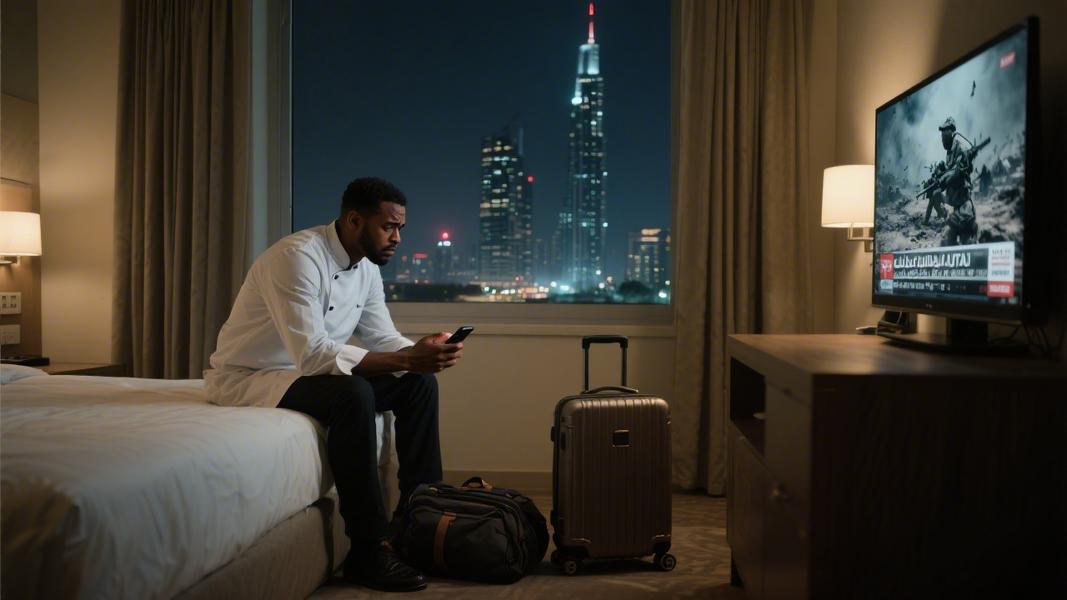
A Dallas chef is holed up in a Doha hotel room, listening to missile interceptions echo outside his window, trying to figure out how to get home. He came for a birthday party. He stayed for a war.
Odies Turner, a chef based in Dallas, Texas, traveled to Qatar last Friday to celebrate a friend’s 30th birthday. By Saturday, he was trapped. The US-Iran war — which began with American and Israeli strikes on February 28, 2026 — had transformed the region overnight, grounding flights, closing airspace, and leaving hundreds of American civilians stranded with little clarity on how or when they’d make it back.
Sirens in the Night
Turner described the moment the conflict became viscerally real. He and others were outside when the alerts hit. “Alert started going off on our phones,” he recalled. “The warning system started to blare. And so, it was like, okay, we should get back in. And when we got back in, that’s when we started to hear the interceptions for the missiles.” Not exactly the birthday weekend anyone had planned.
Since then, he’s been sheltering in his hotel — one of hundreds of Americans now scattered across the Middle East with no clear path out. Major carriers including Qatar Airways have suspended routes amid sweeping airspace closures, leaving travelers in a logistical nightmare. The US government, Turner says, hasn’t exactly rushed to help. “Right now, we’re not being supported,” he said. “There’s no support from the American government. If there is, I haven’t seen it.”
A Seven-Hour Gamble
So what do you do when the flights are gone and the embassies aren’t calling back? You improvise. Turner has been coordinating with other stranded travelers through WhatsApp, piecing together a plan to make a seven to eight-hour overland drive into Saudi Arabia — and from there, catch whatever flight he can find out of Riyadh. “I’ll take this seven to eight-hour drive across the border into Saudi and potentially get on a flight in Riyadh and fly,” he explained. “I know there are flights to Cairo, Egypt.” It’s a long way home from Cairo to Dallas. But it’s something.
The situation reflects a broader reality that’s settled over the region since the conflict erupted on February 28. American civilians who were in the Middle East for business, tourism, or, yes, birthday celebrations, now find themselves navigating a warzone with commercial travel largely paralyzed and official government evacuation channels — if they exist — moving at a pace that apparently hasn’t reached a hotel in Doha yet.
Washington’s View From 30,000 Feet
Meanwhile, back in Washington, the tone is considerably more triumphant. Defense Secretary Pete Hegseth, describing the operation now dubbed “Operation Epic Fury,” didn’t mince words: “America is winning decisively, devastatingly, and without mercy,” he declared. The operation, officials say, has been targeting Iran’s missiles, drones, naval assets, and what the administration describes as the country’s nuclear pathway.
The military metrics do appear significant. General Dan Caine noted that Iran’s ballistic missile launches had dropped by 86 percent compared to the first day of the conflict — a figure the Pentagon has pointed to as evidence that the campaign is systematically degrading Iran’s offensive capabilities. That said, degraded doesn’t mean silent. The interceptions Turner heard from his hotel room suggest the skies over the Gulf are still anything but quiet.
President Donald Trump has framed the strikes as a matter of urgent necessity, claiming Iran was within one month of possessing a nuclear weapon — a timeline that contradicts assessments from most international nonproliferation experts. It’s a justification that will almost certainly be debated long after the last missile is fired.
The Human Arithmetic of War
There’s a version of this story that gets told in briefing rooms and on cable news — maps, percentages, operational objectives. And then there’s the version Odies Turner is living: a hotel room, a phone full of WhatsApp messages, and a very long drive to a border crossing he wasn’t planning to see this week.
Both versions are true. That’s usually how it goes.
As of now, Turner hasn’t made it out. Whether he gets to Riyadh, whether there’s a seat on a flight to Cairo, whether he eventually lands back in Dallas — none of that is certain yet. What is certain is that for the hundreds of Americans currently stranded across the region, Operation Epic Fury is less a headline than a set of circumstances they’re quietly trying to survive. “If there is support,” Turner added, “I haven’t seen it.” Sometimes the most damning sentences are the quietest ones.
