
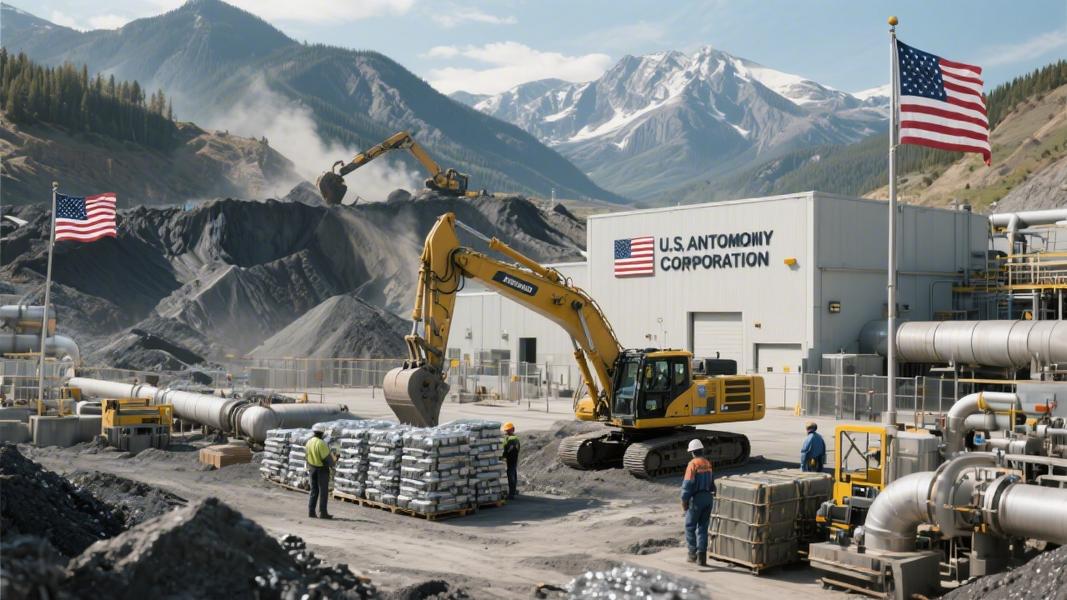
Washington is done waiting on foreign suppliers for one of its most strategically critical minerals — and it’s putting serious money where that resolve is.
The Department of War announced on February 24, 2026, that it had invested $27 million in Defense Production Act Title III funds into U.S. Antimony Corporation (USAC), targeting domestic extraction, processing, and refinement of antimony across facilities in Montana and Alaska. The move is part of a broader push to rebuild American supply chains for materials deemed essential to national defense — and antimony, long overlooked by the general public, sits squarely at the center of that effort.
Why Antimony, and Why Now
Antimony isn’t a household name. But it shows up in flame retardants, ammunition primers, batteries, and a range of defense-critical applications that the U.S. military can’t simply do without. For years, the country has leaned heavily on overseas sources — primarily China — to meet that demand. That dependence has become increasingly uncomfortable as geopolitical tensions sharpen.
“For too long, DOW has depended on overseas sources for its critical mineral production,” said Mike Cadenazzi, Assistant Secretary of War for Industrial Base Policy, in a statement accompanying the announcement. It’s a candid admission from a senior official — and a signal that the urgency here is real, not ceremonial.
The $27 million will fund modernization of USAC’s Thompson Falls, Montana facility, which has already ramped its monthly processing capacity from 100 tons to 300 tons following the installation of new furnaces that came online in January 2026. The federal grant operates on a reimbursement basis, meaning USAC fronts costs and recovers them — a structure that puts some skin in the game for the company, not just the government. Separately, the investment also supports new excavation work in Alaska, advancing what the company calls a vertically integrated supply chain, from the ground up.
The Dollars Behind the Strategy
The $27 million grant, significant on its own, is really just the opening act. USAC has secured a $248 million contract with the Department of War for antimony ingots — a figure that would represent a dramatic transformation for a company that posted roughly $39 million in revenue in 2025. Projected 2026 revenue now stands at $125 million, a guidance figure the company recently raised by $25 million.
How fast did this all come together? Remarkably fast, by any standard. “Paul and I only met 45 days ago and cut the deal, signed it, and announced it on Fox News two weeks ago. We’re very excited,” a company representative disclosed at the 35th BMO Conference. That kind of timeline — 45 days from introduction to a nine-figure federal contract — speaks to the urgency with which the Pentagon is moving on critical minerals. Whether it also raises questions about due diligence is a conversation worth watching.
On the operational side, USAC has reported hauling over 250 tons of stibnite ore to its flotation mill, staking 102 federal claims in Montana, and confirming that its material meets military primer specifications. That last detail matters enormously — it’s one thing to mine and refine antimony; it’s another to have it certified for use in weapons systems. USAC appears to have cleared that bar, at least according to the company’s own updates.
USAC Isn’t the Only Player
Still, the Department of War isn’t betting everything on a single company. Nova Minerals has also entered the picture, receiving a $43.4 million Defense Production Act award aimed at bringing military-grade antimony production online by 2026 or 2027. Nova’s leadership has been direct about its positioning in this emerging domestic supply chain. “The objective is that the Department of War is looking for a company to take the bull by the horns, bring this production back to the U.S.,” an executive stated recently. “We’ve been a first mover in that space.”
That framing — first mover, strategic positioning, government-backed contracts — is language that will resonate on Wall Street as much as it does in the Pentagon. Both companies are now operating at the intersection of defense policy and capital markets, a space that tends to attract as much scrutiny as it does investment.
The Bigger Picture
Jeffrey Frankston, Acting Deputy Assistant Secretary of War for Industrial Base Resilience, put the stakes plainly: “Strong domestic mineral supply chains are essential to support our warfighting capability.” It’s a line that could easily be dismissed as boilerplate — except that the dollars attached to it suggest otherwise.
But it’s not that simple. Rebuilding a domestic antimony industry from near-zero is a multi-year, multi-billion-dollar project. The investments announced so far are meaningful, but they’re a start, not a finish line. Infrastructure takes time. Permitting takes time. Scaling industrial operations to meet military demand — reliably, consistently, at spec — takes time. The government seems to understand this, which is why it’s moving on multiple fronts simultaneously, with DPA Title III as its primary lever.
What’s clear is that antimony has gone from an obscure metallurgical footnote to a front-page national security priority, seemingly overnight. The question now isn’t whether the U.S. is serious about rebuilding this supply chain — the contracts and the cash make that plain enough. The question is whether the timeline is realistic, and whether the companies now carrying that mandate can actually deliver.
For the moment, Washington is choosing to find out.
