
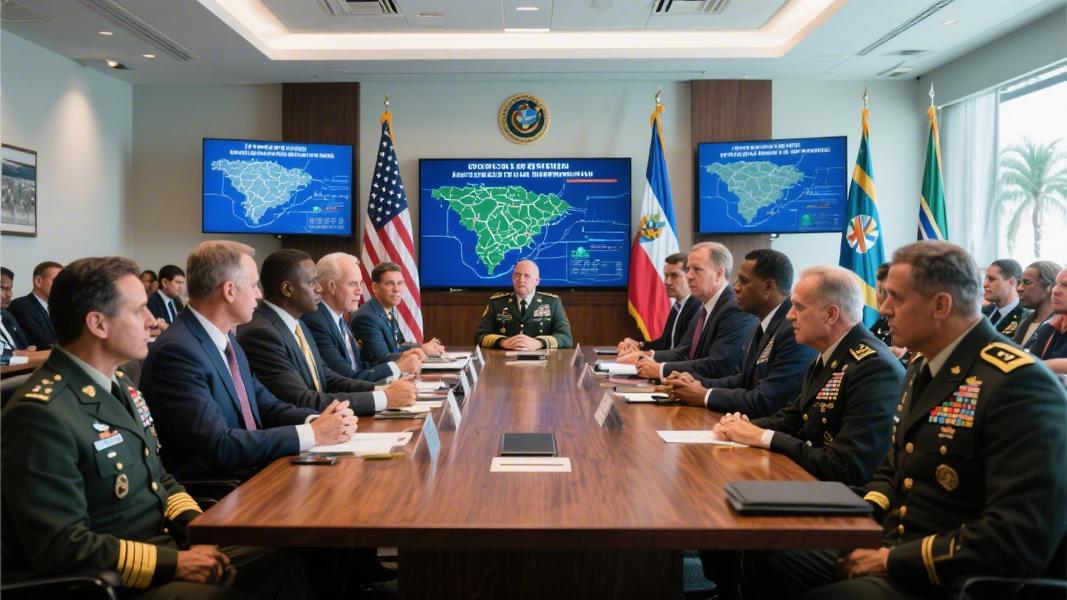
Pete Hegseth gathered defense ministers, security chiefs, and military commanders from across the Western Hemisphere in one room — and made clear the United States is done treating the cartel crisis as someone else’s problem.
On March 5, 2026, the Secretary of Defense hosted the inaugural Americas Counter Cartel Conference at U.S. Southern Command headquarters in Doral, Florida, bringing together representatives from 17 nations spanning the Caribbean, Central America, and South America. The result: a jointly signed security declaration and a pointed message that the fight against drug trafficking networks is now, officially, a hemispheric priority — not just a Washington talking point.
A Conference Built for the Moment
The choice of venue wasn’t accidental. Southern Command — known as SouthCom — sits at the operational heart of U.S. military engagement with Latin America and the Caribbean. Hosting the conference there, alongside SouthCom commander Gen. Francis L. Donovan, sent a signal about institutional commitment that a hotel ballroom in D.C. simply couldn’t. The Miami Herald noted the gathering was framed as an intensification of the broader fight against drug cartels — not a preliminary conversation, but a call to action.
Hegseth, for his part, seemed aware that a conference called the “Americas” Counter Cartel Conference — and not “America’s” — carried rhetorical weight. He leaned into it. “This conference is about you; this conference is about us,” he said, according to SouthCom. “This conference is not called the ‘America’s Counter Cartel Conference’; it’s the ‘Americas Counter Cartel Conference.'” The distinction matters — or at least, it was clearly meant to.
What the Conference Actually Covered
Beyond the declaration-signing and the optics, the agenda was substantive. Sessions focused on disrupting trafficking networks, coordinating cross-border intelligence, and building durable security frameworks between nations that don’t always share the same political headwinds. The U.S. Embassy in Peru highlighted the conference as a landmark step in regional cooperation — the kind of diplomatic-military alignment that’s easier to announce than to actually achieve.
That’s the catch. Signing a joint declaration is one thing. Sustaining the operational and intelligence-sharing commitments it implies — across 17 governments with 17 different domestic pressures — is another challenge entirely. Still, the fact that this many nations showed up and put their names on a document is, by any measure, a notable development.
The Broader Stakes
Why does this matter right now? Drug cartels operating across Latin America have grown increasingly sophisticated — not just in trafficking narcotics northward, but in corrupting institutions, financing armed groups, and destabilizing the very governments the U.S. is trying to partner with. The conference, as described in official readouts, directly targeted those structural threats: the trafficking networks, the cartel financing pipelines, the gaps in regional coordination that bad actors have long exploited.
Chief Pentagon Spokesman Sean Parnell confirmed the scope of the gathering in an official statement, describing it as a convening of defense and security leaders from across the Western Hemisphere — a characterization that undersells neither the ambition nor the logistical effort involved. Getting 17 countries into the same room, on the same page, is rarely as easy as the press release makes it sound.
The conference was framed internally as inaugural — meaning the expectation, at least from the U.S. side, is that it won’t be the last. Whether that momentum holds, or whether the joint declaration becomes another piece of paper filed away in a diplomatic archive, is the question that will define whether this week in Doral actually changed anything.
For now, 17 flags were in the room. That’s where it starts.
