
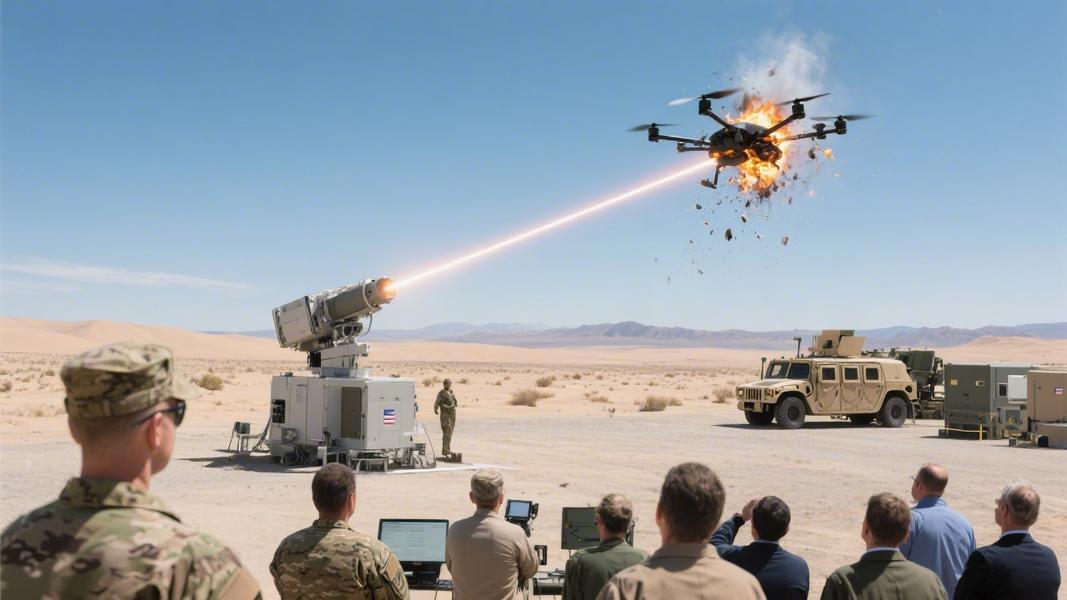
The U.S. military is preparing to fire a high-energy laser at drones over the New Mexico desert — and that’s just one piece of a sweeping counter-drone push that’s been quietly accelerating for months.
Joint Interagency Task Force 401, the Pentagon’s dedicated domestic counter-unmanned aerial systems command, is set to conduct a landmark laser weapons test this weekend at White Sands Missile Range, working alongside the Federal Aviation Administration in what officials describe as a critical step toward integrating advanced directed-energy systems into U.S. airspace defense. The test, scheduled for March 7–8, 2026, comes as JIATF-401 marks a surge of activity — rapid procurement, expanded authorities, and joint exercises — that signals just how seriously the Pentagon is now treating the drone threat at home.
A Laser Test Years in the Making
The White Sands test isn’t happening in a vacuum. It’s the product of a growing coalition of stakeholders — the FAA, Army Program Acquisition Executive-Fires, Northern Command, and Joint Task Force Southern Border — all working under the broader umbrella of the White House Task Force to Restore American Airspace Sovereignty. That’s a lot of agencies at the table, which tells you something about how complicated this problem has become. A senior defense official confirmed the test is moving forward even as senators have begun raising pointed questions about recent counter-drone incidents — a sign that political pressure is building alongside the technical ambition.
“This is a critical step in making sure our warfighters have the most advanced tools to defend the homeland,” said U.S. Army Brigadier General Matt Ross, Director of JIATF-401, in a statement accompanying the announcement. Ross has become the public face of America’s domestic counter-drone effort — and he’s been unusually candid about the stakes involved.
Six Months, $30 Million, and Counting
JIATF-401 officially marked six months since its establishment on February 27, 2026, and the numbers are striking. The task force has executed more than $30 million in rapid procurement actions under its Domestic Shield initiative — an aggressive acquisition push designed to get hardware into operators’ hands fast, not years from now. “From day one, our task was to close real gaps as quickly as we could,” Ross said in a statement marking the milestone. That sense of urgency hasn’t let up.
One of the most concrete examples of that speed: on January 30, 2026, JIATF-401 awarded Perennial Autonomy a $5.2 million agreement for its Bumblebee V2 kinetic counter-drone interceptor, with deliveries beginning in March. The pitch for the system is straightforward — neutralize threats without putting friendly forces or nearby infrastructure at risk. “On the modern battlefield, where drones are a constant threat, having a low-collateral kinetic option is not just an advantage, it is increasingly becoming essential,” Ross noted. It’s the kind of language that would’ve sounded alarmist five years ago. Today, it reads like a procurement memo.
Training, Testing, Exercising — All at Once
So how well-prepared are the people actually operating this equipment? Ross got a firsthand look on February 18, when he visited a JTF-NCR counter-small UAS exercise that simulated dozens of drone incidents, stress-testing eleven sensor systems and three separate mitigation devices. “The threats we face are constantly evolving, and exercises like this are critical to ensuring we stay ahead of our adversaries,” he stated during the visit. It’s a sentiment he returns to often — perhaps because it’s genuinely true, or perhaps because the pace of drone technology keeps making it more true every few months.
Training isn’t happening in silos, either. JIATF-401’s Joint Counter-Small UAS University, based at Fort Sill, Oklahoma, is collaborating closely with the FBI’s C-UAS center — a partnership that underscores just how much this mission blurs the line between military and law enforcement. Domestic airspace, after all, is civilian territory. That’s not a small legal and operational wrinkle.
Expanded Authorities, Expanding Mission
Still, the most consequential development may be less visible than a laser test or a multimillion-dollar contract. In January, the Pentagon quietly expanded JIATF-401’s counter-drone authorities beyond the fence line — giving commanders more flexibility to act against drone threats before they reach protected installations. It’s a significant shift in posture. “Drones are a defining threat for our time,” Ross said at the time. “Technology is evolving fast and our policies and C-UAS strategy here at home must adapt to meet this reality.”
Most recently, JIATF-401 launched a Commercial Solutions Opening for integrated counter-drone systems to support Task Force East, seeking sensors and effectors across four operational zones and six Infantry Squad Vehicles. The solicitation is a signal that the task force isn’t slowing down — it’s scaling up.
The Bigger Picture
What’s easy to miss, amid the procurement announcements and exercise reports, is how much ground JIATF-401 has covered in a remarkably short time. Six months ago, it didn’t exist. Today, it’s testing lasers, training with the FBI, arming soldiers with kinetic interceptors, and operating with authorities that extend past the wire. That’s a fast-moving institution for a fast-moving threat.
Whether it’s moving fast enough is a question senators are already starting to ask — and one that this weekend’s test at White Sands, in its own way, is designed to help answer.
