
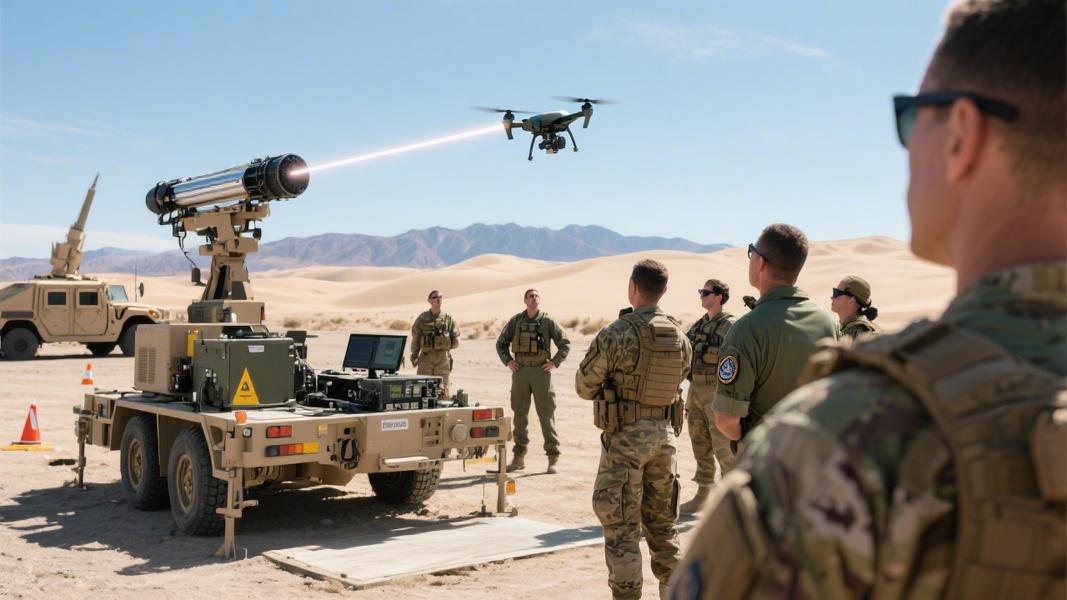
The Pentagon is pointing lasers at the sky — and not everyone is happy about it. As the U.S. military accelerates its push to neutralize rogue drones over American soil, a powerful new task force is moving fast, spending big, and occasionally hitting things it probably shouldn’t.
Joint Interagency Task Force 401, known as JIATF-401, has spent the past several months quietly reshaping how the United States defends its airspace against unmanned aerial threats. The effort spans rapid procurement, expanded command authorities, and live laser tests — all unfolding at a moment when drone incursions near military installations and critical infrastructure have gone from hypothetical concern to documented reality.
Six Months, $30 Million, and a Mandate to Move Fast
JIATF-401 marked its six-month anniversary earlier this year with a striking ledger: more than $30 million in rapid procurement actions executed under its Domestic Shield initiative. “From day one, our task was to close real gaps as quickly as we could,” Army Brigadier General Matt Ross, the task force’s director, said. That urgency, it turns out, has been both the task force’s greatest asset and its most visible liability.
The procurement push is just one piece. JIATF-401 has also launched a Commercial Solutions Opening seeking integrated counter-drone technologies — active and passive radar, electronic warfare systems, cyber defeat tools, and low-latency data platforms designed for both fixed-site towers and Infantry Squad Vehicles. It’s an aggressive shopping list, and the window is open.
More Power to the Commanders
In January, the Pentagon quietly handed base commanders and service chiefs considerably more room to act. JIATF-401 announced additional authorities for counter-drone activities, giving military leaders on the ground greater flexibility to respond to aerial threats without waiting for higher approval. Ross framed it bluntly: “Drones are a defining threat for our time. Technology is evolving fast and our policies and c-UAS strategy here at home must adapt to meet this reality,” he told reporters.
That kind of decentralized authority makes sense on paper. But it also raises questions about oversight — questions that became considerably harder to ignore last month.
The Incident Nobody Planned For
Here’s where it gets complicated. In late February, the U.S. military used a high-energy laser to shoot down a drone belonging to U.S. Customs and Border Protection — a friendly asset, not a threat. The FAA was notified, as required under protocols for counter-drone actions in domestic airspace, but the episode rattled lawmakers and drew immediate scrutiny on Capitol Hill.
The timing was awkward, to say the least. Just days later, senators were already in briefings criticizing the Pentagon, the FAA, and CBP over a pattern of counter-UAS incidents — and JIATF-401 was simultaneously preparing to conduct another laser test that same weekend. The optics, as one might imagine, were not ideal.
White Sands and What Comes Next
Still, the testing schedule didn’t slow down. JIATF-401 and the FAA are set to conduct a high-energy laser test on March 7–8, 2026, at White Sands Missile Range in New Mexico — part of an effort to establish safe, codified procedures for using directed-energy weapons in domestic airspace. Ross called it “a critical step in making sure our warfighters have the most advanced tools to defend the homeland,” in a statement released by the Defense Department.
The FAA’s involvement isn’t ceremonial. Any use of counter-drone technology in U.S. airspace touches on civilian aviation jurisdiction, and getting the two bureaucracies aligned — military necessity on one side, airspace safety on the other — has been one of the more unglamorous but essential parts of what JIATF-401 is trying to build.
Testing the Sensors, Not Just the Shooters
The laser tests are the headline, but detection is just as critical as defeat. JIATF-401 has also been heavily involved in sensor evaluation, recently participating in a Counter-Small Unmanned Aircraft Systems Threat Simulation Exercise that put eleven sensor systems and three mitigation devices through their paces against a range of drone types. “The threats we face are constantly evolving, and exercises like this are critical to ensuring we stay ahead of our adversaries,” Ross stated after the exercise wrapped.
That evolution isn’t abstract. Commercial drones have become cheaper, faster, and more capable with each passing year — and adversaries, both foreign and domestic, have noticed. The broader federal effort to unify detection, assessment, and interdiction under a single coordinating structure is, at its core, a race against that curve.
A Work in Progress — With Real Stakes
What JIATF-401 represents, ultimately, is an institutional bet that the U.S. can move faster than the threat. Six months of procurement documented across radar, electro-optical, infrared, and surveillance systems suggests the spending is real and the urgency is genuine. Whether the governance catches up to the capability is a different question entirely.
Shooting down a friendly drone by accident isn’t a scandal, exactly. But it is a reminder that in a domain as crowded and complex as low-altitude domestic airspace, moving fast means you will, occasionally, break things — and some of those things belong to you.
