
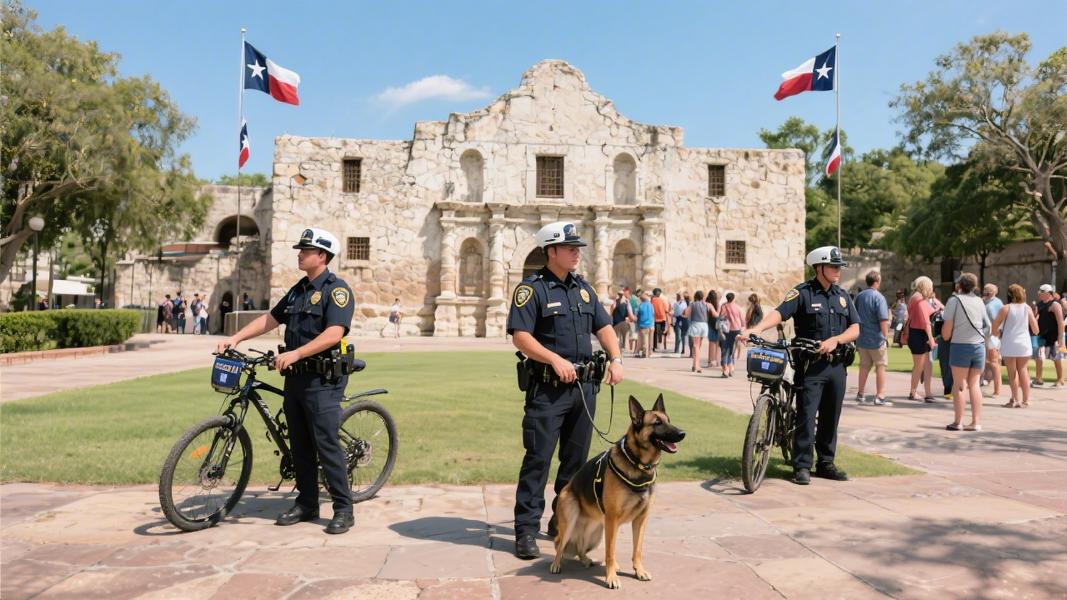
After nearly half a century, the Alamo has a new set of eyes watching over it — and they carry badges.
The Texas Department of Public Safety officially assumed full security operations at the Alamo complex in San Antonio in December 2025, replacing the longtime Alamo Rangers who had guarded the historic site for close to 50 years. The transition, mandated by state legislation and backed by Governor Greg Abbott, marks one of the most significant changes in how Texas protects its most iconic landmark — and signals a broader shift in how the state thinks about homeland security altogether.
From Rangers to Troopers
The handoff didn’t happen overnight. Texas Highway Patrol troopers began patrolling the Alamo grounds as early as September 2025, with DPS gradually building out its presence before assuming complete responsibility on December 4, 2025. By that point, dozens of personnel from the Highway Patrol, the Criminal Investigations Division, and the newly established Homeland Security Division were already stationed at the site. One Explosives Detection K-9 unit is currently deployed, with a second in the pipeline, announced DPS in a statement marking the transition.
The legal backbone for all of this is Senate Bill 3059, which directed the Alamo Trust to coordinate security operations with DPS — mirroring the arrangement DPS already maintains at the State Capitol complex in Austin. The Alamo Trust formally transferred those duties on a Wednesday in early December. In a statement, the Trust said security operations would include “providing the necessary security officers, troopers, and supervisory and indirect support staff to ensure the safety and protection of both visitors and the historical integrity of the site.” It’s a careful, institutional kind of language — but the message is clear. The stakes here aren’t small.
Still, the Alamo Rangers aren’t gone entirely — not yet. Under the terms of SB 3059, their service is formally set to conclude on September 1, 2027, outlined in the legislation. For now, the transition period is underway, and DPS is the dominant force on the ground.
A Personal Mission for DPS Leadership
DPS Colonel Freeman F. Martin didn’t mince words about what this moment means to him. “As the former Region Chief for DPS’ Central Texas Region, I know just how important the Alamo is to the people of San Antonio and all Texans,” he said. “It is a tremendous honor to oversee the department’s transition in taking over security operations for the Alamo, helping to preserve one of the greatest symbols in Texas history.” The colonel’s remarks came as part of DPS’ formal announcement on Alamo Day — a fitting backdrop, if a little theatrical.
But it’s not just ceremony. Martin has also been candid about the pressures driving decisions like this one. “It’s no secret that Texas is facing the most diverse and significant homeland security threats of our lifetime,” he said, “so it is more important today than ever that our state has every tool and resource needed to mitigate and respond to any type of attack or disaster.” Governor Abbott echoed that urgency, noting that “protecting Texas from a broad range of threats and vulnerabilities is a critical mission that continues to evolve.”
Bigger Picture: A State Bracing for Threats
The Alamo security transition doesn’t exist in a vacuum. It’s one piece of a much larger strategic realignment happening inside Texas government right now. The DPS Homeland Security Division — itself only established in 2025 — is the institutional expression of that shift. The state’s new Texas Homeland Security Strategic Plan 2026–2030 lays out six mission areas: Prevent, Protect, Mitigate, Respond, Recover, and enabling capabilities. Across those areas, the plan details 31 objectives and 158 priority actions. That’s not a document written by people who think the threat landscape is calming down.
So why the Alamo specifically? Partly symbolism — it’s the kind of site that, if something went wrong, would reverberate far beyond Texas. Partly practicality — a unified, state-run security apparatus is easier to coordinate than a patchwork of private rangers and ad-hoc protocols. And partly, if we’re being honest, politics. Putting DPS troopers at the Alamo is a statement. It signals to Texans that the state is serious, vigilant, and in control of its own story.
What It Means for Visitors
For the roughly 1.5 million people who visit the Alamo each year, the day-to-day experience may not look dramatically different — at least not immediately. Troopers in uniform instead of Rangers in their distinctive hats. K-9 units working the perimeter. A heavier institutional footprint, quietly present. The shift in oversight also includes a new Alamo Commission, which now holds governance authority over the complex under the framework established by Senate Bill 1, signed by Governor Abbott.
That said, the emotional weight of the change is real for those who knew the Alamo Rangers personally or professionally. Nearly five decades of institutional knowledge, relationships, and quiet dedication doesn’t transfer in a press release. Whether DPS can match that culture — not just the security posture, but the genuine stewardship — remains to be seen.
The Alamo has survived siege, neglect, and decades of debate over who owns its meaning. Now it has state troopers at the gate. Some things change; the argument over what this place represents never really does.
