
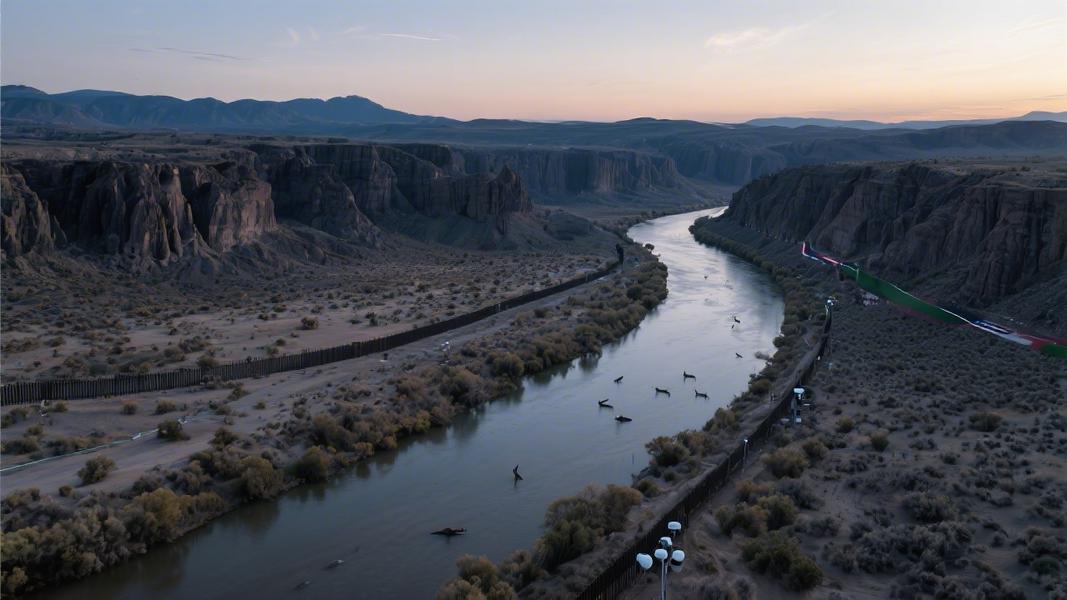
A quiet stretch of desert wilderness that straddles one of the most remote corners of the U.S.-Mexico border is now at the center of a very loud fight. Federal officials are weighing plans to run a steel bollard wall through Big Bend National Park — and not everyone is ready to let that happen without a battle.
The U.S. Customs and Border Protection agency recently updated its official border barrier map, quietly swapping out more than 100 miles of planned “primary wall” — shown in green to indicate steel bollard construction — in Big Bend National Park and Big Bend Ranch State Park with an orange line denoting “detection technology” instead. It sounds like a retreat. But CBP says it’s just a scheduling issue, and that the parks are still very much in the planning pipeline. That distinction matters enormously to the people who live, work, and recreate in one of America’s most dramatic and ecologically sensitive landscapes.
Billions Behind the Push
This isn’t a proposal cooked up in a vacuum. The One Big Beautiful Bill Act, signed into law in July 2025, appropriated a staggering $46.5 billion for border wall construction nationwide. As part of that effort, the Department of Homeland Security has already waived 28 separate federal laws to expedite more than 150 miles of construction stretching from Fort Quitman to Colorado Canyon — a corridor that runs directly through some of Texas’s most protected terrain.
CBP, for its part, isn’t exactly rushing to put a shovel in the Big Bend dirt right now. In a statement, the agency said, “As CBP continues to work to implement President Trump’s Executive Order 14165, ‘Securing our Borders’ and Proclamation 10142, ‘Declaring a National Emergency at the Southern Border of the United States,’ it continues to develop and finalize its execution plan for border barrier construction funded by the One Big Beautiful Bill Act. CBP is currently focusing on the top operational priorities with historical rates of high illegal entry where illegal aliens regularly attempt to enter the United States. The Big Bend National Park and State Park are still in the planning stages.” In other words: not yet, but don’t exhale.
The Case Against a Wall Here, Specifically
Here’s the thing that critics keep pointing out: Big Bend may actually be the worst place along the entire southern border to build a wall — if you’re measuring by operational need. Migrant crossings in the region are among the lowest on the entire border, and the terrain itself — rugged, mountainous, and brutally unforgiving — already does much of the deterrence work on its own. Joint patrols between the National Park Service and Border Patrol, combined with aerial and electronic surveillance, have long provided security coverage without a single foot of steel bollard, according to advocates who’ve tracked the region’s enforcement data closely.
That’s the catch. When you build a wall in a place that doesn’t operationally need one, what you’re really doing is permanently altering an ecosystem — and a cultural landmark — for reasons that may have more to do with optics than outcomes.
Local Fury, National Stakes
Local officials aren’t hiding their anger. The prospect of a wall bisecting Big Bend National Park has outraged community leaders throughout the region, many of whom see the park as both an economic engine and an irreplaceable natural treasure. Big Bend draws hundreds of thousands of visitors a year — hikers, birders, river runners, astronomers who come for some of the darkest skies in North America. A construction corridor and permanent barrier infrastructure would fundamentally change what the park is.
Still, the map change — that quiet swap from green to orange — has given some conservationists a sliver of hope. The update suggests that even within the administration, there may be an acknowledgment that detection technology, not physical barriers, is the more practical solution in terrain like this. Whether that pragmatism holds as construction timelines tighten and political pressure mounts is another question entirely.
Big Bend has survived floods, droughts, and a century of competing land-use fights. Whether it survives this one may depend on how loudly people are willing to speak up — and whether anyone in Washington is listening.
