
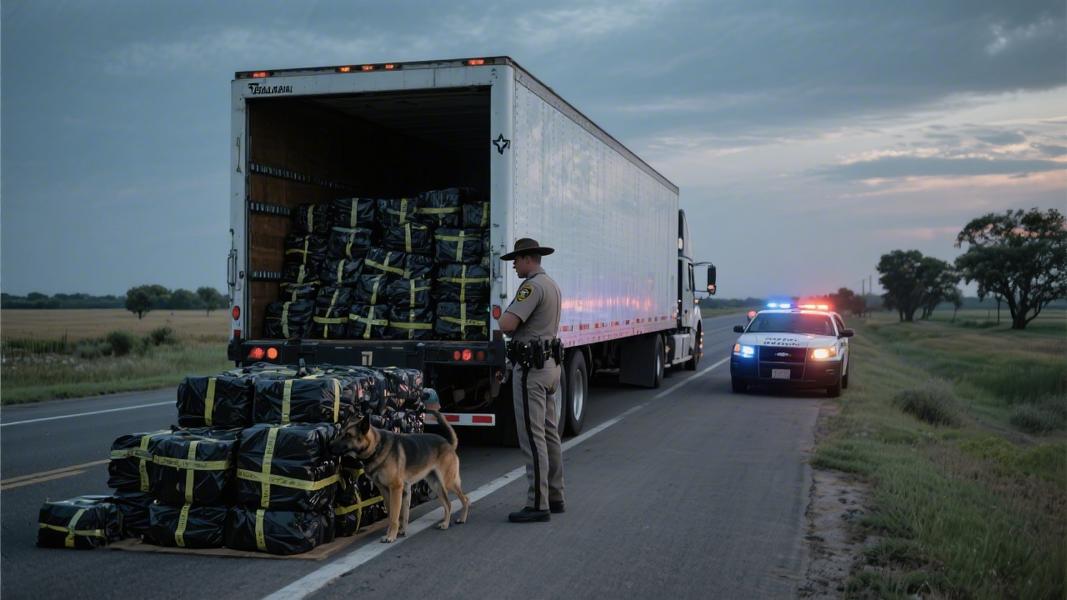
Nearly a ton of methamphetamine — bound for Dallas and stuffed into a hidden compartment beneath the floor of a semi-truck — was pulled off a South Texas highway this week in one of the largest single drug seizures the state has seen in recent memory.
On March 4, 2026, Texas Department of Public Safety troopers conducting a traffic stop on US 281 near George West in Live Oak County discovered 1,980 pounds of methamphetamine — an estimated $3.4 million worth — concealed inside 479 black tape-wrapped bundles packed into a false floor compartment of a commercial trailer. The driver, identified as Diego Mendez, was taken into custody. It’s the kind of bust that doesn’t happen by accident.
A Routine Stop That Wasn’t
Troopers initially pulled the truck over for what appeared to be a routine traffic violation. What they found underneath the trailer floor was anything but routine. The bundles — nearly five hundred of them, each wrapped tightly in black tape — were stacked in a false compartment that, from the outside, gave no indication anything was wrong. That’s the catch with these concealment methods: they’re designed to survive exactly this kind of encounter.
The operation was conducted under Operation Lone Star, the state’s ongoing border security initiative that has deployed DPS troopers and National Guard personnel across South Texas since 2021. Critics of the program have raised concerns about its cost and scope, but seizures like this one are precisely the kind of result the state points to when defending it. DPS confirmed the details of the bust in an official release, noting the shipment was headed north toward Dallas.
Nearly Two Thousand Pounds. Heading to Dallas.
Think about what that number actually means. 1,980 pounds of methamphetamine — just 20 pounds shy of a full ton — moving through a rural stretch of South Texas highway on an otherwise unremarkable Tuesday. Fox4 in Dallas noted the staggering scale of the haul, and it’s hard not to sit with that for a moment. This wasn’t a few kilos taped under a car seat. This was an industrial-scale shipment.
CDL Life, which covers the commercial trucking industry, highlighted the stop as a sobering reminder of how freight infrastructure is increasingly exploited by trafficking networks. Semi-trucks move millions of loads across the country every year — legally, legitimately, without incident. But that volume and normalcy is also what makes them attractive to cartels looking to move product at scale.
A Separate Bust, Just One Day Later
The George West seizure wasn’t the only drug-related arrest to make headlines in the region that week. On March 5, 2026 — just one day later — a targeted narcotics operation in Schertz, Guadalupe County, resulted in the arrest of Raymundo Ruvalcaba and the seizure of 38.54 grams of cocaine along with two firearms, one of which was stolen. News4 San Antonio covered the Schertz arrest in detail, describing it as the result of a deliberate narcotics unit operation rather than a chance encounter.
Still, the Schertz case — however serious — is a footnote compared to what happened on US 281. The sheer weight of that meth shipment puts it in a different category entirely.
What It Signals
How bad is the trafficking pipeline through South Texas right now? Bad enough that nearly a ton of methamphetamine apparently felt like a manageable risk to move in a single load. CBS News Texas described the bust as emblematic of a broader pattern — South Texas as a corridor, Dallas as a destination, and commercial vehicles as the preferred vessel. Fox San Antonio reported that the false floor compartment showed clear signs of professional construction, not improvisation.
That’s not a small-time operation. That’s logistics. And if troopers hadn’t made that stop on a Tuesday afternoon on a two-lane highway in Live Oak County, nearly $3.4 million worth of methamphetamine would have kept rolling north — quietly, invisibly, right past the rest of us.
The drugs are off the road. But the infrastructure that put them there almost certainly isn’t.
