
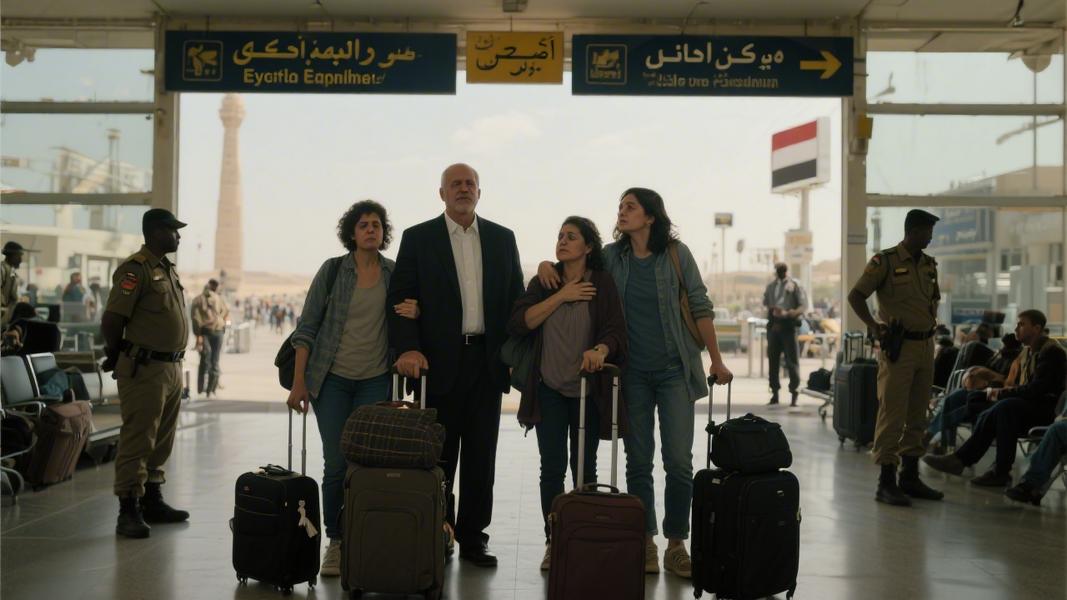
A North Texas pastor had to become a travel agent overnight. That’s not a metaphor — that’s just what happened when a pilgrimage to the Holy Land turned into a scramble for survival.
Nic Collins, a pastor from Rockwall, Texas, organized what was supposed to be a spiritually meaningful trip to Israel arriving near the end of February 2026 — a time of worship, fellowship, and, as he put it, fun. It didn’t stay that way for long. As U.S. and Israeli forces launched attacks on Iran, the conflict escalated rapidly, and Collins found himself shepherding a group of real people — some of them parents with children waiting back home — through missile sirens and impossible decisions. The story of how they got out is a window into just how quickly a faith journey can become a crisis, and why dozens of American pastors are still pressing forward with Israel pilgrimages in 2026 despite the risks.
Sheltering in Place, Then Getting Out
The group didn’t panic immediately. They sheltered as sirens sounded, assessed the situation, and ultimately made the call that safety had to come first. Getting home, though, was a different kind of test. Their travel company back in the States was, to put it charitably, not much help. reported Collins describing the experience with the kind of dry exhaustion that only comes from genuinely living it: “I had to become a travel agent overnight,” he said. “Because our travel company back in America basically said, ‘We can’t do anything for your air flights and stuff. Here’s the phone number. Good luck with that.’ And we kind of said okay.”
So Collins figured it out. The group escaped through Egypt, stayed at a hotel there, and eventually flew home to Texas, arriving on Saturday. Flight costs at that point had surged to as high as $7,000 per person — the kind of number that makes a bad situation feel genuinely punishing. Still, they made it. All of them.
What’s striking is what Collins said next. Even after everything — the sirens, the scrambling, the sky-high fares, the abandoned travel company — his first public comments weren’t about frustration. They were about the people on the other side of the conflict. “We were also concerned about the loss of potentially innocent life,” he noted. “If you know, even in Iran, you know things happen in war. We understand that, but we pray that God would intervene and just make there be as little loss of life as possible across the spectrum, across the Middle East.” He also said he plans to return to Israel for another pilgrimage next year. Some people, it seems, don’t scare easily.
A Calendar Full of Pilgrimages — And No Signs of Stopping
Here’s the thing that might surprise you: Collins isn’t alone in pressing forward. Across the country, churches and faith organizations have 2026 Israel tours already scheduled, marketed, and filling up — some of them just weeks away from departure.
Dallas Theological Seminary has a Holy Land Tour running from February 24 through March 8, 2026, featuring a Jordan River baptism, a Sea of Galilee boat ride, Bethlehem, Garden Tomb communion, and prayer at the Western Wall. The itinerary reads like a highlight reel of the New Testament.
Not far behind on the calendar, Pastors Danny and Paul Bullock are leading an Israel and Jordan tour from March 18–29, 2026, priced at $2,300 per person for double occupancy in Israel, with a $940 add-on for a Jordan extension. The tour takes in Caesarea, Mount Carmel, the Sea of Galilee, the Mount of Olives, the Old City, and Bethlehem — a itinerary that’s ambitious by any measure.
Then there’s Pastor Jack Hibbs, whose Israel Tour runs March 19–30, 2026, with five nights in Jerusalem and four in Tiberias. Teachings from Hibbs, Amir Tsarfati, and Pastor Morgan Lawrence are included, along with all meals, site entrances, and five-star accommodations. It’s a premium experience, clearly designed for people who want their spiritual journey to come with a certain level of comfort.
Spring, Summer, and Beyond
The tours don’t thin out as the year goes on. Beltway Park Church in Abilene, Texas, is offering an Israel Prayer Pilgrimage from April 27 through May 8, 2026, led by Pastor David McQueen. The focus is on walking where Jesus walked and praying in the Holy Land — registration requires a $300 deposit by March 27, 2026, according to the church’s website.
Calvary’s Biblical Journey to Israel, meanwhile, departs in late May — May 25 through June 4, 2026 — led by Trina Franklin, departing from Birmingham International Airport. The journey includes stops at Nazareth Village, Beth She’an, a Jordan River baptism site, and multiple Jerusalem landmarks — a full immersion in biblical geography.
Further out, Robert J. Morgan is leading an Experience Israel Tour from September 1–11, 2026, covering Caesarea Philippi, the Sea of Galilee, the Mount of Beatitudes, and Capernaum, with Bible teachings woven throughout. The program leans heavily on scripture-in-context — the kind of trip designed to make ancient texts feel immediate.
And closing out the year, Pastor Jordan Easley is running a Holy Land tour from December 2–11, 2026, visiting Bethlehem, Jericho, the Mount of Olives, the Sea of Galilee, Jerusalem, the Dead Sea, Masada, and the Valley of Armageddon. The promotional material emphasizes both scriptural significance and exceptional accommodations — a reminder that faith and comfort aren’t mutually exclusive.
Faith Tourism in a Fractured Region
Is it reckless to keep booking these trips? That’s not a rhetorical question — it’s the one every pastor on this list is presumably wrestling with. The Nic Collins situation is a real-world case study in how fast conditions can shift. What begins as a carefully planned spiritual retreat can, within days, become a logistical emergency involving foreign hotels, collapsed travel support, and four-figure airfare gouging.
That said, the demand clearly hasn’t disappeared. If anything, the volume of scheduled pilgrimages through the end of 2026 suggests that American faith communities aren’t treating the Middle East conflict as a reason to stay home — they’re treating Israel as a place worth the risk. Whether that’s courage, faith, or something more complicated probably depends on who you ask.
Collins, for his part, seems unbothered by the question. He got his people home. He prayed for the people he couldn’t. And he’s already planning his return. That, in its own way, might be the whole story.
