
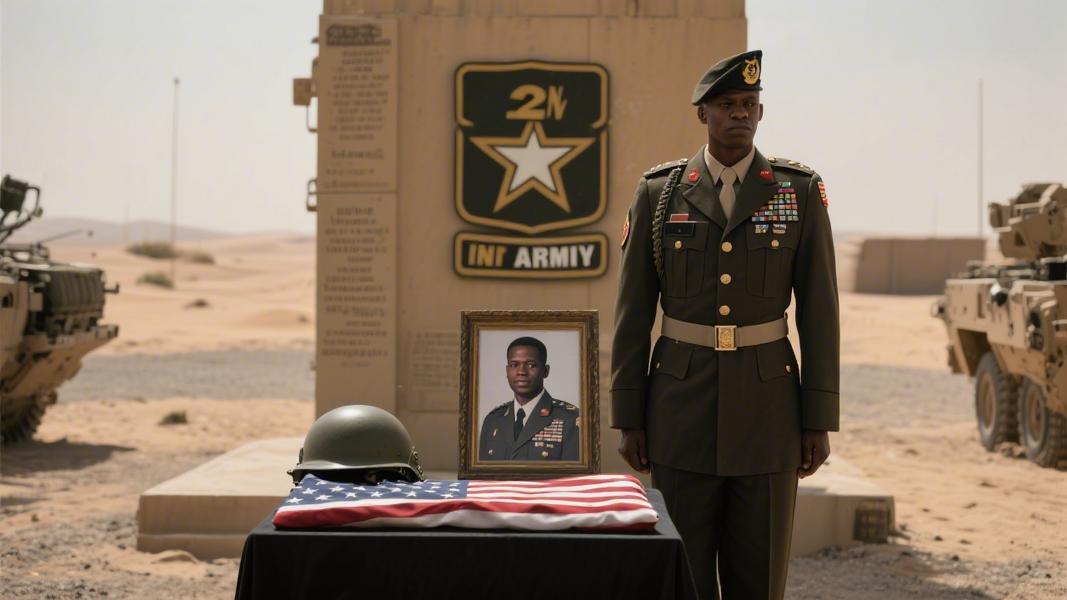
From a Texas border post to a port in Kuwait, the human cost of military service keeps arriving in waves — and the stories behind the headlines don’t always get the attention they deserve.
This is a moment to take stock. Across multiple branches, multiple decades, and multiple continents, the men and women who serve under the American flag have faced threats ranging from enemy drone strikes to the quiet, devastating weight of their own mental health struggles. The pattern is neither new nor simple, but it demands to be seen clearly.
A Death at the Border
In Eagle Pass, Texas, a soldier assigned to Operation Lone Star — the state’s high-profile border security mission — died from a self-inflicted gunshot wound using his own duty weapon. The Texas National Guard didn’t mince words in its response. “We are deeply saddened to have lost one of our own today,” the Guard stated. “We extend our deepest condolences to the family.” Fourteen words of comfort. A life gone.
It’s a reminder that the battlefield isn’t the only place soldiers die. Operation Lone Star has drawn significant scrutiny over troop conditions, morale, and mental health resources — and this loss landed squarely in the middle of those concerns. How many more soldiers are quietly struggling while assigned to politically charged missions far from the traditional support structures of a deployed unit?
Four Soldiers Lost in Kuwait
Then came March 1, 2026. Four U.S. Army Reserve soldiers from the 103rd Sustainment Command were killed at the Port of Shuaiba in Kuwait during an unmanned aircraft system attack — a drone strike, in plain terms — while supporting Operation Epic Fury. These weren’t combat infantry troops; they were sustainment soldiers, the logistical backbone that keeps everything else running. The Army confirmed the deaths in an immediate press release, with their command offering a tribute that cut through the bureaucratic language: “To the families and teammates of these Cactus Nation Soldiers: you have my deepest sympathy and my respect. Our nation is kept safe by folks like these — brave men and women who put it all on the line every single day.”
Four soldiers. A drone. A port. That’s how fast it happens now.
The Long Shadow of Enduring Freedom
Still, the losses in Kuwait didn’t emerge from a vacuum. The National Guard and Reserve components have been carrying extraordinary weight for more than two decades. By one count, 226 Army and Air Guard members had been killed during two decades of Operation Enduring Freedom, according to data from the Defense Casualty Analysis System, as the National Guard Association of the United States documented. That number — 226 — represents people who signed up for part-time service and ended up paying the full price.
The Guard has evolved enormously since its earliest roots. Hawaii’s National Guard, for instance, traces its lineage all the way back to the 1st Hawaiian Guard, organized on November 17, 1852 — a lineage the state details with understandable pride. More than 170 years of service, from island volunteers to soldiers deployed across the globe. It’s a long road, and it hasn’t gotten shorter.
A Pioneer Who Paved the Way
That road has also been shaped by figures whose contributions took generations to fully appreciate. Benjamin Oliver Davis Sr. was promoted to brigadier general in 1940, making him the U.S. Army’s first African American general officer — a milestone achieved in an era when the military was still formally segregated. He died on November 26, 1970, and was buried at Arlington National Cemetery, his legacy cemented in history. As his Wikipedia entry notes, he was “one of the few black officers in an era when American society was largely segregated.” That’s an understatement, of course. He didn’t just serve — he endured, persisted, and broke a ceiling that had no business existing.
His story is worth remembering precisely because it complicates the easy narrative. The military has never been a monolith. It’s been a contested institution, shaped by the people willing to fight for it — and sometimes fight within it.
Tensions on the Home Front
Not every military-adjacent story plays out overseas. In Memphis, Tennessee, an 18-year-old was shot on October 31 by a federal officer with the Memphis Safe Task Force — a multi-agency operation connected to a broader National Guard deployment in the city. The teenager subsequently faced federal robbery and gun-related charges, with a mandatory minimum sentence of 10 years if convicted, the Daily Memphian noted. That’s not a battlefield story. That’s a street corner in an American city, and the line between military deployment and domestic policing is getting blurrier by the year.
That’s the catch, really. The Guard is being asked to do more — border security, urban deployments, overseas combat support — with all the moral and logistical complexity those missions carry. And the soldiers at the center of it are still just people, with families waiting at home and limits that don’t always show up on an official readiness report.
226 names on a casualty list. Four soldiers at a Kuwait port. One death at a border crossing that nobody should forget. As General Davis might have understood better than most: serving this country has never been without cost — and the least the rest of us can do is pay attention.
