
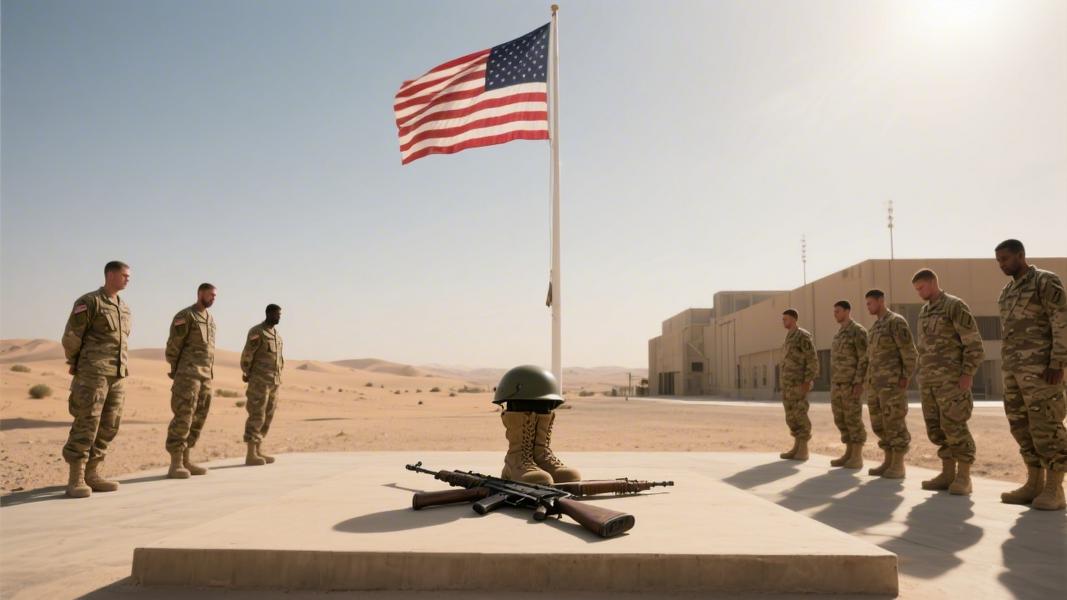
Another American service member is dead. And this time, the Pentagon is putting a name to the loss.
The Department of Defense confirmed the death of Sgt. Benjamin N. Pennington, a U.S. Army soldier killed as a result of injuries sustained during Iranian attacks that struck Prince Sultan Air Base in Saudi Arabia on March 1, 2026 — part of the broader military campaign now designated Operation Epic Fury. Pennington’s death, officially recorded on March 8, 2026, brings the confirmed U.S. fatality count from the operation’s opening salvo to at least five service members, a toll that continues to mount as the conflict stretches into its second week.
A Death Days in the Making
He didn’t die on the battlefield in the traditional sense — not immediately, anyway. Pennington was among those wounded when Iranian forces launched coordinated strikes across multiple U.S. military positions throughout the Middle East on March 1. He survived the initial attack. For days, he fought. Then, a week later, he didn’t make it.
The Pentagon’s official statement was blunt in the way military announcements tend to be: “Last night, a U.S. service member passed away from injuries received during the Iranian regime’s initial attacks across the Middle East. The service member was seriously wounded at the scene of an attack on U.S. troops in the Kingdom of Saudi Arabia on March 1.” No flourish. No editorializing. Just the facts of a young man’s death delivered in bureaucratic cadence.
Still, behind that language is a story that deserves more than a press release. Pennington’s death reflects something important about the nature of modern combat casualties — that the count doesn’t freeze the moment the bombs stop falling. Soldiers die in ICUs days later. The numbers keep climbing, quietly, while the news cycle moves on.
The Broader Picture: Operation Epic Fury’s Human Cost
How bad has it gotten? Early tallies from March 2 had already placed the U.S. death toll at four killed in action — and that was just within the first 24 hours of the conflict’s deadliest phase. Pennington’s passing, confirmed six days later, pushes that number higher and serves as a grim reminder that official counts often lag behind reality on the ground.
Prince Sultan Air Base — a sprawling installation roughly 75 miles southeast of Riyadh — has served as a critical hub for U.S. air operations in the region for decades. That Iran chose it as a target in the opening salvo of hostilities wasn’t incidental. It was a statement. A message about reach, about intent, and about Iran’s willingness to strike directly at American forces rather than through proxies.
That’s a significant escalation. And it’s one that the Biden administration — now navigating the early, volatile weeks of Operation Epic Fury — has had to reckon with in real time, balancing military response with the ever-present risk of a wider regional war pulling in more players than anyone wants.
Who Was Sgt. Pennington?
The details of Pennington’s life — his age, his hometown, his unit, the people waiting for him back home — are the kind of specifics that transform a statistic into a human being. The Army has released that information through official channels, and it’s the kind of detail that ought to anchor every story written about this conflict’s cost. Wars are fought by people, not numbers, and Pennington’s name deserves to be said clearly and often.
His family has been notified, per standard military protocol. What comes next for them — the folded flag, the funeral, the long years of a particular kind of grief that doesn’t really have a name — is something no press release will ever fully capture.
What Comes Next
Operation Epic Fury is still in its early stages, and the diplomatic and military landscape is shifting fast. Iran’s willingness to strike U.S. installations directly — rather than relying on allied militias and proxy networks — marks a dangerous threshold in a conflict that already had no shortage of dangerous thresholds. Whether that aggression triggers a measured response or something more significant remains the central question hanging over every briefing room in Washington and Riyadh right now.
But it’s not that simple, of course. It never is. Escalation is easy to start and historically very hard to stop, and every death — every Sgt. Pennington — raises the political and moral pressure on decision-makers to act in ways that may or may not make the next soldier’s survival more likely.
Sgt. Benjamin N. Pennington survived the attack on March 1. He made it seven more days. That’s not a footnote — that’s the whole story, really, compressed into a single brutal fact about what this war is already costing.
